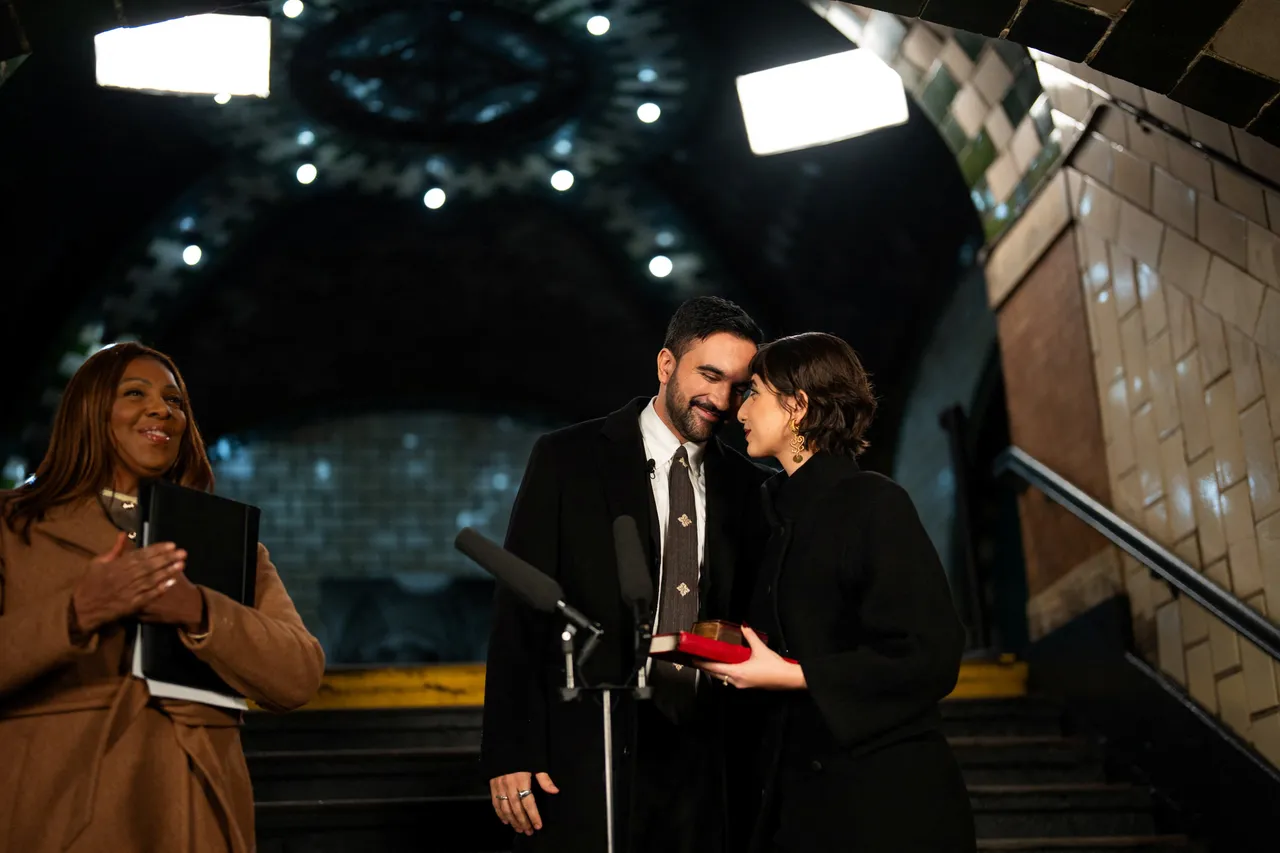
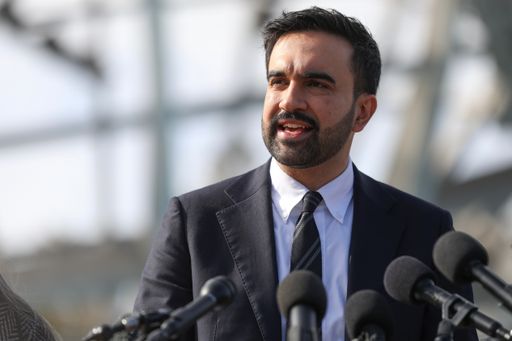
Zohran Mamdani was sworn in just before midnight on January 1 as New York City mayor, becoming the first Muslim and South Asian to lead the largest city of US after taking the oath of office on the Quran.
The ceremony was held at the abandoned Old City Hall subway station, one of the city’s original stations built in 1904 and decommissioned in 1945.
New York Attorney General Letitia James administered the oath alongside Mamdani’s family ahead of a public ceremony on Thursday afternoon to be led by Sen Bernie Sanders.
According to several US media outlets, the Qurans used during the ceremony included a copy belonging to Mamdani’s grandfather and another once owned by Black writer and historian Arturo Schomburg lent by the New York Public Library.
Mamdani, 34, is also the first African-born person to serve as New York City’s mayor. He was born in Uganda to Indian immigrant parents.
He won the mayoral race in November 4 elections, defeating former New York Governor Andrew Cuomo and Republican candidate Curtis Sliwa in a historic victory for the Democratic Party’s progressive wing.
A democratic socialist, Mamdani ran a campaign focused on affordability and expanded social services, pledging free buses, universal childcare, city-run grocery stores, expanded rent-stabilised housing and raising the minimum wage to $30 per hour by 2030.
Most of Mamdani's predecessors were sworn in on a Bible, although the oath to uphold the federal, state and city constitutions does not require the use of any religious text.
And while he has focused heavily on the issue of affordability during his campaign, Mamdani was outspoken about his Muslim faith. He frequently appeared at mosques across the five boroughs as he built a base of support that included many first-time South Asian and Muslim voters.
Modest design
While it is unclear how Schomburg, a Black Puerto Rican historian whose collection documented the global contributions of people of African descent, came into possession of the Quran, scholars believe it reflected his interest in the historical relationship between Islam and Black cultures in the United States and across Africa.
Unlike ornate religious manuscripts associated with royalty or elites, the copy of the Quran that Mamdani used is modest in design. It has a deep red binding with a simple floral medallion and is written in black and red ink.





The script is plain and readable, suggesting it was created for everyday use rather than ceremonial display.
Because the manuscript is undated and unsigned, scholars relied on its binding and script to estimate when it was produced, placing it sometime in the late 18th or early 19th century during the Ottoman period in a region that includes what is now Syria, Lebanon, Palestine and Jordan.
The meteoric rise of a Muslim democratic socialist also brought a surge of Islamophobic rhetoric, amplified by national attention on the race.
In an emotional speech days before the election, Mamdani said the hostility had only strengthened his resolve to be visible about his faith.
"I will not change who I am, how I eat, or the faith that I'm proud to call my own," he said. "I will no longer look for myself in the shadows. I will find myself in the light."
Conservative backlash
The decision to use a Quran has drawn fresh criticism from some conservatives. US Senator Tommy Tuberville of Alabama wrote on social media, "The enemy is inside the gates," in response to a news article about Mamdani's inauguration.
The Council on American-Islamic Relations, a civil-rights group, has designated Tuberville as an anti-Muslim extremist based on past statements.
Such backlash is not new. In 2006, Keith Ellison, the first Muslim elected to Congress, faced condemnation from conservatives after he chose to use a Quran for his ceremonial oath.
While the use of the Bible to take an oath is a common tradition that makes it seem like a rule, there is no law that requires officials to use a specific religious text for taking an oath.
Former US president Theodore Roosevelt didn't swear on the Bible when taking the oath. Even current President Donald Trump himself didn't place his hand on the Bible during his inauguration.
Following Mamdani's inauguration, the Quran will go on public display at the New York Public Library.