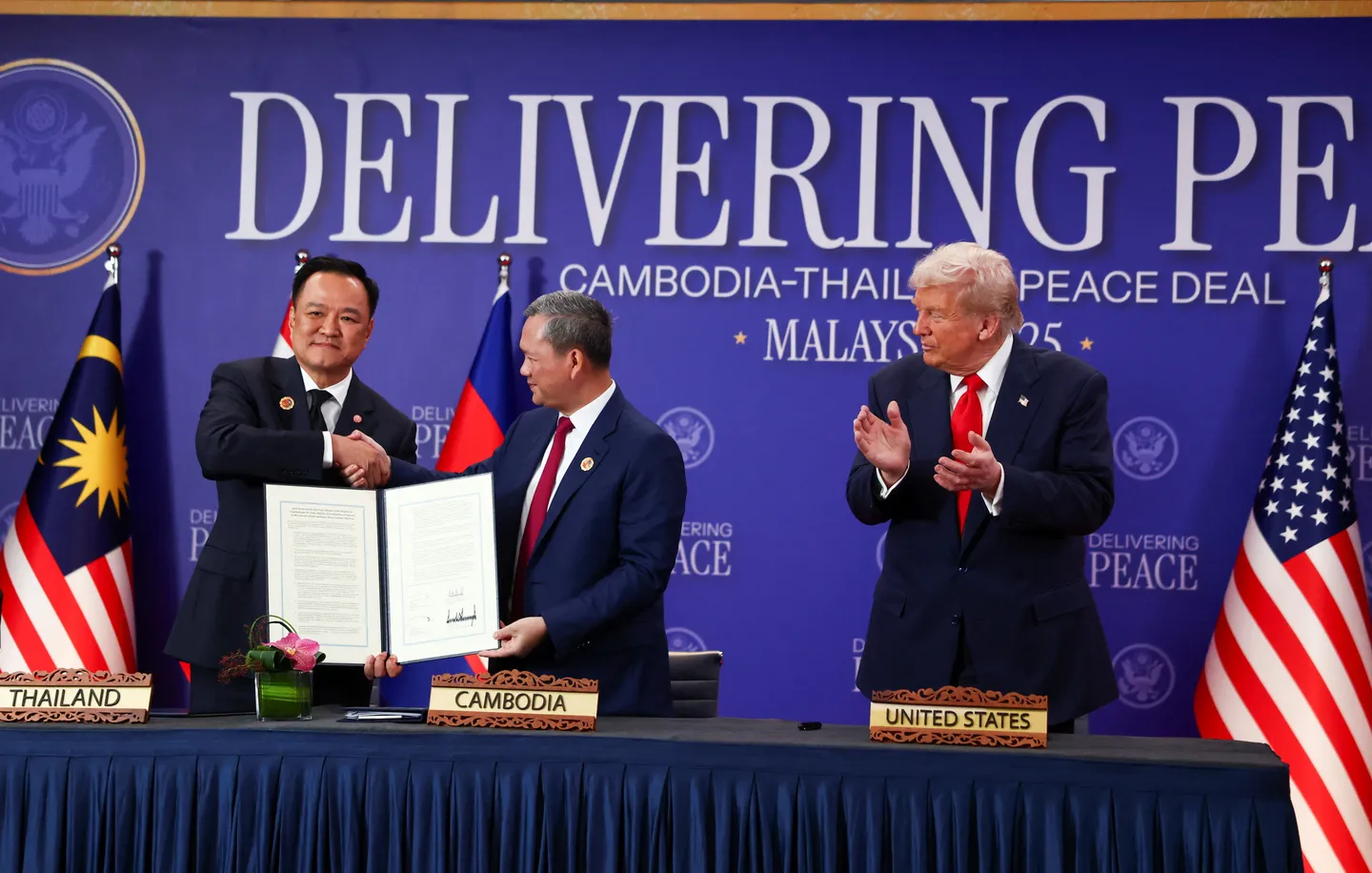
The leaders of Thailand and Cambodia signed an enhanced ceasefire deal on Sunday in the presence of US President Donald Trump, who intervened in July to bring an end to their deadly five-day border conflict.
The agreement was signed soon after Trump’s arrival at a summit of the Association of Southeast Asian Nations in Kuala Lumpur.
It builds on a truce reached three months ago after Trump called the then leaders of the two countries and urged them to end hostilities or risk putting their respective trade talks with Washington on hold.
“Both countries are agreeing to cease all hostilities and work to build good, neighbourly relationships,” US President Donald Trump said at the signing ceremony alongside Malaysian Prime Minister Anwar Ibrahim, Cambodian Prime Minister Hun Manet and Thai Prime Minister Anutin Charnvirakul.
The accord, signed at the 47th ASEAN Summit, includes the release of 18 Cambodian prisoners of war.
“Under this agreement, observers from ASEAN countries, including Malaysia, will be deployed to make sure that the peace prevails and endures,” Trump said.
“We do a lot of business with both of them. We have to use that business to make sure they don't get into wars, but this is going to be a very long peace,” Trump added.
Cambodian Prime Minister Hun Manet thanked Trump for his efforts, saying he had nominated the US president for the Nobel Peace Prize “in reflection of the gratitude of his people.”
Thai Prime Minister Anutin Charnvirakul also thanked participating leaders, saying the declaration “reflects our collective will to resolve differences peacefully and with full respect for sovereignty and territorial integrity.”
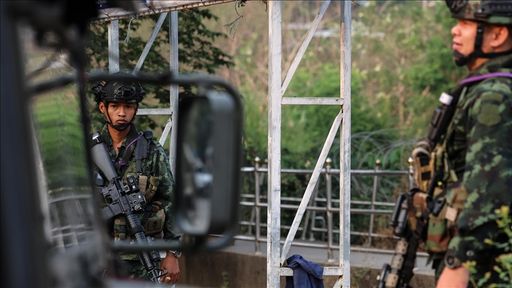
Tensions between Thailand and Cambodia over undemarcated points along their 817-kilometre (508-mile) land border erupted into a deadly five-day conflict in July.
The five-day war killed at least 48 people and temporarily displaced hundreds of thousands on both sides in what was the worst fighting between the two countries in decades.
A ceasefire brokered by Trump and Anwar ended the fighting, with both sides working on de-escalation measures since.




Border claims cause periodic tensions
Border disputes are long-standing issues that have caused periodic tensions between the two neighbours. Thailand and Cambodia share more than 800 kilometres (500 miles) of land border.
The contesting claims stem largely from a 1907 map drawn under French colonial rule that was used to separate Cambodia from Thailand.
Cambodia has been using the map as a reference to claim territory, while Thailand has argued the map is inaccurate.
In February, Cambodian troops and their family members entered an ancient temple along the border in one of the disputed areas and sang the Cambodian national anthem, leading to a brief argument with Thai troops.
The most prominent and violent conflicts broke out around the 1,000-year-old Preah Vihear temple.
In 1962, the International Court of Justice awarded sovereignty over the area to Cambodia and that became a major irritant in relations.
Cambodia went back to the court in 2011, following several clashes between its army and Thai forces which killed about 20 and displaced thousands of people.
The court reaffirmed the ruling in 2013, a decision that still rattled Thailand.