 Esra Karataş Alpay
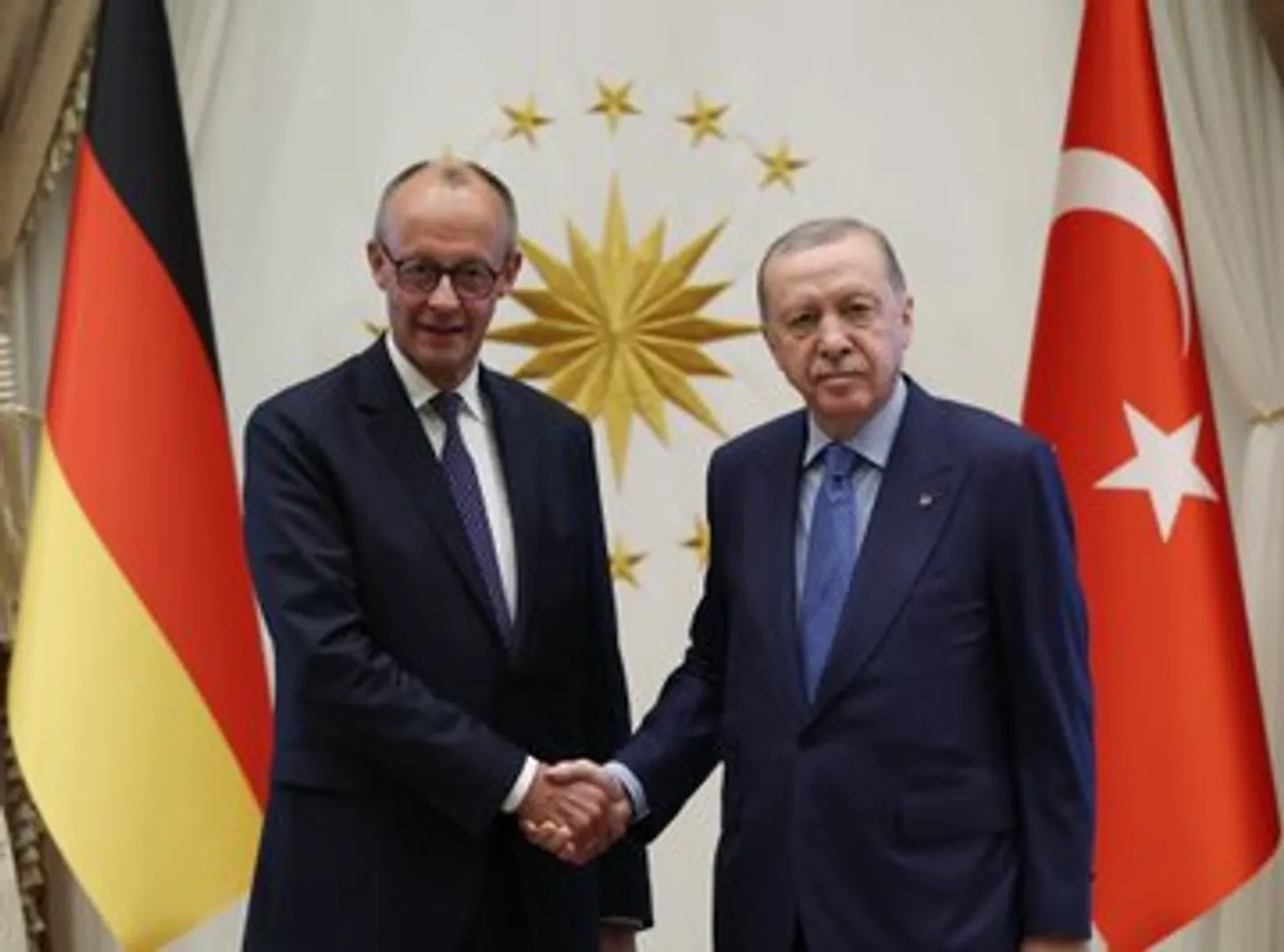
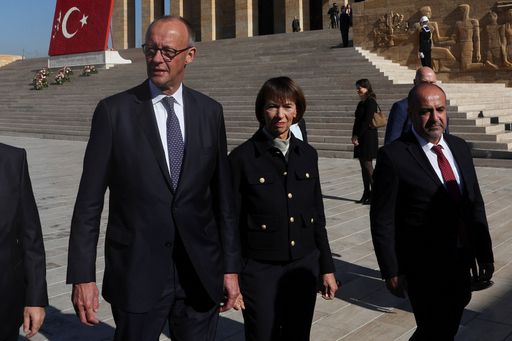
German Chancellor Friedrich Merz’s first official visit to Türkiye this week marked both a symbolic and strategic turning point in a relationship that spans more than a century.
In a meeting with President Recep Tayyip Erdogan in Ankara, the two leaders reaffirmed the importance of Turkish-German cooperation — even as they disagreed over Palestine’s Gaza.
“Strong foundations and a multi-layered network of relations between Türkiye and Germany are indispensable for Europe’s and our neighbouring regions’ security,” President Erdogan declared at a joint press conference, calling the partnership vital to regional and continental stability.
The visit carried a powerful historical resonance. From the early 20th-century Ottoman-German alliance to the Berlin–Baghdad Railway project and the Cold War-era NATO collaboration, the two nations share a bond both human and strategic.
Germany is home to a 3.5 million-strong Turkish community, the largest outside of Türkiye.
This year marks the 64th anniversary of the 1961 labour agreement, which enabled Turkish workers to help rebuild postwar Germany — a migration that has since evolved into a deep social and cultural connection.
Erdogan described the diaspora as “a bridge of friendship and a shared asset,” and said protecting their rights remained a priority.
A changing Europe and Türkiye’s growing role
Observers note that Merz’s visit comes at a time when Europe is rethinking its entire defence architecture.
Associate Professor Suay Nilhan Acikalin, an expert on European-Turkish relations at Haci Bayram Veli University in Ankara, tells TRT World that the context of the Russia-Ukraine war has altered Germany’s strategic calculations and given Türkiye a far more central role.
“Turkish-German relations, as in previous periods, continue to encompass highly significant issues,” Acikalin observes, noting that ties between the two countries are shaped not only by the large Turkish community in Germany but also by their deep historical relationship.
“Yet, in the recent period — particularly with the outbreak of the Russia-Ukraine war — Germany and, more broadly, Europe have undergone major shifts in their defence and security architecture. Within this changing framework, Türkiye has assumed a much more pivotal role.”
She adds that unlike in the past, Germany is now approaching Türkiye within a strategic framework, leading to a more pragmatic tone in Berlin.
“In contrast to earlier periods, we are now witnessing Germany’s approach to Türkiye within a strategic context,” she says. “This shift naturally brings about positive implications for bilateral relations.”
According to Acikalin, the lifting of long-standing embargoes, the positive progress on the Eurofighter issue, and renewed acknowledgement of Türkiye’s role in Europe’s defence all point to the beginning of a new, more constructive era.
“The occasional tensions and points of rupture historically seen in Turkish-German relations may now be giving way to a new, more realistic phase — one marked by a pragmatic approach increasingly embraced by Germany,” she says, adding that despite divergences on issues such as Palestine, “it is possible to foresee a period of closer and more positive cooperation in the near future.”
President Erdogan also reiterated Türkiye’s determination to pursue full EU membership, emphasising that the country had its own standards of governance.
Security at the heart of Merz’s visit
Security was indeed the defining theme of Merz’s Ankara trip.
Professor Ozden Zeynep Oktav from Medeniyet University in Istanbul, an academic of international relations, tells TRT World that beyond diplomacy, the visit reflected Germany’s need to deepen ties with a rising military power.



“Despite many divergences between Türkiye and Germany, Chancellor Merz paid a visit to Ankara and urged deeper ties with Türkiye for several reasons,” Oktav says.
“First of all, Türkiye’s rise as a military power is extremely precious for Germany.”
Oktav argues that Europe’s ageing population, declining military readiness, and growing anxiety over future wars have left Germany increasingly dependent on Türkiye’s defence capabilities.
“As people in Germany and likewise in Europe are becoming more anxious about the possibility of a future war, Türkiye’s cooperation in militaristic terms is very important,” she says.
“There is no manoeuvring capability of European armies, as they have been at peace for a long time.”
Divergence over Gaza, convergence on pragmatism
The only major discord during the visit surfaced over Palestine’s Gaza. Merz reiterated Germany’s position that Israel has a right to self-defence, while President Erdogan strongly condemned what he called a “genocide.”
“More than 60,000 children, women, and the elderly have been killed,” Erdogan said. “Hamas does not possess nuclear weapons — Israel does. Germany, are you not seeing this? Are you not following what is happening?”
Oktav notes that Israel’s genocide in Gaza has also created domestic political pressure on the German government.
“There is a big gap between the German electorate and Merz’s views regarding the Israeli genocide,” she says. “Therefore, cooperating with Türkiye will add value to Merz’s policies, as he will be giving a message in inner politics by cooperating with Türkiye.”
Relationship renewed through necessity
In the end, both leaders framed their dialogue within Europe’s broader security and moral landscape.
Erdogan said Türkiye and Germany “can work hand in hand” to help end wars in both Ukraine and Gaza, a sentiment echoed by analysts who see a renewed strategic convergence between Ankara and Berlin.
As Acikalin summarises, Türkiye’s role in Europe’s security is now too critical to ignore, and Germany’s tone towards Ankara reflects a new era of realism.
Oktav agrees that, beyond rhetoric, security remains the most decisive reason for Merz’s visit.
“All in all, the most important reason why Merz paid a visit to President Erdogan is closely related to security,” she concludes.
Merz’s first official trip to Türkiye revealed the depth of mutual ties between the two nations that, after a century of shared history, once again find themselves on the same strategic frontier of Europe’s future.