 Salih Saki
When Italian painter Fausto Zonaro boarded a ship bound for Istanbul in 1891, he was travelling in third class. By the time he reached the city, he had been moved to first class – a gesture of appreciation from the ship’s captain, whose portrait Zonaro had painted during the voyage.
The artist arrived in the Ottoman capital with little money, unaware that the city would become his home for the next 19 years and that he would eventually serve as the empire’s last official court painter.
His paintings would offer a glimpse into the final decades of the Ottoman Empire, capturing not only the military and ceremonial life of the palace but also the customs, religious celebrations and everyday occupations of Istanbul’s residents.
Born in Italy in 1854, Zonaro worked alongside his father as a mason before pursuing his interest in painting. He studied at a technical school in Lendinara and later received artistic training at the Accademia Cignaroli in Verona and the Accademia di Belle Arti di Roma.
His artistic journey eventually took him to Paris, but Istanbul captured his imagination.
Fatma Urekli, a professor in the Department of History at Mimar Sinan Fine Arts University, says that both literary influences and personal circumstances drew the Italian painter to the Ottoman capital.
“Zonaro clearly had a passion for Istanbul. The Istanbul memoirs of Pierre Loti, Théophile Gautier, and Edmondo de Amicis, along with wanting to get out of financial trouble and hoping for a better future, played a big role in shaping his interest in the city,” she tells TRT World.
Finding his place in Istanbul
Zonaro was helped by Elisabetta Pante, known as Elisa, who had arrived in Istanbul two months before him and would later become his wife. He began his new life in a small room with a bay window in one of the wooden houses in the city centre.
As he gradually built a circle of acquaintances, even the modest earnings from selling his first paintings brought him considerable joy.
His close friend Attilio Centelli once described him as “that lovable madman who considers the whole world his home, carries his house on his back, and keeps his wealth in his head”, a description Urekli says captures the artist’s restless, productive spirit.
Zonaro’s fortunes changed when his work attracted the attention of the Ottoman palace.
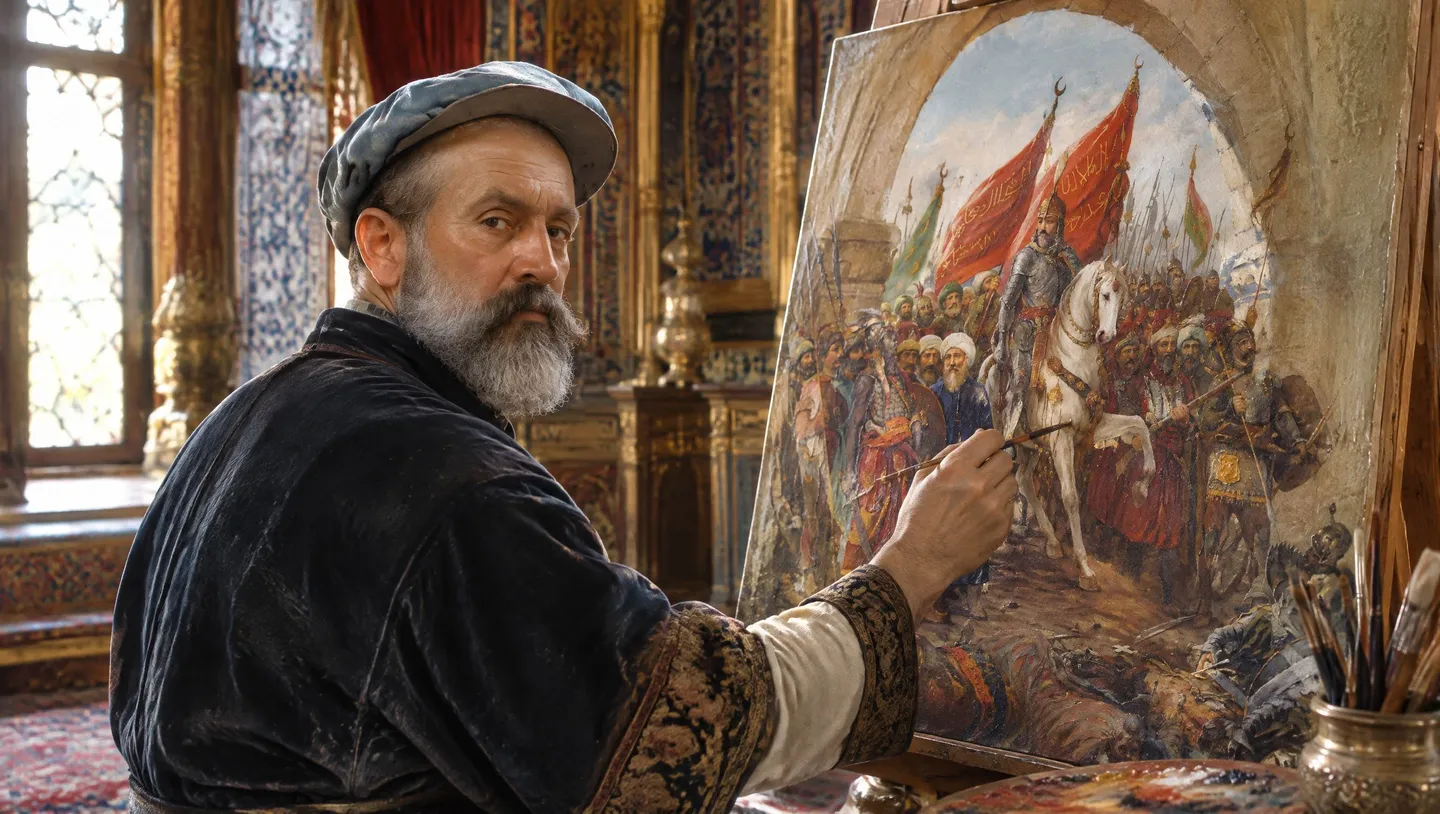
Following the death of the former court painter, Luigi Acquarone, Zonaro was appointed court painter on April 17, 1896, after his painting The Ertugrul Cavalry Regiment won admiration, Urekli says.
His next painting, The Attack (Hucum), earned him a house he could use as both a residence and a studio.
“The fact that a foreign national reached the title of Ressâm-ı Hazret-i Şehriyârî (Painter to His Imperial Majesty) in the Ottoman palace shows that he gained an important place in the cultural dynamism of the period,” Urekli says.
Throughout his career, Elisa played an important role in supporting Zonaro’s work and helping him reach audiences beyond the Ottoman Empire.
“Zonaro’s closest helper and supporter was undoubtedly his wife, Elisa. She gave the artist moral support by providing him with a comfortable and peaceful working environment at home,” Urekli tells TRT World.
Having completed a six-month photography course in Paris, Elisa photographed her husband’s paintings and arranged for them to be published in European magazines, including Die Illustrierte Zeitung and Barcelona Cómica.
Her work helped introduce Zonaro’s paintings to a wider European audience.
Although born and raised in Italy, Zonaro developed a deep interest in Ottoman history and culture, reflected in the variety of subjects he painted during his years in Istanbul.
His military and historical paintings, including The Ertugrul Cavalry Regiment and The Attack (Hucum), resulted from extensive preparation, detailed sketches, and careful observation.
Named after Osman Bey, the founder of the Ottoman Empire, the Ertugrul Cavalry Regiment served as the sultan’s personal guard.
Every Friday, Sultan Abdulhamid II would take part in a ceremonial procession accompanied by the regiment. Zonaro observed these processions while preparing what would become one of his best-known paintings.
“Zonaro painted his work depicting the passing of the Ertuğrul Cavalry Regiment based on direct observation. He prepared over a long period not from photographs, but by taking notes from live impressions,” Urekli says.
Elisa also assisted him during the painting's preparation, which involved close attention to everything from the number of buttons on the soldiers’ uniforms to the rhythm of the horses’ gait.
“I worked so meticulously,” Zonaro recalled, according to Urekli.
Beyond the military ceremonies and historical events associated with his position as court painter, Zonaro was also drawn to the everyday life of Istanbul and traditions that would gradually disappear.
His subjects included firefighters, public petition writers and street vendors, as well as religious celebrations observed by the city’s Muslim and non-Muslim communities.
“He reflected everything just as it was. This point is very important! The international community came to know the Ottoman Empire better through his brush,” Urekli says.
“Let me say this from a historian’s perspective; in his works, we see the customs and traditions of Istanbul that have been left on the dusty shelves of history.”
For historians, paintings such as Petition Writers (Arzuhalciler), Firefighters (Tulumbacilar) and View of the Bosphorus from Kandilli offer valuable visual records of Ottoman society.
His historical paintings, including The Attack (Hucum), and his portraits of Sultan Mehmed the Conqueror also reflect his interest in the empire’s past.
According to Urekli, Zonaro was the only painter known to have painted a portrait of Sultan Abdulhamid II during his 33-year reign.
Leaving Istanbul behind
Zonaro’s career at the Ottoman palace ended after the overthrow of Sultan Abdulhamid II in 1909.
In 1910, after spending 19 years in Istanbul, he returned to Italy. But his departure did not end his artistic relationship with the city.
For some time after his return, Zonaro continued to paint scenes of Istanbul, working from photographs Elisa took during their years in the Ottoman capital.
He died in Sanremo, Italy, in 1929, leaving behind a collection of paintings that continues to offer insight into the people, customs and daily life of the Ottoman Empire in its final decades.