 Mohamed Solaimane
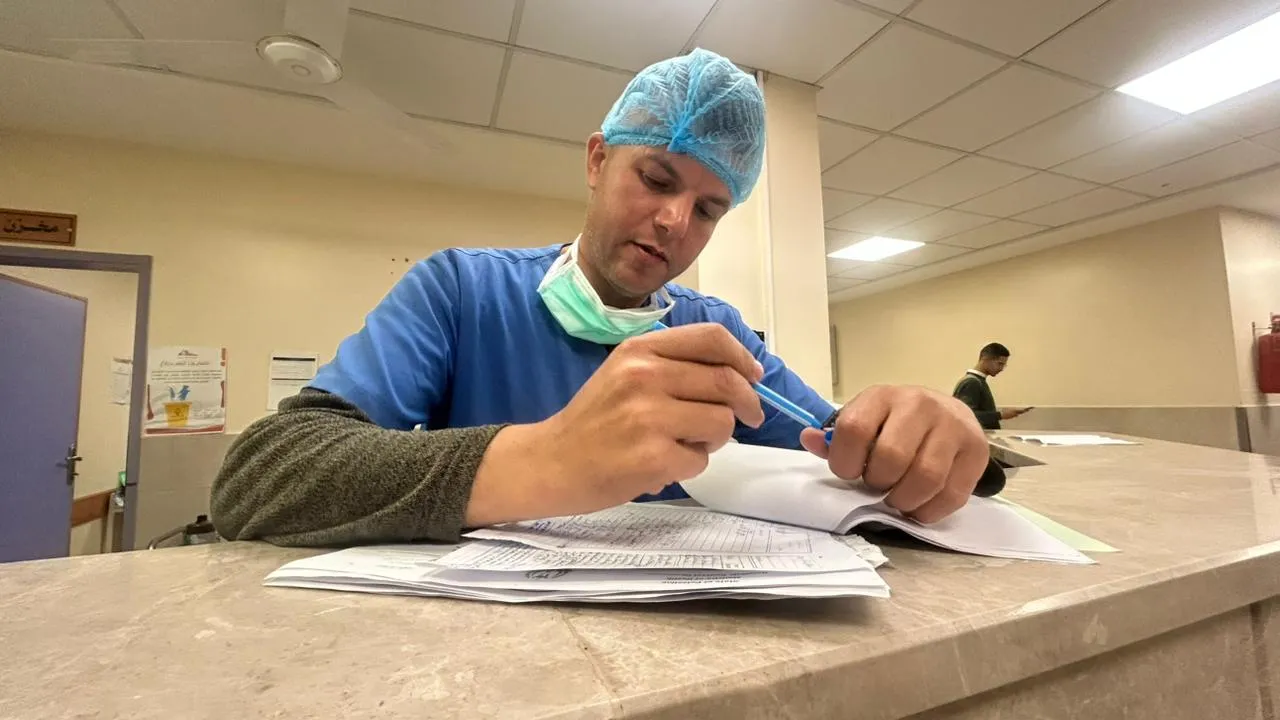
Paediatrician Ahmad Al-Farra moves quietly between the cold rooms of the Al-Tahrir Building for Paediatrics and Obstetrics, which he heads at the Nasser Medical Complex in Khan Younis.
Bedside, he examines, diagnoses, and prescribes treatment for children, backing up his assessments with lab tests whenever possible.
That diligence has become critical amid a recent spike in pediatric illnesses driven by a sharp drop in temperature, and the exposure of displaced children to winter weather in tents scattered across southern Gaza.
Families insist that Al-Farra personally treat their children. He is among 170 distinguished physicians who recently earned the Palestinian Board Certification – the highest medical speciality credential in the occupied Palestinian territories – joining the small number of board-certified doctors still in Gaza.
After graduating from Damascus University, Al-Farra returned to Gaza in 1997, but a year later, he left for Egypt to complete a master’s degree in paediatrics before returning again in 2002.
“The scientific and hands-on training modules were well structured and significantly strengthened both my theoretical knowledge and practical abilities,” Al-Farra tells TRT World, noting that in medicine, a little extra knowledge can save lives.
Today, he manages four pediatric departments and three obstetrics and gynaecology departments, overseeing 14 physicians.
“The board qualifications preserve knowledge transfer and prevent scientific and practical gaps, especially given the absence of graduate academic programs in Gaza’s universities and the difficulty of pursuing them abroad,” says Al-Farra.
Relentless Israeli bombardment since October 7, 2024, often deliberately targeting healthcare facilities in Gaza, has devastated the healthcare system and led to severe resource shortages.
According to a WHO report, 94 percent of hospitals have been damaged or destroyed, overwhelming remaining partially functional facilities and disrupting essential services.
Over the past two years, hospitals have been overwhelmed by mass casualty incidents, with an average of eight incidents per day.
Al-Shifa and Al-Ahli Arab hospitals in Gaza City were at times operating at almost 300 percent capacity, the report notes, treating complex trauma cases amid severe shortages of medicines and supplies.
Despite a ceasefire and a UN Security Council-endorsed peace plan in November, the healthcare system remains in crisis.
On December 22, Medicins Sans Frontiere (MSF) warned that new Israeli registration rules for international NGOs providing essential medical care risk leaving hundreds of thousands of people in Gaza without lifesaving healthcare in 2026.
Under the new policy in March, INGOs not registered by December 31 face closure within 60 days. Of roughly 100 applications submitted, 14 have already been rejected, including some accused of “delegitimisation campaigns” against Israel or supporting boycotts.
Behind these policy shifts and system failures are the human stories of the doctors still holding the system together.
Against all odds
Al-Farra, a father of six aged 9 to 21, still dreams of specialising further in pediatric rheumatology. But he cannot forget the personal toll of the war.
“We kept working despite the intense bombardment, displacement, and hunger,” he says.
He recalls how his youngest child struggled at the height of the mid-year famine, while his family waited for water to arrive, sometimes only after his shift ended.
Obstetrician-gynaecologist Mohammed Madi, who also completed the Palestinian Board this year, has been displaced seven times since May 2024, moving from Rafah to Al-Mawasi in Khan Younis.
He began the Board programme in 2020.
“It was a qualitative leap,” he says. “Thanks to the expertise of professors and daily lectures in the hospital, and Arab and foreign consultants on video call,” Madi tells TRT World.
During the months he worked in Rafah, deliveries multiplied fivefold, forcing him into multiple back-to-back shifts.
“In normal times, a physician works about 35 hours a week but a board resident must work another 35 hours a week to qualify,” says Madi, father of three daughters.
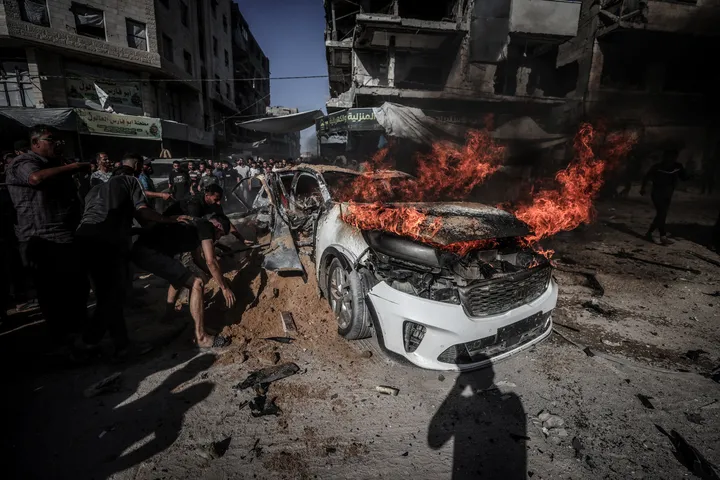
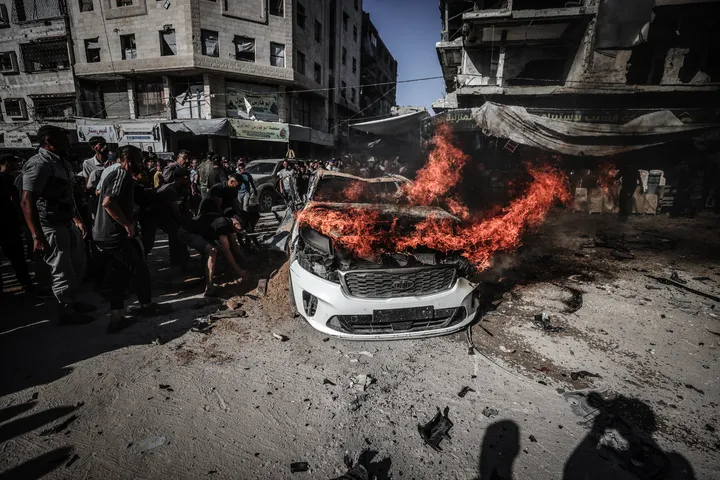

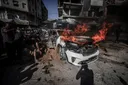
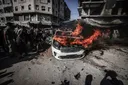
All this while also faced with displacement, the harsh realities of tent life, food insecurity and constant bombardment.
“Many times I heard my wife screaming when the bombs intensified nearby,” he says. “I could do nothing but try to soothe her on the phone.”
Travel for further training or to participate in conferences and to learn from non-Palestinian experts is impossible.
“Gaza is under occupation. Crossings are closed. Everything here is different from any other educational environment in the world,” says Madi.
Still, he says he would choose the same path again.
“We learn to serve the world before ourselves,” he says.
Rebuilding a training system from rubble
Haitham Al-Ajla, coordinator of the Palestinian Board in Otolaryngology (ENT), says trainers and residents have continued despite threats to their lives, families, and workplaces.
Equipment at the previous training centre in Al-Shifa Medical Complex was destroyed during an Israeli raid two years ago. The Board’s headquarters later moved to Nasser Medical Complex, which itself was raided twice.
One trainer salvaged some tools until March 2024, when the programme was revived after several months of interruption.
“Microscopes, examination units, endoscopy monitors, specialised cameras, and most equipment were destroyed,” says Al-Ajla. “So we did our best to fix them. We now work with the bare minimum, protecting the equipment like our lives and families, because we know how vital it is for saving lives and how dangerous any malfunction would be.”
Displaced from Shujaiyya to Al-Zawayda, he says simply staying in training is an act of defiance.
“The absence of personal safety and the sense of possible Israeli targeting at any moment is enough to break anyone,” he says. “Trainers and trainees bid farewell to their families every morning, sometimes leaving instructions to their wives in case they are killed or arrested.”
Only the top 10 applicants are shortlisted for the Board each year. After interviews, just two to five doctors may be accepted, depending on needs and capacity. Certification typically takes four and seven years, Mohammed Abu Salmiya, director of Al-Shifa, where 80 board-certified doctors now serve.
“The graduation of 170 new Board-certified physicians is a message of defiance and resilience,” Abu Salmiya says. “The achievement was to run the Board amid genocide, destruction, displacement, bombardment, and hunger.”
The programme currently covers 16 specialities, relying primarily on Palestinian trainers, with additional support via tele-consultation and visiting delegations.
Rebuilding Gaza’s medical education system, he stresses, will require major investment and reconstruction.
“The success of our 170 doctors is dazzling and joyful amid an immense weight of sorrow and suffering.”
These newly certified doctors, he says, stand in for the many senior physicians who have been killed, detained or forced into exile.
“Our doctors embody a message of life, a refusal to succumb to death, and a drive to build despite pervasive loss.”
This article was produced in collaboration with Egab.