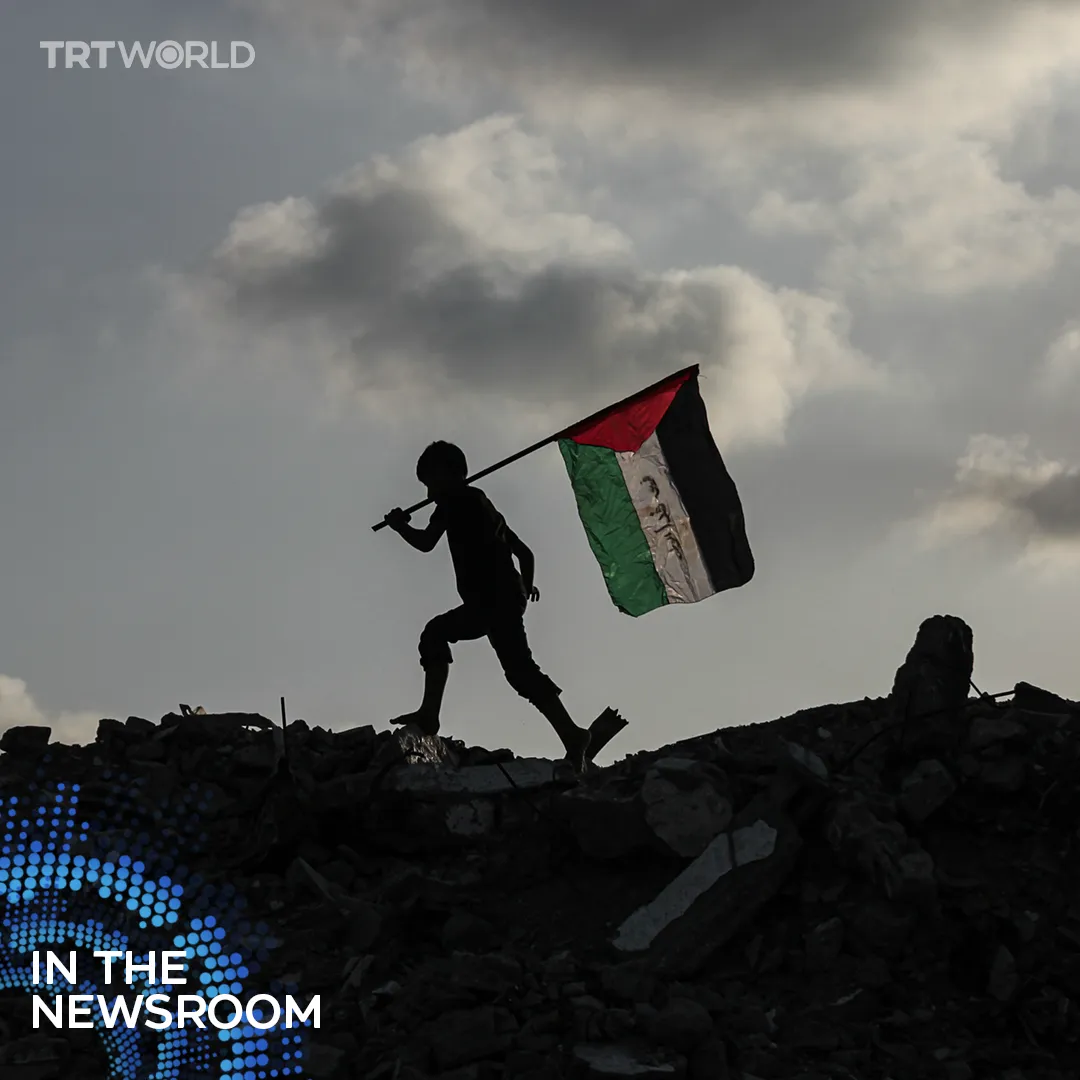
Host/Producer: Ezgi Toper
Craft Editor: Nasrullah Yilmaz
Production Team: Afzal Ahmed, Mucteba Samil Olmez, Khaled Selim
Executive Producer: Nasra Omar Bwana
Transcript
MIDDLE EAST COMMENTATOR CHRIS DOYLE:
It does give a boost to Palestinians: the sense that the international community is beginning to move away from Israel, that is true, that it is more supportive of Palestinian national rights, as these recognitions show. But it all has the sense of too little too late.
HOST OF ‘IN THE NEWSROOM’ EZGI TOPER:
Many European countries are finally recognising the state of Palestine.
But after decades of silence and complicity, is it too little, too late? And given their role in shaping today’s reality, what does recognition by France, the UK, and others really mean. Can it make any difference?
You’re listening to “In the Newsroom” and I’m Ezgi Toper. In this podcast we have conversations with colleagues and experts that go beyond the headlines.
In this episode, we're looking at the recent wave of European countries that have begun recognising the State of Palestine. But they are arriving decades late to a conversation much of the world settled long ago.
To understand things better, we’re breaking down some of the questions you might have about Palestinian recognition.
QUESTION ONE: When did this all start?
The State of Palestine was declared in 1988. Following the announcement, more than 80 countries extended recognitions, with strong support from nations in Africa, Asia, the former Soviet bloc and the Arab world.
For these countries, Palestine’s right to statehood was never in question.
In contrast, Europe aligned itself with US policies and Israeli preferences. Until now, nearly four decades later, on Monday, September 23, 2025, France officially recognised the State of Palestine.
FRENCH PRESIDENT EMMANUEL MACRON: We must do everything within our power to preserve the very possibility of a two-state solution. Israel and Palestine living side-by-side in peace and security. This is why I declare that today, France recognises the State of Palestine.
EZGI: French President Emmanuel Macron made the announcement at a high-level summit ahead of the United Nations General Assembly in New York. The two-state solution summit, co-hosted by France and Saudi Arabia, was boycotted by Israel and the US.
At the same meeting, Belgium, Malta, Andorra, Monaco, and Luxembourg also formally recognised Palestine. Just a day earlier, the UK, Australia, Canada, and Portugal formally recognised Palestine. And last year, Ireland, Spain, and Norway did the same.
Each of these moves was hailed as a boost to international momentum for Palestinian statehood.
Currently, around 75 percent of UN member states recognise Palestine. At the UN, Palestine has “permanent observer state” status, meaning it can participate in debates but cannot vote.
QUESTION TWO: How does recognition actually help Palestine?
One, it affirms Palestinians’ right to their own homeland, something Israel’s occupation, annexation, and settlement expansion seem aimed at permanently erasing.
Two, it upgrades Palestine’s diplomatic status, allowing it to negotiate as a state rather than a non-recognised entity. Recognition also allows countries to establish treaties and full diplomatic relations with Palestine. It can strengthen international legal arguments and obligations under the UN Geneva Conventions.
Three, it can pave the way for practical measures such as sanctions, trade restrictions, arms embargoes, no-fly zones, or any other pressure on Israel.
In addition, with France and the UK now on board, four of the UN Security Council’s five permanent members support Palestine, as China and Russia recognised Palestine back in 1988. That leaves the US, Israel’s strongest ally, isolated and ramps up diplomatic pressure on Israel as the war in Gaza continues.
For nearly two years, Israeli attacks have killed more than 65,000 Palestinians, mostly civilians in Gaza. Nearly the entire population has been displaced, famine is spreading, and much of the land lies in ruins.
So, for Palestinians, these recognitions are long-overdue validations of their right to a state.
QUESTION THREE: What are critics of these recognitions saying?
Critics argue that if recognition is not paired with these concrete actions, it is largely symbolic. Chris Doyle, a Middle East commentator and the Director of the Council of Arab-British Understanding, speaks on this during an interview with TRT World.
DOYLE: It would matter far more if there was also in tandem serious actions like uh sanctions, disinvestment, the isolation of Israel to indicate the utter outrage of an international community that should now be seeing Israel as a rogue state, a state that has felt free to bomb seven countries over the last 12 months, five capitals of those countries. And that it has to draw a line. These powers have to say enough is enough.
EZGI: And other critics say perhaps it is just a tool for European countries to appease growing outrage from their citizens over Israel’s war on Gaza.
In her latest piece titled “France should have recognised Palestinian statehood years ago,” French Journalist Rokhaya Diallo slams the recognition as “long overdue”. She says France’s credibility is weakened by ongoing military and economic ties to Israel.
Specifically, she criticises France for not sanctioning Israel, a contrast in EU actions taken against countries like Russia.
Similarly, in journalist Justin Salhani’s latest piece for Al Jazeera, he asks, “Is recognising Palestine a way to ‘save face’ for Western leaders?”
QUESTION FOUR: How is the UK’s recognition of Palestine different from other Western countries?
The UK’s recognition carries extra weight. Unlike other countries, the UK made recognition conditional on Israel taking concrete steps like agreeing to a ceasefire, allowing humanitarian aid into Gaza, and halting annexations in the occupied West Bank.
UK PRIME MINISTER KEIR STARMER: So, today, to revive the hope of peace and a two-state solution, I state clearly, as prime minister of this great country, that the United Kingdom formally recognises the state of Palestine.
Back in July, UK Prime Minister Keir Starmer said that if Israel didn’t agree to these conditions, the UK would recognise Palestine as a state.
But by tying recognition to Israeli action, critics say the UK uses Palestinian statehood as leverage to pressure Israel, rather than recognising Palestine on its own merits.
Karen Scott, a law professor at the University of Canterbury, points this out in her latest piece for The Conversation titled, “Why UK recognition of a Palestinian state should not be conditional on Israel’s actions.”
She says the UK’s rhetoric sets a concerning precedent, and recognition of states should be based on their own right to self-determination not the policies of a third country.
Palestine already meets most criteria for statehood according to international law: they have a permanent population, territory, government, and capacity for international relations.
So, she argues that the UK should have recognised Palestine unconditionally, while continuing to pressure Israel diplomatically and through sanctions to comply with international law.
And the double standard of sanctions is hard to ignore. In his speech, Starmer announced that further sanctions will be taken against figures in Hamas but did not apply the same for Israeli officials. He even said the UK’s recognition means Hamas can have “no role” in Palestine’s government.
STARMER: Because it means Hamas can have no future, no role in government, no role in security. We have already prescribed and sanctioned Hamas and we will go further. I have directed work to sanction other Hamas figures in the coming weeks.
EZGI: In response to his speech, Irish presidential candidate Catherine Connolly said it is not Starmer’s place to decide Hamas’ role in a Palestinian state, stressing Palestinians must choose their leaders.
IRISH PRESIDENTIAL CANDIDATE CATHERINE CONNOLLY: I come from Ireland, a history of colonisation, and I would be very wary of telling a sovereign people how to run their country. The Palestinians must decide in a democratic way who they want to lead their country. What Keir Starmer and other countries should be doing is stopping the genocide – absolutely calling out what it is “genocide” and using our voices to stop it.
But Starmer’s words are even more striking given the UK’s historical roots in the Israel-Palestine conflict. In an op-ed for TRT World, Emeritus Oxford professor Avi Shlaim slammed the UK’s move as “pathetically little and a century late.”
He traces today’s crisis back to the Balfour Declaration of 1917, when Britain expressed support for a Jewish homeland in Palestine, while suppressing Palestinian rights.
At the time, Palestinians made up 90 percent of the population. But Britain blocked elections, supported Zionist settlements, and reduced Palestinians to “non-Jewish communities.” This laid the groundwork for displacement and conflict that continues today.
And since then, British governments have largely backed Israel, giving cover to ongoing annexation and settlement expansion.
QUESTION FIVE: After these announcements, what was the reaction at the UN General Assembly?
EZGI: Back in New York, Palestinian Authority President Mahmoud Abbas praised the countries recognising Palestine. He delivered his statement by video because the US denied him a visa to attend the UNGA.
Meanwhile, naturally, Israel condemned the recognitions.
Prime Minister Benjamin Netanyahu even reiterated said a Palestinian state “will not be established west of the Jordan River.”
ISRAELI PRIME MINISTER BENJAMIN NETANYAHU: I have a clear message for those leaders who recognise a Palestinian state. After the horrific massacre on October 7, you are giving a huge reward to terrorism. And I have another message for you: it will not happen."
EZGI: And in his address to the UN, Trump not only relentlessly mocked the organisation, blasting it for failing to bring peace, he also called the recognition a "reward" to Hamas and urged the group to release hostages to reach peace.
US PRESIDENT DONALD TRUMP: Now, as if to encourage continued conflict, some of this body is seeking to unilaterally recognise a Palestinian state. The rewards would be too great for Hamas terrorists for their atrocities.
EZGI: But UN Secretary-General Antonio Guterres rejected both Israeli and US claims.
UN SECRETARY-GENERAL ANTONIO GUTERRES: What is the alternative? A one-state scenario where Palestinians are denied basic rights, expelled from their homes and their lands, forced to live under perpetual occupation, discrimination and subjugation. How is this possible in the 21st century? How is it acceptable? This is neither peace nor justice. It will only increase the growing isolation of Israel on the global stage. And let’s be clear: statehood for Palestinians is a right, not a reward."
EZGI: Netanyahu also tried another angle to oppose the recognition.
According to media reports, he wrote a letter to Macron accusing France of failing to address the rise of antisemitism in the country. The Israeli leader argued that recognising a Palestinian state would “pour fuel on this antisemitic fire,” implying a direct link between French support for Palestine and threats to Jewish communities.
But France condemned these remarks as “abhorrent”. The sentiment was echoed by our commentator earlier, Chris Doyle, who called Israel’s claims that this will only ignite violence against Israelis as “utter nonsense”.
DOYLE: It's utter nonsense. In fact, it is the absence of a political solution to this conflict. It is the absence of rights for Palestinians, statehood for those who think that is the way forward that you have two states lying side-by-side. That is what is endangering Israel. It is the belief that you can settle all of this through naked force. That your only answer to all of this is to try to bomb and starve a civilian population.
QUESTION SIX: How have Palestinians responded to this news?
EZGI: On the ground, the recognition of Palestinian statehood has sparked both joy and concern among Palestinians. Many spoke to media, saying that they fear Israel may respond with increased violence or intensified repression.
Because despite the recognition, Palestinians remain vulnerable as Israel continues land confiscation, settlement expansion, and efforts to undermine the Palestinian Authority, meaning a Palestinian state still lacks effective territory and governance.
Omar Baddar from the National Policy Council of the Arab American Institute tells TRT World that violence is expected to escalate.
POLITICAL ANALYST OMAR BADDAR: So, Israel is seeing the writing on the wall. They know that in the long term, this policy is not going to be sustainable. And so, they're rushing to do as much damage as they possibly can in the shortest time that they possibly can because they know that the clock is running out on American and Western support for their policies. And as long as that window exists, they see it in the next three years at least with the Trump administration.
QUESTION SEVEN: So, where does this leave us?
Europe’s recent recognition of Palestine is historic but it is also complicated. They have finally acknowledged what Palestinians have been demanding for decades: the right to their own sovereign state. In doing so, they have sent a strong symbolic message to the world that Israel cannot ignore the reality of Palestinian statehood forever.
Yet symbolism alone cannot end occupation, halt settlement expansion, or stop the humanitarian catastrophe in Gaza. So, critics are right to question the timing and motivations behind these recognitions because recognitions must be part of a broader strategy, not an endpoint.
Even if symbolic now, it all contributes to long-term delegitimisation of occupation in the eyes of international law and public opinion. Thanks for tuning in. Until next time, I’m Ezgi Toper, and this was “In the Newsroom”, a special analysis.