PODCAST TRANSCRIPT
DR. SAMAH JABR, PSYCHIATRIST: This is a big difference between what I learned in Western institutions of mental health and the daily practice in Palestine. All Western interventions assume that trauma is from the past and there is safety. We establish a safe place to do the psychological work, and there is a hopeful future. In Palestine, trauma is ongoing and it’s not from the past. There is no safe place.
EZGI TOPER, HOST: Welcome to The HUMAN Line: a podcast that explores how people navigate the extremes of human experience. Each episode examines what tests our humanity and how we reclaim it.
In Palestine, Israel’s ongoing war and decades-long occupation have left deep, collective and generational consequences for mental health. But how can psychological care be understood, let alone practiced, when trauma is continuous and violence has no clear end?
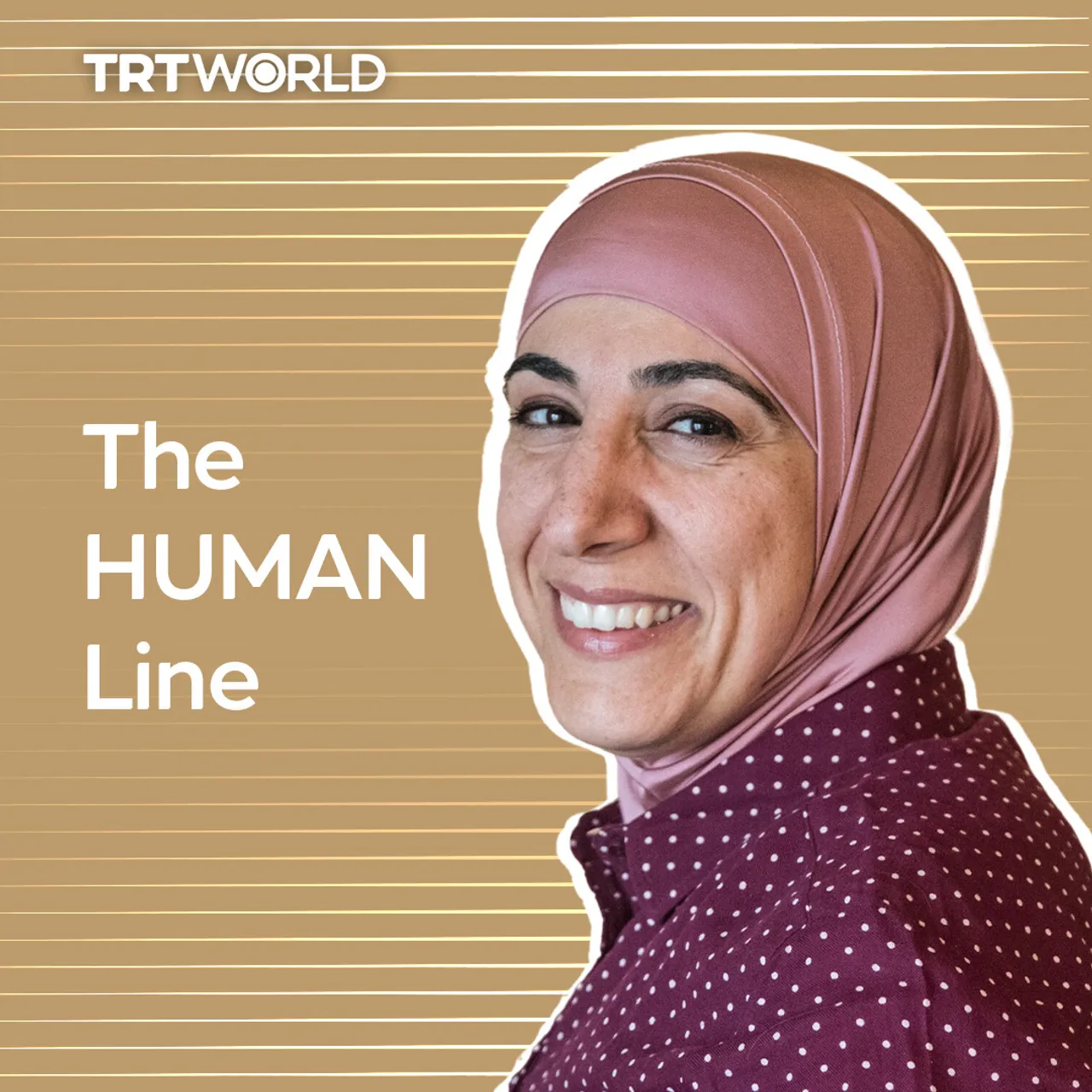
I’m your host Ezgi Toper and in this episode, we’re speaking with Dr. Samah Jabr, a renowned Palestinian Psychiatrist, author, and the former Head of the Mental Health Unit in the Palestinian Ministry of Health.
DR. JABR: What we are living in Palestine is a situation of extreme political violence. It is colonialism with every meaning of the word, and this has catastrophic psychological consequences. Human loss is so common. People grieve for an amputated limb. People grieve for years lost in political detention. And grief is widespread. It touches every aspect of Palestinian life, and there is also anticipatory anxiety because the political violence has been going on and on. It is repetitive, so this is what people expect.
So there is existential anxiety about the future and you can imagine that this creates a lot of psychological suffering and pain for individuals, and many of those who come to see us in our clinical practice, they don't have a disorder or a diagnosis, but they carry this pain and we try to open a safe place in spite of all the difficulties, to facilitate for people to talk about this psychological suffering and pain.
EZGI: Can you walk us through how you actually put that into practice? What are some day to day barriers that you face while trying to practice clinical care in Palestine?
DR. JABR: This is a big difference between what I learned in Western institutions of mental health and the daily practice in Palestine. All Western interventions assume that trauma is from the past. And there is safety. We establish a safe place to do the psychological work, and there is a hopeful future.
In Palestine, trauma is ongoing and it's not from the past. There is no safe place. Sometimes we practice in shelters under bombardment when people come through checkpoints. So how to do mental health interventions when there is no safe place? This is a very big question that conventional psychiatry and psychotherapy have not provided us with an answer for, and it is difficult to see hope in the near future in Palestine.
I think the mental health professionals in Palestine need to be very humble and learn from the people. What works for them? What helps them in dire times? So, I observed a lot. I see people helping themselves organically without our intervention. They gather in groups. They tell stories. They chant. They learn verses from the Quran that gives meaning to their difficult experiences. So we need to learn from this and facilitate this as far as it works. Sometimes the questions for us are not clinical questions. They are very basic questions like, how can I find a tent? Where can I have clean water? Very basic questions. So without safety, without basic needs, international approaches in mental health like trauma focused CBT, EMDR, narrative therapy would not work.
EZGI: As Dr. Jabr explains, western psychiatry relies heavily on terms like PTSD. But she says for Palestinians, trauma is not “post-traumatic” since the violence is ongoing. This is why her approach to therapy differs from Western clinical practice.
DR. JABR: In Western psychiatry, we teach people how to ground themselves in breathing techniques and exercises, but it is obvious that people in Palestine ground themselves in spiritual meaning. They tell us things from the literature of Islamic theology that helps them understand their experience and be patient with it.
So for example, one woman brought from literature the example of Miriam. Feeling a psychological collapse and wishing to die when she was outcasted from the community because she was pregnant and so she had a death wish. And then she explains that the revelation came to tell her. And shake towards you the trunk of the palm tree. So this is about agency. How people can have and express their agency even in very difficult moments? When I listen to stories like that being told by people. I understand that we need to invent new interventions that are suitable for this unique situation, unique crisis in Palestine, and often we mental health professionals are not the experts.
EZGI: She’s also made an important distinction between Western ideas of “resilience” and the Palestinian concept of “sumud.”
DR. JABR: Resilience means bouncing back, adjusting to difficulties. Usually it means individual traits. It's a depoliticised concept while smooth is a politicised concept. And it is not only about your personal traits, it's about the relationships you develop with other members of the community, so it has the collective aspect in addition to the individual traits. And so it's a mindset and it is also action-oriented, and it doesn't mean in any way adjusting to injustice or coping with the reality in a way that accepts it. It's about challenging the reality and making transformation and change. That's the big difference between the two notions.
How do we see that illustrated in Palestine? For example, in spite of the horrors that were taking place in Gaza, medical students were following their studies and they just graduated. We saw images of a collective wedding sponsored and supported by some Turkish organisations. So, people still want to express human emotions and procreate and live in spite of all the death that is surrounding them.
We see people trying to develop a meaning. Their cognitive functioning is navigating a sense of the senseless. So a lot of poetry, a lot of literature is being written from people in Gaza who are living in very difficult circumstances. Those are examples of “sumud”.
EZGI: And one thing Dr. Jabr has stressed throughout her work is how collective trauma manifests differently to individual trauma because the mental health consequences in Palestine are carried down from generation to generation through epigenetics.
D. JABR: We know from a scientific point of view that trauma passes from one generation to another through different mechanisms through the social aspect, storytelling. Through the psychological aspect, the attachment, parents who are traumatised tend to become overprotective and very anxious or detached and numb.
And if you are a child growing under the care of a parent who is overprotective or numb, this will affect your prospect to the world in which you live. We observe that there are many people who are anxious of things that they have not lived themselves. Let me give some concrete examples to explain this.
I receive now children who have fear of dogs. And I looked thoroughly into this fear of dogs. Is it simply xenophobia? Or is it something more complex than this? We know that for many colonised nations in the world, dogs have been used as a proxy, as an extension for military power. From Haiti during French colonisation to the occupied land. Now, we are hearing stories about dogs being trained – military dogs being trained – to rape Palestinians. So, I think for generations to come Palestinians will have heightened anxiety and disgust from dogs in reaction to this history.
So, I'm very much interested in the contextual analysis of the symptom. Why do people have this symptom? Sometimes it is not due to their direct experience, but to the stories that they hear from other people in the community or from older generations.
Because of the weaponised starvation in Gaza, and while people were starving in Gaza, I received in the West Bank and Jerusalem, young people who stopped eating. It is not their experience, but they stopped eating because they thought that if the world could not stop genocide and weaponised starvation in Gaza, why wouldn't it be repeated in the West Bank and Jerusalem? And sometimes in empathy, sometimes they felt guilty to eat luxurious food when our brothers and sisters in Gaza cannot eat.
The generation that is starved, the offspring will have psychological consequences. That's another example of transmitted trauma over generations. So some studies suggested that people will have more psychiatric disorders in the future, the offspring of those who were starved. Some studies suggested that their functioning and potential for professional success will be affected.
The relationship to money and food will be affected for different generations to come.
EZGI: Dr. Jabr has also argued that occupation itself is a mental health problem, and her work draws heavily on Frantz Fanon and liberation psychology. She explains what it means, in practice, to treat mental health as part of a broader struggle for liberation rather than as a personal adjustment to injustice:
DR. JABR: We need to understand the intention of colonial trauma. It has the intention of making people feel helpless. So, they exploit all the everything possible in order to to bring people to their knees and to make those who watch the atrocities helpless. And if we understand that this is the intention of colonial trauma, we know that the remedy comes from finding our little role. Our little responses. Finding our agency as individuals. And try to move ourselves from the position of helplessness to the position of having some agency.
Identify the small battles that we can take as individuals. Can we support? Can we educate? Can we be a voice for the voiceless? Can we contribute financially? So, we need to identify our little battles in order to liberate ourselves from the position of helplessness, because that is the intention of colonial trauma to make people lose their agency completely. And what differentiates between a human being and non-human beings? Human beings have a will and agency, and immense violence and power attacks people in their agency.
EZGI: Liberation psychology looks beyond symptoms and toward the systems that create them. When Dr. Jabr speaks about restoring agency as a response to colonial trauma, she is pointing to a broader responsibility. Especially for those whose work places them on the frontlines of suffering.
DR. JABR: Let me remind you of the time of COVID. The responsibility of the doctor was not only to treat the people who caught the virus. The responsibility of the doctor was to educate about distance, about hygiene, to eliminate the virus from the environment, and violence. Structural violence, colonial violence as an example, is the virus in the environment that is affecting everybody.
So, it is meaningless to treat the individual who is affected by amputation, who is wounded, who is tortured in detention centres, and care less about structural violence in the environment. So, I think any health professional, any mental health professional, should be vocal about political violence, not only take care of individuals.
The potential for a Palestinian health worker to be targeted is like 240 percent more than an ordinary Palestinian because they have been speaking about the violence, the structural oppression, and educating the world about it, writing to institutions. They continued to work in order to restore health and care in very dire times.
We lost more than 1,600 health professionals in Gaza over the past two years. That's a huge number. The Palestinian population living in the territories is a very small population. And the health structures were all destroyed in Gaza, and health professionals were targeted by killing, by detention. Some of them died under torture. They were tortured to death. So, it is important to be aware of our responsibilities, to promote solidarity among health professionals internationally.
I see a repetition of this situation in Sudan now. The health professionals are being targeted in Sudan. I think whenever an oppressive system wants to inflict the utmost pain on a population, when they want to bring the population to their knees, they target the health system because the health system speaks against the oppression, the killing, and the structural violence.
They can provide testimony. They have witnessed and they can provide for the future. The data and the documentation provided by health professionals is very important for. The legal consequences of all of this violence and violations of human rights.
EZGI: Then how as a healer do you personally keep yourself from burnout or despair when working in these conditions and feeling this constant threat for the work that you're trying to do as well?
DR. JABR: That's a very important question. Western psychiatry teaches us that if we care too much, we will develop burnout, and I think that there is no problem if we care, there is a problem if we are the only ones who care. If the world doesn't care and we care. So, I think professional solidarity can protect the Palestinian health workers on the ground who care for their people and for their patients.
It can get very difficult for them because they lose family members, because their homes are demolished, because they are displaced and some of them have only the clothes and the shirts that they are wearing. So, all of that is difficult. It is important to send a message to them that they are not alone and to continue carrying their stories and their voices to our health institutions and challenge the institutions who have been quiet and passive about all the violations that have been committed against the health staff.
You know, we understand that this trauma is a collective trauma, so sometimes individual responses are not sufficient. We need to process things collectively. We need to connect with each other, with other professionals, with other journalists, with colleagues.
People go to demonstrations in groups, not only as individuals, because this collective processing is an appropriate response to the collective trauma that we are living. We feel that we are not alone when we do that.
And seeking justice is very important, even if we don't achieve it soon. But justice has a healing effect, and as mental health professionals, we need to realise this because seeking justice maintains the hope for a better future for people. So, it is an important element for the healing process.
EZGI: Thank you so much
DR. JABR: Pleasure, thank you.
Presenter / Producer: Ezgi Toper
Executive Producer: Nasra Omar Bwana
Craft editor: Nasrullah Yilmaz
Camera : Sahin Solak, Gokhan Deniz, Deniz Duman