Baba Umar
US Secretary of State Antony Blinken is likely to reschedule an aborted visit to China in the coming weeks, officials said, as the two superpowers try again to put a cap on tensions.
A US official said on condition of anonymity on Tuesday that Blinken was expected to reschedule his visit to China in the coming weeks but stressed that no date had been set.
National Security Council spokesperson John Kirby said that the recent talks in Beijing touched on "the potential for future visits" and were "very useful."
"I think you'll see us speak to future visits here in the near future," he told reporters.
Blinken had been set to travel to China in February but cancelled the trip after the United States detected and later shot down what it said was a Chinese espionage balloon over US soil.
But both countries gave a positive assessment of a recent visit to Beijing by senior US officials, which included Daniel Kritenbrink, the top US diplomat for East Asia who also arranged Blinken's previously planned trip.
State Department spokesperson Vedant Patel said that Kritenbrink and senior White House official Sarah Beran had "candid and productive discussions" in China, but regarding Blinken's trip said only, "We look forward to rescheduling that visit when conditions allow."
"Our viewpoint is that there is no substitute for in-person meetings or engagements, whether they be in Washington or Beijing, to carry forward our discussion," Patel told reporters.
Tensions have soared in recent years between the world's two largest economies on a host of issues including trade and security, with the United States claiming that China is moving ahead on preparations to take over Taiwan, which China says is its inseparable province.
Presidents Joe Biden and Xi Jinping agreed to work to avoid miscalculations when they held extensive talks in Bali in November, but tensions soon flared anew over the balloon.






Boosting engagement with China
Separately, and without mentioning Blinken's trip, US Asia-Pacific coordinator Kurt Campbell told an event at the Hudson Institute that exchanges with Beijing were improving.
"The lines of communications are opening up and we are able to lay out more constructively our areas of interest and concern," although the US had been unsuccessful in getting China to agree to effective crisis mechanisms, Campbell said.
He said episodes like what he called "dangerous" navigation by a Chinese destroyer in the Taiwan Strait on Saturday, showed the need for these "to prevent circumstances where unintended consequences can have terrible consequences."
China says both sides of the Taiwan Strait belong to China, and that it is right and proper for China to uphold its sovereignty.
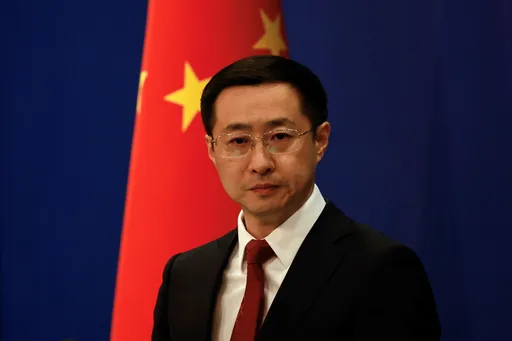
A Chinese Foreign Ministry spokesperson said on Monday that the measures taken by the Chinese military were "reasonable, legitimate, and professional and safe."
"China is increasingly a great power. Her [military] forces rub up against ours much more than they did in the past. The potential for miscalculation, inadvertence, is real and growing," Campbell said.
The Biden administration has pushed to boost engagement with China even as ties have deteriorated over disputes ranging from military activity in the South China Sea, technology competition, to Taiwan.