 Zeki Tarik Sarioglu
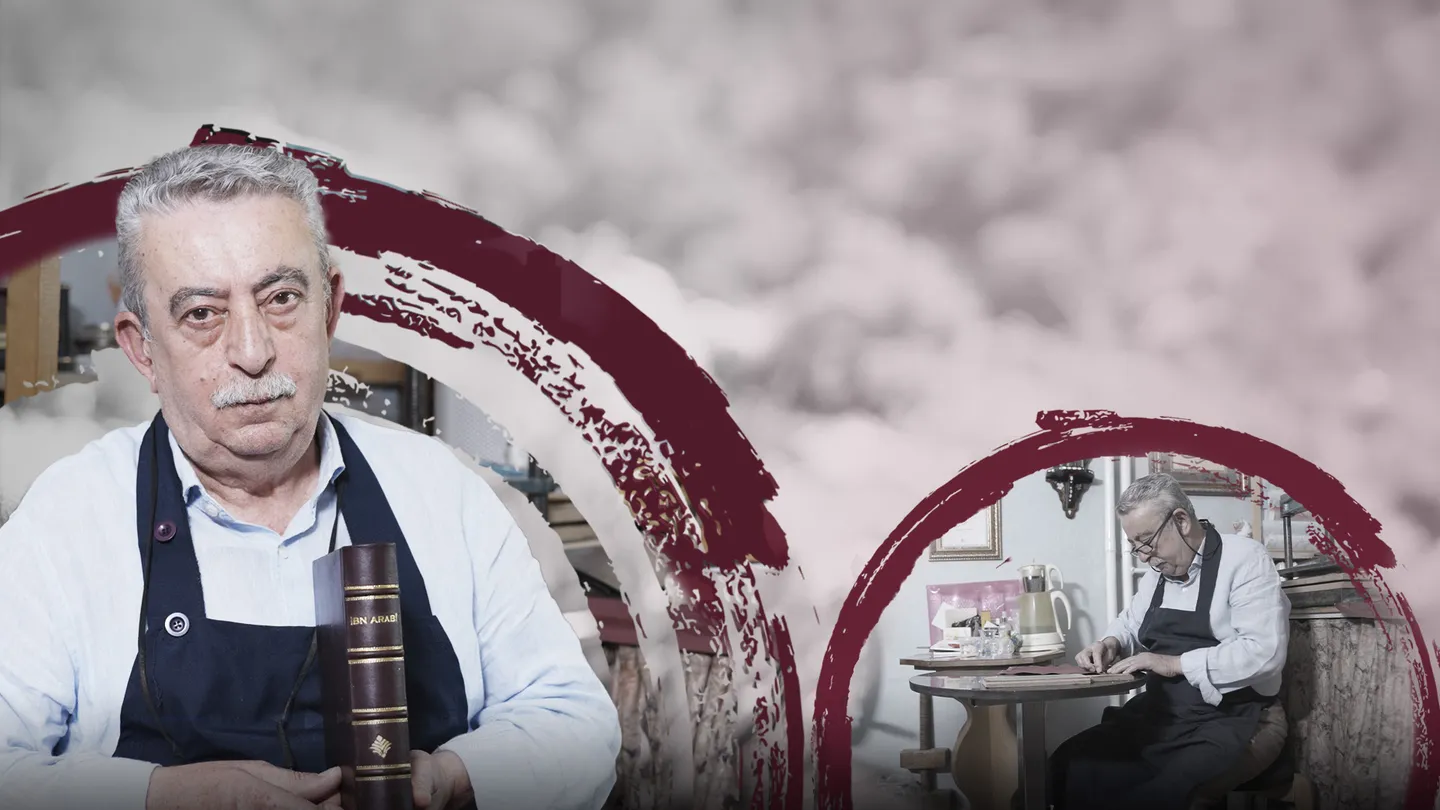
For nearly 60 years, Mehmet Karsli has dedicated himself to the patient, intricate art hidden beneath a book's cover.
“We only see the cover of a book, but there are many processes underneath it,” says the master bookbinder, who has spent much of his life repairing and restoring books.
The process involves carefully taking a book apart, repairing damaged pages, stitching them back together, applying glue, trimming the edges, and finally crafting a new cover.
Each stage demands attention to detail, and even the smallest mistake can undo hours of painstaking work.
“If you make a mistake in even one letter when lettering the cover, you have to discard it and make a new cover,” he tells TRT World.
Yet despite the craft's demanding nature, Karsli’s passion never faded.
“I have been in this profession for about 60 years, and believe me, I have never been tired of working.”
From apprentice to master
Born in 1951 in Musalikalesi village in the Akdagmadeni district of Yozgat, Karsli moved to Ankara at age nine.
After completing primary school, he began an apprenticeship at a bookbinding workshop in Hacettepe, balancing his early training with his education.
He spent his days learning the craft and attended middle school in the evenings. After graduating, he enrolled in the printing department of an industrial vocational high school.
His interest in books and bookbinding, however, began with something much simpler: the quality of paper.
At the time, Karsli recalls, good-quality paper was difficult to find. Most notebooks were made from second- or third-grade paper, which deteriorated easily when people erased writing.
But one of his friends, whose father worked as a printer, had notebooks made from better-quality paper. Their appearance caught Karsli's attention.
“He would come with beautiful notebooks, and that is how I became interested in this craft,” he says.
That early fascination eventually led him to a bookbinding workshop, where he discovered that learning the profession required far more than an interest in books.
The training followed a gradual process. Apprentices first learned by watching experienced bookbinders before moving on to stitching, repairing, rounding the spine, and cutting the book.
Making covers came much later.
“After learning to round the spine, you would only move on to making the covers after another year to a year and a half,” he tells TRT World.
Karsli likens the craft to a city's infrastructure, where much of the essential work remains hidden beneath the surface.
In traditional bookbinding, pages are stitched together, headbands are woven at the top and bottom of the spine, and the edges are trimmed. A board is then prepared to form the cover's foundation, before leather is thinned, shaped, and applied.
What appears to be a single finished object is, in fact, the result of numerous carefully executed stages.
The work beneath the cover
For Karsli, bookbinding began with the practical need to protect and hold written pages together.
“Bookbinding has existed since the invention of paper,” he says.
As writing on individual sheets became more common, people needed covers to keep the pages together and protect them from damage.
The craft's terminology also reflects its traditional materials. The word cilt, derived from the Arabic word for “skin” or “leather”, came to describe a book's protective covering, reflecting the widespread use of leather in traditional bindings.
Karsli distinguishes between two approaches to the profession: modern bookbinding and the traditional methods associated with Ottoman craftsmanship.
The classical tradition he describes belongs to a broader heritage of book arts that developed over centuries.





Important bookbinding examples emerged in Anatolia during the Seljuk period, and the craft later developed distinctive characteristics under the Ottomans.
In the classical Ottoman period, bookbinding was practised in palace workshops alongside calligraphy, illumination and miniature painting.
Its defining features include the decorative shamsa (a star-shaped, circular, or oval rosette medallion) and the headband, both of which require specialised techniques.
The headband is woven at the top and bottom of the book's spine, while the shamsa is a prominent decorative motif on traditional covers, often featuring vegetal or geometric patterns.
Restoring an old manuscript requires the same meticulous approach: first assess its condition, then carefully remove accumulated dirt.
“When a manuscript comes in, the first thing you do is give it a dry cleaning. After the dry cleaning, if there are any torn areas, you restore them,” he explains.
Once you've repaired the damaged sections, you stitch the pages together and begin work on the cover.
“After stitching it, you make the cover. Then you stamp the shamsa onto the cover. After the shamsa, you decorate it with gold or in a simple style. You weave the headband,” he explains.
“Then you glue the covers together, and a finished work of art emerges.”
What is particularly striking in Karsli’s story is that after decades in the profession, he chose to become a student again.
In 2010, his works were displayed at a group exhibition in Istanbul. Master bookbinder Islam Secen saw Karsli’s pieces there and expressed an interest in meeting him.
“He said, ‘I want to meet this master’.”
When Karsli later visited Istanbul, he sought out Secen not just to meet him, but to ask to become his student.
“I said to him, ‘Master, I sometimes receive questions about classical bookbinding, but I do not know this art. Could you teach me?’”
For the next year and a half, Karsli travelled regularly from Ankara to Istanbul to study classical bookbinding under Secen.
By then, he already had his own workshop and a steady stream of customers. Nevertheless, he made time for the training, closing his workshop every Friday evening and taking an overnight train to Istanbul.
“I went to Istanbul for a year and a half.”
“On Friday evening, I would close the workshop, take the train at night, and arrive in Istanbul in the morning.”
“I would attend the course, return in the evening, and open my workshop on Monday.”
Do it with love
Alongside his training and development as a bookbinder, Karsli built a career working in public institutions.
He began working at Ankara University's Faculty of Agriculture at a young age and secured a permanent position there when he turned 18.
In January 1982, he moved to Parliament, where he continued working until his retirement in 1996.
Retirement, however, did not mean stepping away from the profession. Instead, it gave him the opportunity to devote himself to his own workshop and the craft he had loved since childhood.
His decades of dedication have also brought recognition.
In the 60th year of his career, Karsli received an award from Turkish President Recep Tayyip Erdogan, an honour he describes as one of the most meaningful moments of his life.
For a man who has spent much of his life learning, practising and teaching a centuries-old craft, the lesson he hopes to pass on extends well beyond bookbinding.
“Whatever you do, do what you love,” he tells TRT World.
“If you love what you do, you will surely succeed.”