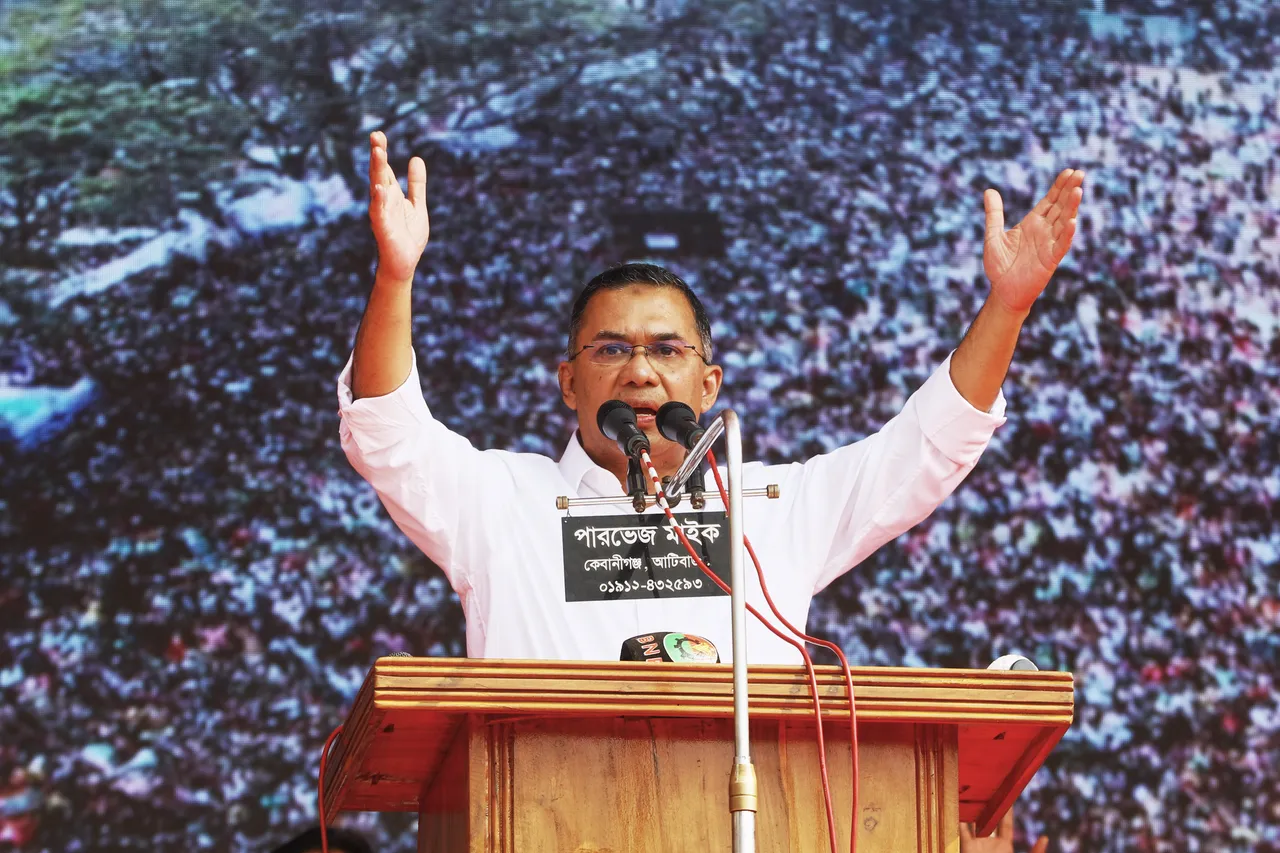
After leaving Bangladesh in 2007 amidst allegations of military torture and a wave of prosecutions he has long described as politically motivated – cases that were later quashed following the fall of the Awami League government – Tarique Rahman spent nearly 17 years in exile in the United Kingdom.
Long vilified by the local media for his roles during 2001-06 BNP-led government, now he is back — not just to re-enter politics, but to stake a claim to the country’s highest office.
From midnight rallies to hosting his own podcast, the chairman of the opposition Bangladesh Nationalist Party has re-emerged as a central figure in Bangladesh’s political landscape.
Once the arch-rival of Awami League, led for years by Sheikh Hasina, Rahman is now at the forefront of a shifting balance of power as Bangladesh prepares for a national election after years of upheaval, including disputed polls, boycotted or challenged by the opposition.
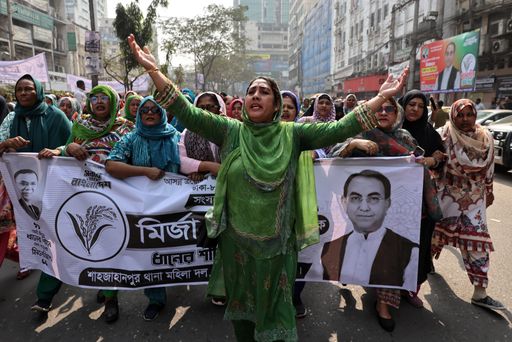
Within the BNP, his homecoming has injected momentum. Rallies have drawn large crowds and renewed organisational energy.
Yet the early phase of his return has also brought into view the less cinematic questions that will define the party’s next chapter: whether BNP can keep its message coherent, whether it can impose discipline across constituencies, and whether the leadership transition that now looks inevitable can hold together a coalition shaped by legacy, survival and internal bargaining.
Those questions became sharper with the death of Begum Khaleda Zia, Rahman’s mother and the party’s longstanding leader.
Her passing closed a defining chapter of BNP history and pushed the post-Zia question from internal reality to public fact: for the first time since its founding, the party must operate without the figure who commanded near-universal loyalty across factions.
Mustafa Kamal Rusho, a retired brigadier general and analyst of military, security and political affairs, sees Rahman’s elevation less as a rupture than as the culmination of a process that began years ago.
The decision to make him chairman was taken internally by senior BNP leaders, rather than through a public party vote.
“Following her imprisonment in 2018, Tarique Rahman assumed the role of acting chairman, effectively preventing a leadership vacuum within the party,” Rusho told TRT World.
“His recent elevation to chairman therefore represents more of an institutional transition than a dramatic shift.”
In the short term, Rusho believes Rahman’s return and formal appointment may help stabilise the party. “Rahman’s return and formal appointment are likely to serve as a unifying force for the party, at least in the immediate term,” he said.
But he was careful not to overstate the implications.
“The broader question remains whether this development will contribute to political stability in the country,” Rusho said.
“While the BNP may experience a degree of internal cohesion, its long-term stability — and its impact on the national political landscape — remains uncertain.”
Rusho outlined two possible trajectories for the BNP in the post–Khaleda Zia era.
On one hand, Rahman’s succession could reduce immediate factionalism.
Dynastic continuity, he argued, may reassure party members and preserve the BNP’s traditional identity.
By positioning himself as the bearer of Khaleda Zia’s vision, Rahman could consolidate internal dynamics and maintain organisational unity.
On the other hand, Rusho warned of a slower decline.
“The charisma, popularity, and authority that Begum Khaleda Zia commanded were deeply personal and historically grounded,” he said. “These are qualities that Tarique Rahman will need to earn rather than inherit.”
Lessons from exile — and their limits
Before returning to Dhaka, Rahman spent nearly 17 years abroad, largely in the United Kingdom’s capital.
BNP leaders have said there was no political space for him to return during Hasina’s rule. Supporters argue that exile exposed him to Western political systems and governance practices that could inform a different style of leadership.
“It is reasonable to assume that such prolonged exposure may have influenced his outlook,” Rusho said. But he cautioned against drawing quick conclusions.
“Party politics in our country differs significantly from the political culture of Western democracies,” he said.
“Translating those practices into local realities will not be straightforward.”
For now, Rusho remains guarded.
“Ultimately, time will determine whether he can implement meaningful or fundamental changes,” he said.
“If such reforms do materialise, they could prove beneficial for the country. For now, it remains a matter of cautious optimism and patient observation.”
Dilara Choudhury, a political analyst and former professor and chair of the Department of Government and Politics at Jahangirnagar University, argues that both Rahman and the BNP have changed — not always in step.
“The politics that former prime minister Begum Khaleda Zia and former president Ziaur Rahman practised for so long is very different from where the BNP has arrived today,” she said.
“During his 17 years of exile in London, the BNP changed a lot — it went through a huge makeover.”
In her view, Rahman has accepted that reality. “Tarique has accepted the reshaped BNP,” she said.
“The new politics he is into is not the same politics people expected from the successors of Khaleda Zia and Ziaur Rahman.”
Still, Choudhury believes the momentum surrounding Rahman’s return has weakened.







“Before his homecoming, there was a lot of buzz,” she said. “On the very first day he arrived in Dhaka, a wave unfolded within the party and across the country. But that wave is no longer visible. It’s fading away.”
She attributes part of that to preparation and messaging.
“In many places, he is saying things in his speeches that are not correct,” she said, pointing to instances where Rahman referenced projects already in place as future initiatives.
“He seems to lack homework in some areas.”
She also questioned his delivery. “His ability to inspire people — which his mother and father both had — he is not even nearly there,” she said.
Generational tension and internal dissent
Beyond individual speeches, Choudhury sees deeper structural problems inside the BNP — particularly a generational divide.
“After the fall of Hasina, people wanted to see a new dimension of politics in Bangladesh,” she said.
“They wanted young people at the forefront.”
Instead, she argues, policy decisions remain dominated by senior leaders whose political instincts were shaped decades ago.
“Those who practised politics in 1991 are still the key players,” she said. “They feel comfortable with the old politics.”
Younger voters, she added, are focused on jobs, employment and modern education — not historical battles.
“Gen Z doesn’t care much about what happened in 1971,” she said. “They want to keep pace with the modern world.”

Choudhury also warned of growing dissatisfaction among mid-ranking BNP leaders — many of whom endured imprisonment and repression over the years but were passed over for nominations.
“Nominations have been given to loan defaulters and people with foreign citizenship,” she said. “Those who want to see a new Bangladesh are in despair.”
The consequences are already visible. “In 79 parliamentary seats, there are 92 rebel candidates,” she said, out of 300 constituencies nationwide.
“They are not obeying Tarique Rahman’s instructions.”
For Choudhury, this raises a fundamental question.
“If he cannot bring discipline within the party,” she asked, “how will he govern firmly?
She argued that the challenge extends beyond party management to questions of economic stewardship, geopolitical balancing, and leadership credibility among cadres who endured years of repression.
She also warned that if the BNP performs poorly in the election, Rahman’s leadership could face a serious challenge — even the risk of a split.
Sabbir Ahmed, a professor of political science at the University of Dhaka, takes a more balanced view.
“I believe the legacies of [Tarique Rahman’s parents] Ziaur Rahman and Khaleda Zia will remain within the party,” he said.
“However, Tarique Zia [Rahman] has also built a legacy of his own over the last 16 years.”
For Ahmed, the question is not whether the BNP will change, but how.
“If the party completely deviates from its founding principles, its essence will be destroyed,” he said.
“But a party survives because it adapts to changing circumstances.”
He pointed to historical shifts in BNP governance to illustrate that adaptation is not new
“Ziaur Rahman internationalised the Ganges water issue,” he said. “During Khaleda Zia’s time, that approach did not work the same way. So we saw changes in practice.”
“Tarique Rahman will likely have to do the same. The reality then and the reality now are not the same,” Ahmed said, pointing to shifts in regional geopolitics and Bangladesh’s foreign alignments following the end of Hasina’s long rule.
Ahmed also framed internal divisions as a structural feature of Bangladeshi politics. “Parties like the BNP or Awami League are power-centred,” he said.
“Politics has become about the distribution of power — the ‘cream’ of the state.”
Despite the turbulence, Ahmed believes Rahman has already repositioned the BNP as a national alternative.
“Right now, the BNP is the only credible alternative,” he said, arguing that groups like Bangladesh Jamaat-e-Islami lack comparable national reach.
He also sees a change in Rahman himself.
“There is a big difference between the Tarique Rahman who left the country and the one who returned,” Ahmed said. “He is more organised, more mature.”
What stands out most, he added, is restraint. “So far, he hasn’t lost his temper,” Ahmed said. “That matters in a chaotic political environment.”