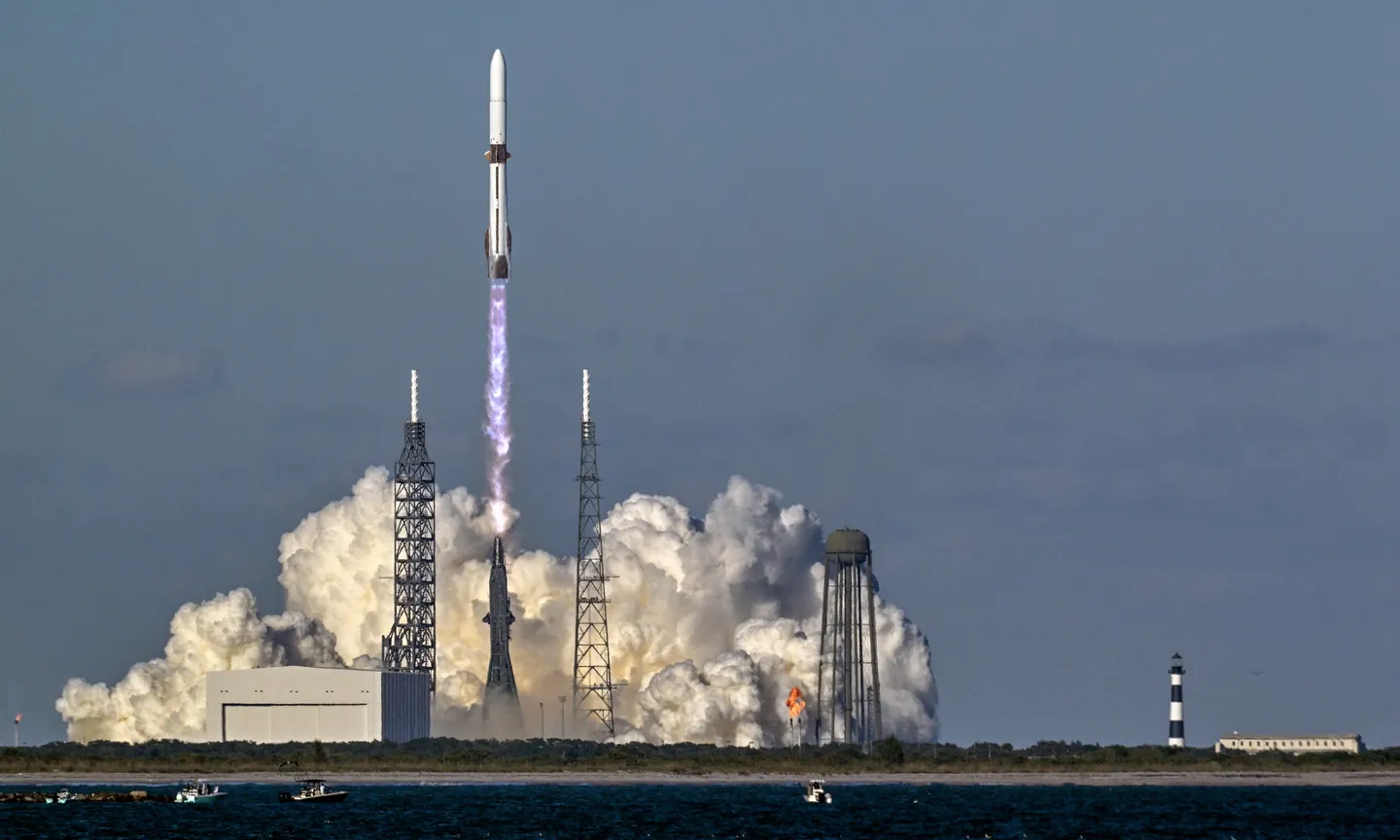
Blue Origin has launched its massive New Glenn rocket and managed to catch the booster for reuse, a technical breakthrough for the space company owned by Jeff Bezos.
The powerful two-stage rocket, standing 32 stories tall, blasted off from Cape Canaveral Space Force Station on Thursday, marking the first mission flown by Blue Origin since New Glenn's inaugural test launch on January 16.
A live Blue Origin webcast showed the rocket ascending from its launch tower in a roar of flames and billowing clouds of vapor moments after its seven BE-4 engines thundered to life, gulping more than 1,270 kilos of liquid fuel per second.
The launch followed several days of delays forced by cloudy skies and a geomagnetic storm.
Landing the rocket's booster stage on a floating platform in the Atlantic is a feat accomplished amid rising competition with rival SpaceX, the Elon Musk-owned company that until now was the only to accomplish the maneuver with an orbital-class rocket.
The primary mission of Thursday's launch involves NASA's twin EscaPADE spacecraft, designed to orbit Mars in tandem to analyse how solar winds — streams of high-energy charged particles from the sun — interact with the planet's magnetic field and how that interaction might contribute to depletion of the thin Martian atmosphere.
Satellite company Viasat also has a payload on board that will remain attached to the New Glenn rocket's upper stage in a technical demonstration of an in-space communications relay above Earth.
Mars misson
EscaPADE - short for Escape and Plasma Acceleration and Dynamics Explorers - originally was slated to launch in October 2024, but was delayed for more than a year by setbacks in development of New Glenn.





When the rocket made its test flight in January, it carried Blue Origin's own payload, a prototype for the maneuverable Blue Ring spacecraft that the company is developing for the Pentagon and commercial customers.
The Blue and Gold satellites were built for NASA by the California-based aerospace company Rocket Lab, with instruments supplied by the University of California, Berkeley.
Blue Origin, founded by Bezos in 2000, has until recently been known mainly for a space tourism business that flies wealthy passengers to the edge of space in the suborbital New Shepard, a smaller single-stage reusable vehicle that also has carried more than 200 research experiments inside its capsule.
If Thursday's launch succeeds, EscaPADE would become the first science payload delivered to space by Blue Origin for a paying customer, a key milestone for the Bezos-owned company in its quest to compete on a more equal footing with Elon Musk's SpaceX, the world's most active rocket launch service.
SpaceX has launched its Falcon rockets on nearly 280 missions during the past two years, most of them serving its own Starlink satellite business.
Blue Origin has spent billions of dollars over the past decade developing New Glenn, a heavy-lift rocket intended to be the company's workhorse for carrying humans and cargo into space.
Named for John Glenn, the first American to orbit Earth, it produces two times more thrust at liftoff than SpaceX's Falcon 9 rocket and about the same as SpaceX's Falcon Heavy vehicle, while offering more cargo room than any of its rivals.