 Sahika Aydinol
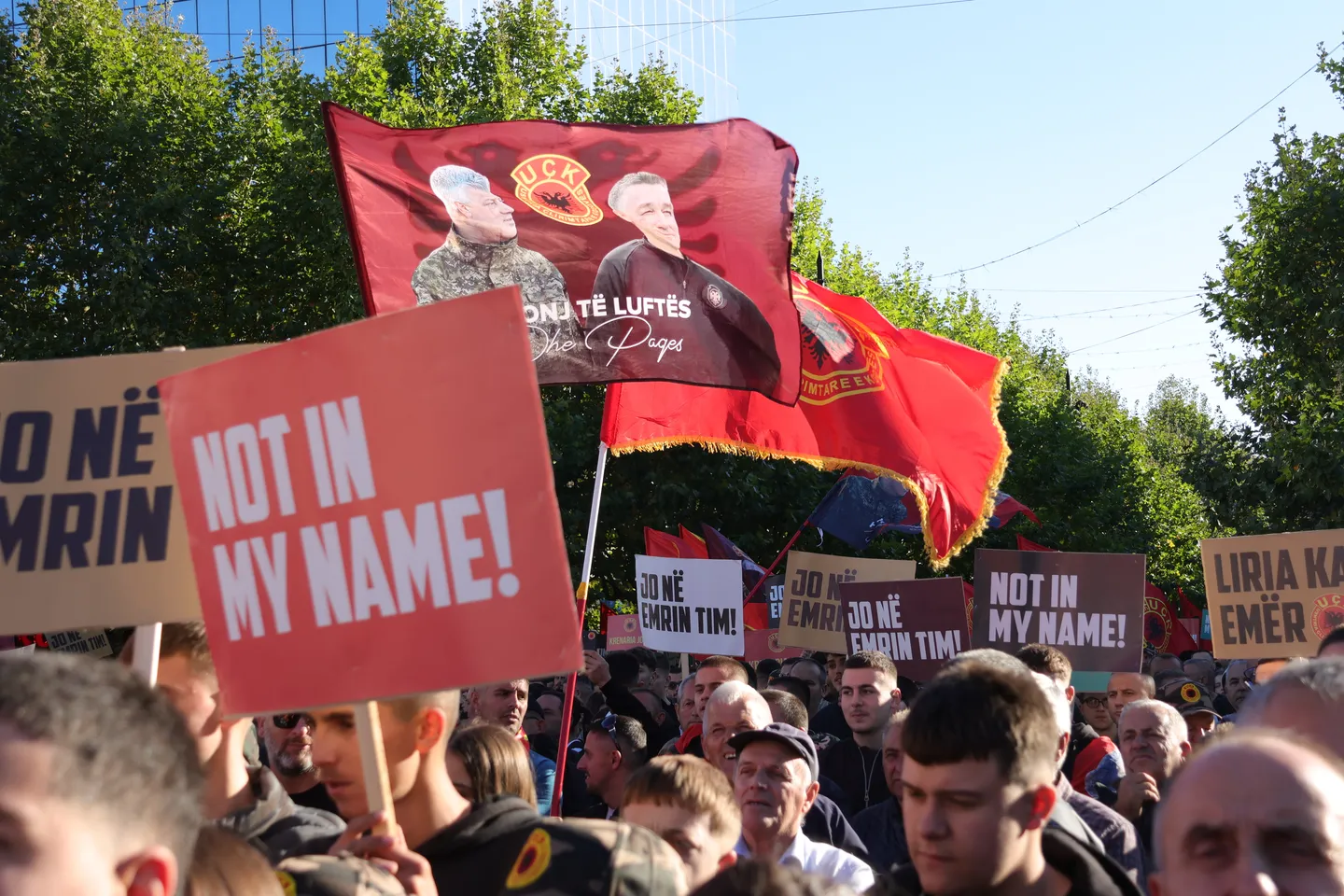
Last week, when thousands of Kosovars and Albanians converged in Pristina for a massive rally, there was a sense of deju vu among the people of Europe’s youngest country.
Carrying placards and posters, the protesters rent the air with full-throated cries of “Jo ne emrin tim” — not in my name – the same Albanian phrase splashed across posters in Kosovo’s capital.
The October 1 protests were the largest of the daily rallies being held in the capital’s central square since September 16, when former president and one of the most prominent figures of Kosovo’s independence movement Hashim Thaci was found guilty of war crimes by a special court in The Hague.
Kosovars have rejected the conviction of Thaci, 58, who was the political chief of the Kosovo Liberation Army (KLA), an ethnic Albanian group that battled Serb forces for Kosovo’s independence in a bitter conflict that claimed more than 13,000 lives.
An estimated one million ethnic Albanian Kosovars were driven from their homes during the fighting.
Since the ruling, Kosovars and Albanians have gathered in the capital every single night to defend his legacy.
On Thursday, their numbers swelled tenfold as the rally coincided with a historic commemoration that directly illuminates the current unrest.
October 1 holds a special place in the history of the country, which gained independence from Serbia on February 17, 2008.
It is widely accepted that the student uprising on October 1, 1997, was a major catalyst in the country's path to independence after years of bloody struggle against the Serbian regime.
Many view the September ruling against Thaci and three other members of the now-disbanded KLA as tarnishing the legacy of the people’s resistance.
Gazmend Syla, a member of the KLA Veteran’s Association, describes the protests as “the only response of a nation facing the threat of annihilation".
A 78-day campaign of NATO air strikes against Serbian forces eventually forced Belgrade to withdraw from Kosovo.
Serbia still does not recognise Kosovo, though more than 100 countries do. Türkiye was one of the first countries to recognise Kosovo after its declared independence.
Echoes from the past
Back in 1997, Kosovo was officially still part of a crumbling Yugoslavia.
Tens of thousands of students had gathered in the city on October 1 to protest the outlawing of their native language by the regime of convicted war criminal Slobodan Milosevic, as he strove to hold onto the remnants of Yugoslavia after the Balkan wars.
It was followed by a formal ban from national schools and universities, forcing Kosovar Albanian students into underground learning centres.
They had assembled for a peaceful protest, with student leader Bujar Dugolli even releasing white doves at the beginning of his speech to symbolise their intentions.
Serbian police greeted them in riot gear and did not wait long before unleashing unrestricted violence with batons, tear gas and water cannons. Hundreds of students were injured or arrested.
Nearly three decades have passed, but Albanian protesters in Pristina’s square still share their resolve, even as they feel similar humiliation and indignation.
When the special court in The Hague decided that Thaci and three co-defendants were guilty of a series of war crimes, it hit a raw nerve for Albanians in Kosovo and the broader region.
In Albania’s capital Tirana, the City Council declared the four men honorary citizens in an act of solidarity.
Failed dialogue and armed resistance
Before the Kosovo War officially began, youth-led protesters had believed they could convince a heavy-handed government in Belgrade to change course through non-violent resistance.
That belief was shattered when police response signalled mercilessness and the impossibility of dialogue.
Trust in the Democratic League of Kosovo – the main political body which was organising a pacifist resistance at the time – collapsed virtually overnight.
And very next month, the Kosovo Liberation Army, a secretive resistance movement that Thaci would have commanding authority over, made its first public appearance in late November 1997.



What has angered Kosovars most is how the case against Thaci was built – based mostly on anonymous witnesses.
“Witnesses say they were packed into crowded basements or shut into rooms without toilets,” says Agron Leka, a former member of Kosovo’s Youth Assembly.
“How do you think other Albanians were living at the time? My mother was always in hiding. A sniper shot her cousin while she was next to him,” Leka tells TRT World, indicating that Albanians faced worse situations during the war.
Ignoring the truth
The public reaction underscores a fundamental friction. The court operates on a sterile legal paradigm that struggles to accommodate a complex historical truth: that an irregular guerrilla force can commit operational violations while simultaneously serving as the primary shield for an existential survival campaign.
Inside one of Pristina’s war museums, exhibition assistant Besnik Tafa explains that the public is emotionally removed from Thaci’s past.
“They are more so reacting to the sentence. It feels like a great injustice compared to some of the Serbian commanders,” he tells TRT World.
He points to Sreten Lukic, the former head of the Serbian Police in Kosovo, who was sentenced to 20 years for crimes against humanity, including the deportation and persecution of Kosovar Albanians, and Yugoslav army chief Dragoljub Ojdanic, who received 15 years for the same crimes.
For much of the population, it’s difficult to comprehend how Thaci can receive a harsher punishment than those implicated in a campaign of ethnic cleansing.
Anila Shala, who has been protesting regularly in Pristina, was born after the war but, like countless others, carries the bloodstains in her lineage.
“How is this supposed to make me think of my uncle?” she asks. He had joined the armed resistance after Shala’s grandfather was murdered during state-sanctioned violence.
She also fears that legally dismantling the credibility of KLA commanders will, by extension, undermine all the veterans who wrote the state's founding chapter.
“You can’t say the verdict is directed at a few individuals. If you say the father is a criminal, and the mother is a criminal, then their entire family is probably criminal,” she tells TRT World.
The shock and anger were so visceral across the country that it sent Kosovo’s highly fragmented parliament into historic unified action.
Lawmakers unanimously declared the court’s decision “unacceptable” and passed a formal declaration rejecting “any attempt to question Kosovo’s liberation war or to equate the people who fought for freedom and survival with the regime that oppressed them".
While the ruling initially galvanised cooperation, it has now created further division. Kosovo’s parliament must elect a new president by October 6.

Now, KLA-aligned parties are threatening to boycott and collapse the whole process if the government does not announce strict measures to contest the ruling internationally.
Prime Minister Albin Kurti is trying to empathise with the people without outright offending the Western members of the court, whom Kosovo depends on for hundreds of millions of dollars in aid annually.
The real danger, in Kosovars’ eyes, is that Thaci’s sentencing invites revisionism into their narrative.
Rina Kastrati, another exhibition assistant, believes the international community will paint the ruling with a broad brush.
“Kosovars can hold duality. We know our history. Other countries will mostly know the headlines (about Thaci’s conviction),” she tells TRT World.
In the international arena, the guilty verdict risks flattening the power asymmetry in Kosovo’s existential battle, falsely implying that guerrilla fighters had comparable capacity to commit comparable crimes as Belgrade’s state machinery.
For Kastrati, whose father’s life was saved by resistance fighters, the legal equation is intolerable.
“The KLA is part of the reason why I’m alive,” she adds.