 Melis Alemdar
Turkish-American artist Refik Anadol enjoys a level of recognition akin to that of rock stars. His name is a household one both in his homeland and in international art circles.
Anadol, a prolific artist if there ever was one, gained prominence when he began using code to elicit visualisations informed by massive data sets filtered through generative AI algorithms.
“I’ve been exploring machine learning as an artistic collaborator since 2016, starting with my residency at Google’s Artists and Machine Intelligence (AMI) program,” Anadol tells TRT World.
“That was where I began developing the concepts of AI Data Paintings and AI Data Sculptures.”
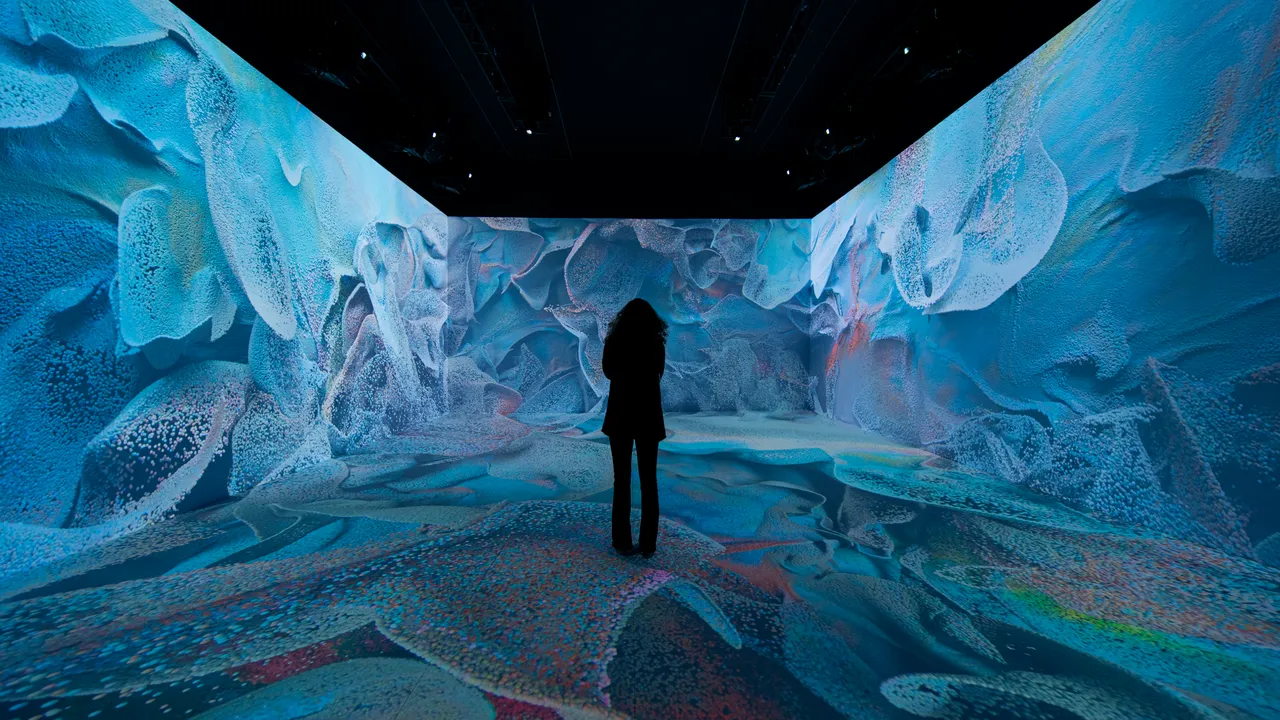
His work has been featured in many museums, including New York’s Museum of Modern Art, which holds “Unsupervised — Machine Hallucinations” in its permanent collection, as well as Istanbul Modern, where he exhibited a work undulating like the sea, inspired by currents in the Bosphorus.
His solo exhibition “Machine Memoirs: Space” at Istanbul’s Pilevneli Dolapdere in spring 2021 drew unprecedented crowds, as visitors queued patiently during the pandemic, lines spilling onto the avenue and beyond.
Anadol has previously shown his work “Melting Memories” at Pilevneli Dolapdere in 2018, preceded by ”Sceptical Interventions” at Pilevneli Project in 2012.
AI ‘expands human creativity’
In August 2025, Anadol was chosen as one of 100 AI pioneers by TIME magazine, in the Innovators section.
The magazine didn’t just feature Anadol among other notable individuals, but also asked him to design the issue’s cover.
Anadol used decades of TIME covers as a data set to fulfil the commissioned work.
“TIME provided Anadol with more than 5,000 past TIME covers, allowing his AI to reimagine what the cover would look like for the TIME100 AI issue”, the magazine explains.
Anadol tells TRT World he feels “deeply grateful … humbled” about the experience.
“Beyond the personal recognition, what matters most to me is what this moment represents: that we can discuss AI not just through fear or hype, but through culture, imagination, and hope.”
Anadol is often presented as a digital or AI artist, but in essence, he aligns more with conceptual artists than casual AI users, whose only input into AI is to craft increasingly detailed prompts to produce clearly computer-generated images.
Anadol can be considered a conceptual artist because, although his latest work may superficially resemble his earlier pieces, the ideas behind it are different.
And like most conceptual art, the physical (or, in this case, digital materialised on screen) aspect of the work makes more sense once you understand the thinking behind it.
For the Istanbul Modern piece in 2023, “Infinity Room: Bosphorus”, he chose to use the strait’s multitudinous currents as his data set.
The concept began with the realisation that the Bosphorus is “not just a geographical passage, but a living system—currents, wind, and invisible flows that constantly shape the city,” Anadol tells TRT World.
“I wanted to create an experience where people could feel those invisible forces, not as a scientific chart, but as an immersive emotional reality.”
He says his goal with the Bosphorus artwork was “for visitors to leave with a new awareness: that the city is alive, and we are flowing inside its rhythms.”
On the other hand, his work at the Museum of Modern Art (MoMA), “Unsupervised”, on display between November 19, 2022, and April 15, 2023, reimagines centuries of art in the museum’s collection to churn out digital ‘hallucinations’.
Critic Ben Davis derisively called it “an extremely intelligent lava lamp”, referring to Anadol’s digital art, which was a towering, high-res screen where abstract images morph hypnotically and ceaselessly.


Davis thinks the movements of Anadol’s work are a sophisticated version of a lava lamp in which brightly coloured wax blobs heated by a lightbulb float across a colorful liquid.
Anadol says he gets the joke, and jokes back: “the work is undeniably mesmerising!” He explains that he considers beauty and accessibility not as weaknesses but as an “invitation to the conversation”.
Trained on MoMA’s collection, “Unsupervised” is the first generative AI artwork the museum has acquired. Anadol tells TRT World nearly three million people have visited it: “a historic level of engagement”.
“If someone wants to stay with the beauty, that is fine. But if they look deeper, the work is a meditation on the "thinking brush"—how the future of creativity is being reshaped by algorithms.”

Machine learning as ‘artistic collaborator’
According to Anadol, “the most profound evolution from those early experiments to today is the shift in control, intention, and responsibility.”
He says he was following his curiosity when he first started working with AI: “In the beginning, we were largely discovering whether a machine could "dream"—learning the latent language of neural networks to see what aesthetics might emerge.”
He says nowadays, his practice “has expanded into building custom systems, training our own models, and rigorously defining our ethics: how we collect data, how we document it, and how we make that process transparent.”
He summarises the evolution of his approach to art as: “I moved from simply ‘using AI tools’ to ‘building worlds where AI can meaningfully collaborate with human imagination.’”
Endemic flowers
His most recent work in Istanbul, Large Nature Model: Türkiye – Flora, for a Turkish bank, relies on a collection of flowers that bloom across Turkiye.
He tells TRT World that he is “incredibly proud” of this work that opened at Is Bankasi’s Museum of Painting and Sculpture as a permanent installation in September 2025, featuring “something fragile and precious: biodiversity”.
Anadol says the project “grew from a desire to create a ‘digital monument’ to nature”. He conducted extensive field research across 33 national parks, “focusing on species [endemic to Turkiye] that exist nowhere else on Earth”.
He explains that the project is focused on flowers because “they sit at the intersection of science, culture, and emotion.”
“Everyone understands flowers intuitively, yet few realize how many species are quietly disappearing,” he says.
“We wanted to create an experience that is mesmerizing but also educational; alongside the artwork, we display our ethical data collection methods and a "Living Encyclopedia" to connect aesthetic wonder with real-world knowledge.”
The “we” he uses in his answers is not the royal “we” – Anadol says that there is a team behind his production process: “This is never just me. These works are built with my incredible team at Refik Anadol Studio, my wife and partner Efsun, and our collaborators,” he says.

Dataland: The world’s first AI museum
Its name is a subtle nod to Disneyland, also in Los Angeles. Dataland, the world’s first museum of AI arts, will open in spring 2026, in a development designed by Frank Gehry called The Grand LA.
Anadol calls it “my life’s work and a long-term dream”.
“Dataland is not just a venue to show finished art; it is a living institution dedicated to research, education, and ethical experimentation,” he tells TRT World. “We are building it to be a home for the Large Nature Model, where data visualization meets nature-focused AI.”
According to Anadol, AI is reshaping labour, truth and ecology in an unprecedented era, which is why he believes “we need a physical institution where people can encounter these technologies through curiosity and critical thinking—not just on a personal screen”.
“My hope is that Dataland becomes a global model for a future-facing museum: immersive, inclusive, and ethically grounded.”