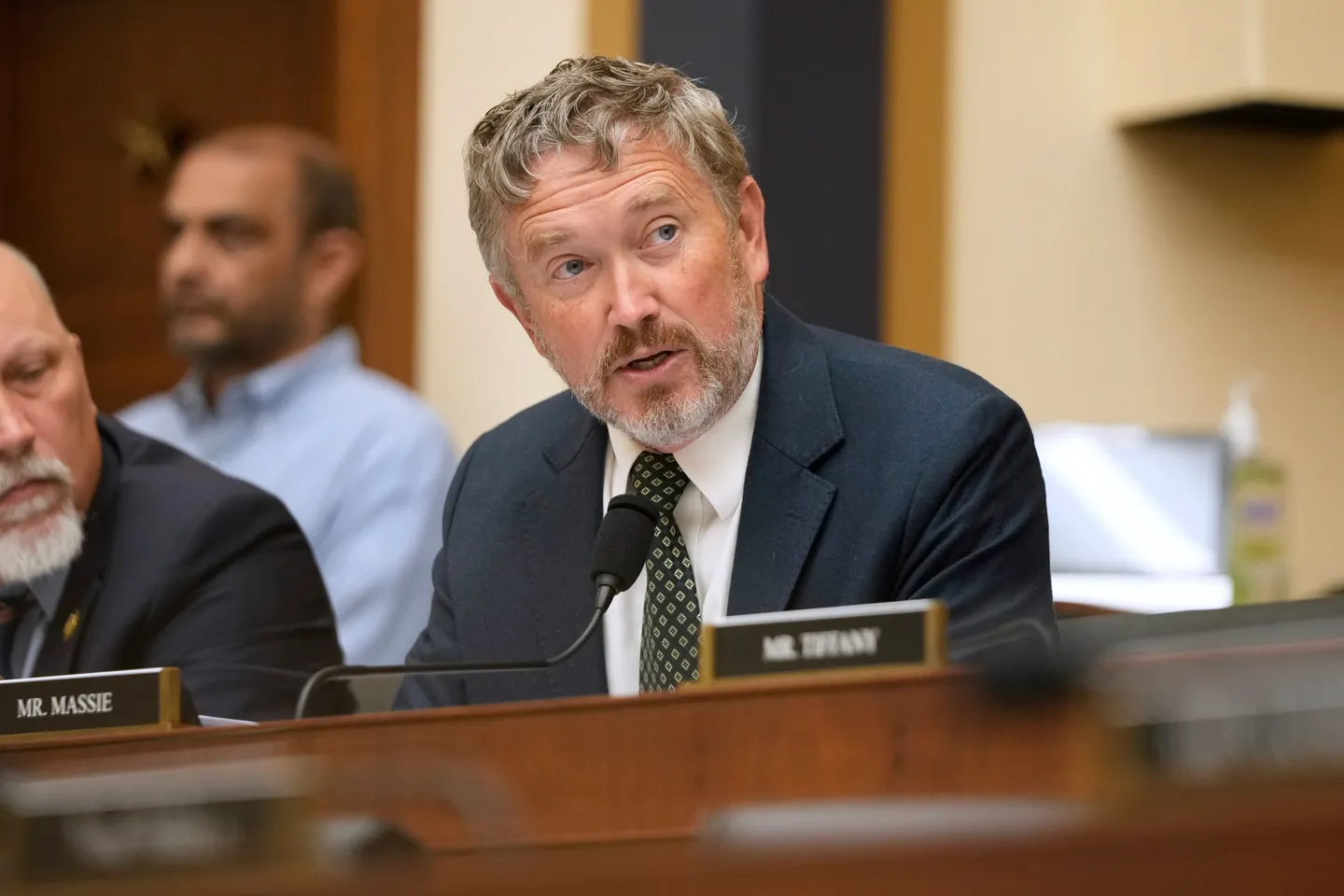
US President Donald Trump has intensified his feud with Republican Congressman Thomas Massie, calling for his removal from office and endorsing a challenger, while Massie pushes forward a new bill to ban government-funded propaganda aimed at American citizens.
The confrontation marks the latest rift between Trump and a member of his own party, highlighting deep divisions inside the Republican ranks ahead of next year’s congressional primaries.
On his Truth Social platform, Trump blasted Massie on Friday, describing him as "a weak and pathetic RINO" — the pejorative acronym for "Republican in name only" — and urging voters in Kentucky’s 4th Congressional District to replace him.
"Third-rate Congressman Thomas Massie, a weak and pathetic RINO from the great Commonwealth of Kentucky, must be thrown out of office as soon as possible," Trump wrote.
He threw his support behind Captain Ed Gallrein, a decorated Navy SEAL, Army Ranger, and fifth-generation Kentucky farmer.
He said Gallrein embodies the "wisdom and courage" needed to defend the country, support veterans, and "ensure peace through strength."
The remarks came shortly after Trump also criticised Kentucky Senator Rand Paul, underscoring widening tension between the White House and libertarian-leaning Republicans who oppose parts of Trump’s foreign and fiscal policies.
According to local reports, Massie has publicly clashed with Trump on key issues such as government spending, surveillance authorities, and military interventions abroad.
Massie’s counter move: Ban on government propaganda
Hours before Trump’s remarks, Massie introduced a bill aimed at banning the use of taxpayer money for domestic propaganda, a measure that quickly drew attention across Washington.
The legislation would repeal the Smith–Mundt Modernization Act of 2013, which lifted long-standing restrictions that prevented federal agencies from directing government information or media content toward US audiences.
Under Massie’s proposal, federal entities such as the State Department and the US Agency for Global Media (USAGM) would be prohibited from funding or distributing government messaging that targets the American public.
"Taxpayer-funded fake news should never be used to influence the American people," Massie said in announcing the bill.
He argued that the measure would restore transparency and accountability in publicly funded communications.
"Americans shouldn’t pay taxes to be propagandised by their own government," he said.
"The bill demands full transparency in all federally funded communications. No more government-run influence campaigns disguised as news."
Massie’s office said the legislation would also require clear labelling for any government-sponsored materials sent overseas and ensure that agencies disclose their media operations to Congress.
The Kentucky congressman’s measure has the backing of many senators like Mike Lee, who filed a companion bill in the Senate.





"The federal government should not be in the business of shaping domestic opinion through covert messaging," Lee said, describing the initiative as a step toward "protecting Americans from their own government’s spin machine."
The proposal comes amid growing scrutiny over information operations carried out by US agencies both domestically and abroad.
Critics have accused the government of blurring the line between public diplomacy and psychological operations, especially during wartime or election seasons.
Feud turns personal
Trump’s attack on Massie, who has served in Congress since 2012, was unusually personal even by the president’s standards.
In his post, Trump accused Massie of undermining his administration’s agenda and "making life very easy for the Radical Left."
He claimed Massie’s support among Republican voters in Kentucky had collapsed.
"Massie is now polling at about 9 percent because the great people of Kentucky are wise to him," Trump said.
Massie, who has often broken ranks with party leadership, is known for opposing foreign military aid packages, pandemic-related spending, and domestic surveillance programmes.
His independent streak has made him a frequent target of Trump’s ire but also earned him respect among libertarian conservatives.
The congressman has yet to publicly respond to Trump’s latest attack but previously said his disagreements with the administration stem from "principles of fiscal conservatism and constitutional restraint."
While Gallrein has not formally announced a campaign, Trump’s endorsement appears designed to pressure him into entering the race.
Representative Thomas Massie, one of the few US lawmakers openly opposing the pro-Israel lobby AIPAC, has been vocal about its influence in Washington.
In an interview with Tucker Carlson last year, Massie said many members of Congress have "an AIPAC person" who regularly contacts them and shapes their political decisions, describing the group as a powerful lobbying force that few are willing to challenge.
GOP divisions widen
Trump’s outburst underscores widening divisions inside the Republican Party between his "America First" loyalists and libertarian conservatives who prioritise small government and non-interventionist policies.
Massie’s bill against government-funded propaganda, meanwhile, appeals to voters sceptical of federal authority and media manipulation — an audience that overlaps with many of Trump’s supporters.
Observers note the irony that Trump’s attacks on Massie came as the congressman was promoting a measure meant to curb federal influence campaigns — an issue Trump himself has repeatedly raised when criticising what he calls "deep state" misinformation.
For now, both men appear to be testing their support bases ahead of next year’s primaries, setting up a potential clash that could shape the Republican Party’s internal dynamics well into 2026.