 Husam Maarouf
When US envoy Steve Witkoff announced what he described as “phase two” of the ceasefire in Gaza, the statement was cautiously received as a signal that negotiations might be inching forward.
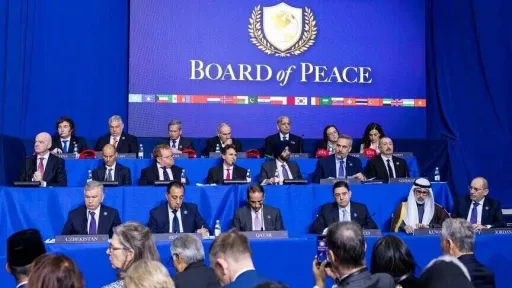
Days later, the White House issued a follow-up announcement, unveiling members of a newly formed Board of Peace. The body is tasked with overseeing a technocratic committee responsible for Gaza’s day-to-day administration in the post-war period.
For many Palestinians in the enclave, however, the announcement did not register as politcial breakthrough. Instead, it landed as something more modest, and perhaps more urgent: a tentative first step toward restoring basic order in a place where even marginal improvements would be significant.
That urgency is visible in the daily calculations of survival.
Distressed, Ahmed Diab, 55, steps out of his tent in western Gaza City, carrying his 13-year-old daughter, Heba, in his arms. She is battling cancer, and they are headed toward the nearest public transportation stop, about a kilometre away along a road fractured by potholes, debris, and rubble.
Heba's body is unusually light. Her head rests silently on her father's shoulder.That silence, Diab says, frightens him more than crying ever could.
"When will Gaza become a place fit for living again?” he asks quietly. “It is exhausting to keep going like this.”
Heba suffers from a tumour pressing on her nerves and sometimes loses consciousness without warning.
"I carry her afraid she might suddenly slip away, leaving me alone on the road." In those moments, Diab thinks of nothing except reaching the hospital and hoping that time will not betray him before transportation does.
Shattered roads
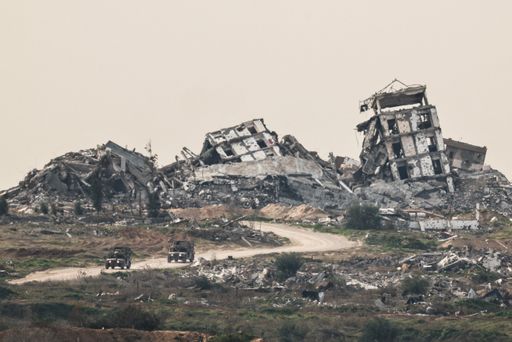
In Gaza, the transportation crisis has become part of the illness itself. High fuel prices, shattered roads, and the scarcity of vehicles have turned a hospital visit into a daily ordeal.
"Sometimes I can’t find a car, and sometimes I do, but I can’t afford the fare,” Diab explains. When drivers refuse to navigate damaged roads, he carries Heba even farther, masking his fear so she will not see it.
Since the genocide began, Diab has been displaced five times. His home in northern Gaza was destroyed, so he now lives in a camp in western Gaza City.
"I don’t just miss the house,” he says, “I miss the roads that used to take us anywhere without hardship." For Diab, streets are not just an urban detail, but a necessity for survival.
When he heard about the formation of the committee to govern Gaza, he felt something he hadn’t allowed himself to feel in months.
"Even though a real solution is still far away, there is something like hope inside me," he says.
He does not dwell on political affiliations. "What I understand," he says, "is the need for real solutions, like paved roads, access to hospitals, and a life lived with dignity."
But hope, for Diab, is painfully conditional. Heba’s health continues to deteriortae, and he cannot reliably get her to treatment.
"My hope," he says, "is that the new government can make promises and actually carry them out."
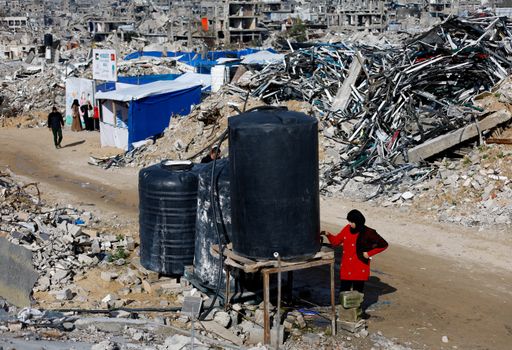
Israel’s near-daily attacks have left entire neighbourhoods in ruins, paralysed municipal services, and forced most of the population into displacement.
Schools have been closed for a third consecutive year, while families endure winter storms in tents and makeshift shelters.
Against this backdrop, questions dominate daily conversation: where would reconstruction begin, who would lead it, and whether any administration can function under current political and material constraints.

"I was [just] relieved when the committee was announced because for me that meant Israeli attacks would not continue,” Samer Al-Haddad, a 39-year-old civil engineer, tells TRT World.
The proposed structure is three-tiered, with the US-led “Board of Peace” at the top, comprised largely of billionaires and figures closely aligned with Israel.
Bulgarian diplomat Nickolay Mladenov has been appointed High Representative of the board and will oversee the transition from Hamas rule to a technocratic Palestinian administration led by former Palestinian Authority deputy minister Ali Shaath.
Alongside this, the White House announced the creation of a Gaza Executive Board, which will work alongside Mladenov’s office and the newly formed National Committee for the Administration of Gaza, tasked with implementing policies on the ground.
"We want a tangible difference on the ground," says Mariam Rashdan, a 43-year-old teacher.
For her, the new administration will be judged by a single measure. “If education returns, I will get hope,” she says.“Education is not a luxury. It is the only thing that makes children feel like this situation has improved.”
Rashdan remains cautious. "I don't trust easily. But if I see real steps, I will support it."
According to the UN Office for the Coordination of Humanitarian Affairs, around 800,000 people — nearly 40 percent of Gaza’s population — are living in flood-prone areas. Winter storms have rendered many shelters uninhabitable, damaging hundreds of tents and exposing thousands to harsh weather. More than 60 occupied buildings in Gaza City are at risk of collapse.
"I want an alternative to tents, even if it's temporary,” Rashdan says. “A tent reminds you every morning that you have no home.”
A realistic plan
While Washington presents the Gaza administration plan as a pathway to reconstruction and prosperity, Palestinians remain absent from the top decision-making body, raising doubts about whose vision of Gaza will ultimately prevail.
Yousef Al-Sak, a 22-year-old shop owner, says, "I don't ask for miracles. What I want is a normal life—without death, hunger, or the huge complications we face now.”
For Al-Sak, credibility hinges on honesty. "The administration should state what it can and cannot do and present a realistic plan,” he says. “Then we will support it.”
Palestinians in Gaza say they are not viewing the new administration through rose-coloured glasses. Instead, they are placing cautious hope in incremental change, an uncertain process, but preferable to paralysis.
Hope is not a luxury for them, but a final wager: an attempt to mend what remains, however fragile, rather than surrender to total collapse.
Whether Gaza’s governing committee can translate that fragile hope into tangible change remains an open question.