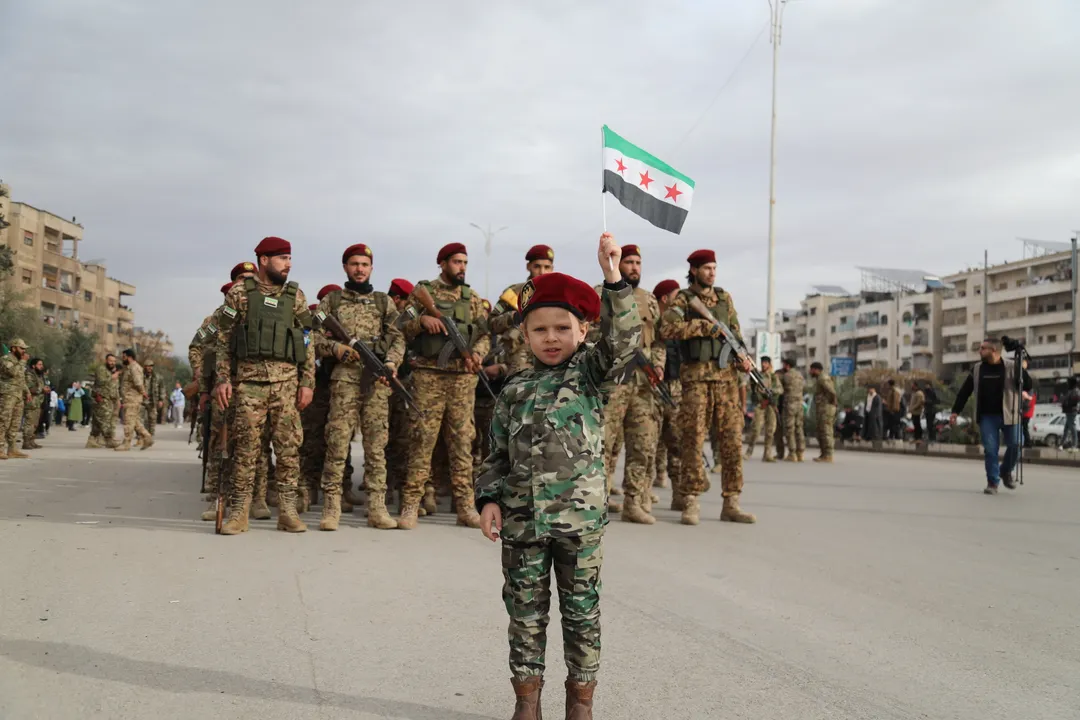
Celebrations erupted across Syria today as the country marks the first anniversary of the fall of Bashar al Assad. Crowds filled the streets waving the revolutionary colours of green, white, black and three red stars.
December 8 was a defining moment in the country’s history and the end of more than five decades of Baathist rule.
A year ago, this scene was nearly unimaginable. Yet here Syria stands: A state attempting to rebuild after 14 years of war, institutional collapse, and displacement on a historic scale.
So, what has changed over the past twelve months? What remains uncertain? And what does the next phase hold for a nation still emerging from the shadow of conflict?
I’m Ezgi Toper, and this is Aloud. This show brings you TRT articles made for audio. In this episode, we’ve adapted the article titled “On anniversary of Assad’s fall, President al Sharaa vows to rebuild a ‘strong Syria”, published on December 8, 2025.
At dawn in Damascus, inside the Umayyad Mosque, Syria’s new president Ahmed al Sharaa is greeted by chants of “hurriya!” (freedom.)
Wearing a military uniform, a deliberate symbol of continuity and control, he declares: “No obstacle will stop us, and together we will face every challenge.”
He pledged a reconstruction “worthy of Syria’s present and its past,” emphasising justice, support for the vulnerable, and national restoration from north to south, east to west.
In an act rich with spiritual significance, al Sharaa placed a piece of the Kaaba’s cloth (a gift from Saudi Crown Prince Mohammed bin Salman) inside the mosque.
The gesture is both a religious symbolism, and a sign of diplomatic realignment in a post-Assad Syria.
Türkiye has formally referred to today as Liberation Day. In a statement, Ankara acknowledged the "numerous challenges" faced in the past year while praising what it described as “lasting steps” towards reintegration, stability and diplomacy.
It has been twelve months since Assad fled to Russia, ending almost twenty-five years in power and fracturing the regime that has ruled since 1963.
The transitional administration that emerged in January is now attempting to define the future of the Syrian state.
Electricity, once limited to only a few hours per day, now reaches most areas for eight to ten hours daily. In several major cities, including Damascus and Aleppo, uninterrupted 24-hour power has been introduced on trial for the first time in fifteen years.
A presidential decree in June raised civil servant salaries from 250,000 Syrian pounds, which is about $15 at the time, to 750,000 Syrian pounds, which is now about $65.
In addition, owning foreign currency is no longer a crime, fuel queues are gone and checkpoint bribes have largely vanished.
And perhaps the most symbolic development of all: prisons such as the notorious Sednaya have been permanently closed.
According to the Syrian Network for Human Rights (SNHR), regime forces detained at least 1.2 million Syrians during the civil war and subjected them to various torture methods.
For Syrians, the closing of these prisons and torture centres represents the end of a climate of fear that defined life under the former regime.
But UN Secretary-General Antonio Guterres warns the transition will only succeed if the world commits to a sovereign, united, inclusive Syria.
That’s all for this episode. This Aloud episode was based on several articles published on TRT World. Thanks for listening.