Host: Nasra Omar Bwana
Guest: Umer Bin Ajmal
Craft Editor: Nasrullah Yilmaz
Production Team: Ezgi Toper, Afzal Ahmed, Mucteba Samil Olmez, Khaled Selim
Executive Producer: Nasra Omar Bwana
TRANSCRIPT
UMER: Look, it's, Bangladesh is an independent country. One can't just rely on support from big regional powers to carry out their own if I may just put it very plainly, I don't think this is how regional rivalries work. China can, can get influence, can poke India. But it's very hard to tell. And, and for so long, Bangladesh has been, had been under India's influence. So I think the safest way would be for to find a diplomatic solution to this.
NASRA: My name is Nasra Omar Bwana, you’re listening to “In the Newsroom” . In this podcast, we have conversations with colleagues and experts that go beyond the headlines.
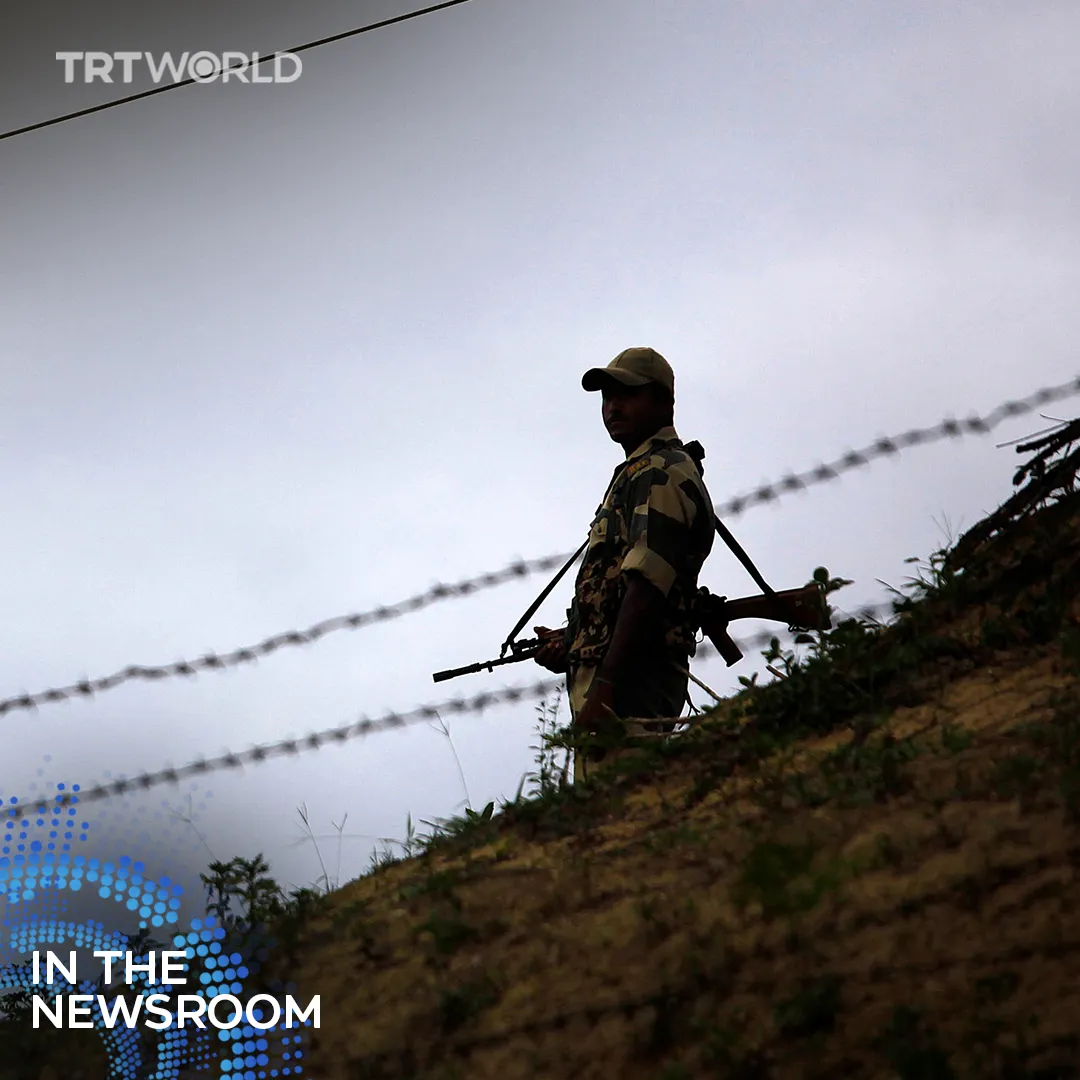
In recent weeks, India has established three new fully operational army garrisons close to the Bangladesh border around the strategic Silungiri corridor. Historically, New Delhi and Dhaka have maintained cordial ties since Bangladesh’s independence so what has caused this recent shift?
To help us make sense of the situation, I’m speaking to Umer Bin Ajmal, a producer at TRT World.
NASRA: welcome to the show, Umer.
UMER: Thanks for having me, Nasra.
NASRA Actually, welcome back because we've had you before for another episode.
UMER: Happy to be back.
NASRA: We'll go straight into it. Right now, there's heightened activity happening in India closer to Bangladesh. Can you tell us what is happening?
UMER: So what's happening right now, as we know that India and Bangladesh, the relationship between the two countries have, has historically, been very friendly. India played a major role in Bangladesh's independence in 1971, and, and since then, the two countries have generally maintained very close ties.
But the situation dramatically changed after last year's student-led uprising, the so-called July Revolution. So which toppled Sheikh Hasina's government, who is in India, Hasina was long seen as New Delhi's ally, and the new interim leader, Nobel laureate Muhammad Yunus, started to engage with Beijing and Islamabad, the two rivals of India.
NASRA: Initially the interim leader of Bangladesh Muhammad Yunus, seemed to paint a positive picture of their relationship with India.
YUNUS: We always insisted right from day one our relationship with India is the best relationship ever because our fate and India’s fate is tied together, we cannot isolate from each other so we are always encouraging everything to happen in the best possible way. But somehow there is a kind of cloud on certain issues
NASRA: So did the stance change as Sheikh Hasina continued to stay in India?
UMER: Because Bangladesh revolted Hasina. Hasina was close to India and that was the country she fled to. And, and during the uprising, even during the uprising, India has a very, strong, stance against, this revolution staunchly backing Hasina. And since the uprising, since the new dispensation has come to the fore in Bangladesh, we have seen that India has adopted quite an aggressive stance toward Bangladesh. I mean Indian media has been quite like, churning negative stories about whatever is going on and what they have actually gone as far as to call, the students who led the revolution as extremist elements.
So definitely, Yunus engaging with Beijing in Islamabad unsettled New Delhi. It also marked the first time in decades that Dhaka appeared to be stepping out of India's shadow and courting India's key regional rivals.
NASRA: So what has India done now?
UMER: So what's happening now, what we are seeing is a military buildup by India near the Siliguri corridor.
NASRA: Just before you go on, tell us what the Siliguri corridor is
UMER: It's often called India's chicken's neck. And why is it called that is because it's this incredibly narrow stretch of land. 170 kilometres long, about 80 kilometres wide, but at its narrowest path, it's just 22 kilometres wide. And if you stand, at that point, at its narrowest point, from the Bangladeshi side, of course, you're bordering India, but across, you can see Nepal.
NASRA: It's interesting. When I read that it's called the chicken's neck, I had to go back and look at the map, and it does look like a chicken's neck. you cannot unsee the chicken after that.
UMER: So it's a lifeline for India's northeast. Every road, rail, and even military supply route to the region passes through this thin strip, and it connects India's northern West Bengal side to its other northeastern states, to the mainland.
So to the north is Nepal, to the south is Bangladesh, and to the east, Bhutan and China. So you can imagine how vulnerable that makes it. So if, let's say if the corridor were ever cut off, India's entire northeast could be isolated. That's why it's considered one of India's most critical strategic choke points.
UMER: So over the past several weeks, India has established 3 new army garrisons. So if I may just talk about those regions. So in Assam, it's an Indian state, it's one of Assam's districts, one in Bihar, and one in West Bengal. So these are all close to, all 3 are close to Bangladesh border. And crucially, all of them are near Siliguri corridor, the close to the chicken's neck, or at the chicken snack. So this came just as the Indian Air Force held a massive air show in Guwahati earlier this week. Officially, they said that they're marking their ninety-third anniversary, but strategically, this time, this timing and location sent a message. So these moves coincide with Bangladesh's shifting alignments. Yunus's comments in Beijing earlier this year that that described India's northeast as landlocked…
YUNUS: The seven states of India eastern part of India called Seven Sisters they are landlock country… landlocked region of India they have no way to reach out to the ocean we are the only guardian of the ocean for all this region so this opens up a huge possibility so this could be an extension of the Chinese economy
UMER: …and his meeting with Pakistan's military chief just recently, where apparently gifted a book which allegedly displayed parts of India's northeast as Greater Bangladesh, both stirred massive outrage in India.
So what we are seeing is India, moving from quiet observation to visible readiness we can say, to secure the corridor and signal that, you know, that they're watching the eastern front and they're not ignoring it.
NASRA: What are the experts in the region saying about these developments?
UMER: So they describe this as a, on, on India's part, they describe it as a shift from ambiguity to readiness, because for so long, India was very ambiguous about its eastern front. A senior Indian security official told the Week, it's a weekly news magazine that, goal for India is to, and I quote, eliminate vulnerabilities and provide multiple rapid response options, unquote, for India's Eastern Command. Experts are interpreting the buildup, not sort of as a reaction to immediate threats, but as a part of long-term strategy. So they say that India's aim is to ensure that it can mobilise fast if let's say the regional equation changes, So Nasra, it could be about provocation, it could be about preparedness. I think the only way we would know if we're gonna keep watching it closely.
NASRA: When you look at what's happening now, it calls back to a time, it was in the 1960s, I believe 1962.
UMER: The first Indo-Sino War.
NASRA: Yes, So whatever is happening now has some people thinking back that time when India and China went to war. A key trigger back then was India giving asylum to the Dalai Lama after the Tibetan uprising. China saw that as a direct challenge, tensions built for years, and eventually it boiled over into the Indo-China War.
So when you fast-forward to today and now we have Sheikh Hasina has taken refuge in India once again India is hosting a politically sensitive figure with regional consequences. What are the parallels we're seeing here?
UMER: I think some similarities are definitely there with Hasina being in India. But I wouldn't call it that India it's gonna be fearing something like that could happen. But there is rather one major exception I would say in this, in this situation that between Bangladesh and India, there are no territorial disputes, but you never know, there could be.
I think militarily, India is too big a power. So I don't think they would be afraid, but rather, they could initiate something. But at this point, I think it's just a speculation. But yeah, definitely setting up of military garrisons so close to the border does point to something. But I wouldn't think that Bangladesh would escalate it to, to such a length, or they would go to such a length that, you know, to start something.
NASRA: Even with China’s support?
UMER: Look, it's, Bangladesh is, is an independent country or one can't just rely on support from big regional powers to carry out their own if I may just put it very plainly, I don't think this is how regional rivalries work. China can, can get influence, can, can poke India. But t's very hard to tell. And, and for so long, Bangladesh has been, had been under India's influence. So I think the safest way would be to find a diplomatic solution to this. But as I said, I think it's just speculation as of now. So, it's, it's an interesting situation that's developing and definitely worrisome. But it's too early to say if it can, if it would go to a war or to a military, military escalation.
NASRA: What are local communities saying about this?
UMER: Official narratives, on part of India, they emphasise security. The Indian Army portrayed these new garrisons as a stabilising measure. But so far what we know that there isn't much detailed local reporting yet within Assam or North Bengal about how residents actually feel. But based on past patterns in, in border regions, reactions are often mixed. Some people feel safer, let's say, they, they're gonna say that, you know, we feel safe because the military garrisons are here and we don't need to worry about anything, while others, Maybe farmers or traders who depend on informal cross-border movement, they may find daily life becoming more restricted. So, while in part of India or on part of Bangladesh, the intention could be of reassurance, the ground realities might be more complex. So that's, I would say that that's an area where future local reporting will really matter for sure.
NASRA: Have you heard about anything from the Bangladeshi side?
UMER I mean, that's, overall, the situation in Bangladesh, that's, that's, one of the biggest strategic concerns for India. But what we are seeing, through Bangladeshi media, like they're also playing up the presence of Indian military garrisons. But then, there are some old military facilities from the Second World War era, they are being upgraded by China. They're installing radars and stuff. So something is going on, definitely that has provoked a reaction. But as I said, why Bangladesh is becoming a strategic concern for India is because China has recently, of late, also become a major player in Bangladesh's economy. Like they're, as, as I said, they're upgrading ports, power projects, and reportedly assisting with radar systems at an airbase just across one of India's new garrisons.
So, and when you add to that, Pakistan's rare naval visit to Dhaka earlier this week, it was the first since 1971, when Bangladesh attained its independence. So starts to look like a subtle but meaningful, let's say, realignment.
So from New Delhi's point of view, I would think that the worry isn't, just to Bangladesh's actions, but who Bangladesh is partnering with, it would be fair to say that India feels like it is a slow encirclement, a kind of squeeze from the east, and which explains this building of new garrisons just close to the border.
NASRA: Most of what we've discussed is more militarily or security wise. Are we seeing a similar shift economically? In the region. And could this be a driving factor?
UMER: Like right now, the region is facing quite difficulties economically. But for, for like a good time, for so many years, Bangladesh was rising, was a rising star in the region, was growing at a great rate, but then they had their, crises, various crises, economic crisis, energy crisis, and then they have, recently, they have this political crisis, so it has slowed down a bit. But I think the focus should be on economic recovery. And I think that's what the, the Yunus administration is also trying. And with the investment coming in from China and other partners or the sort of realignment. I think this is the idea. But it's, it's like work in progress, I would say.
NASRA: Tell us more about this realignment. How do these developments now tie to the larger South Asian strategic realignments beyond India, beyond Bangladesh, Nepal?
UMER: Exactly, Afghanistan. So we are witnessing a reshuffling of alliances across South Asia. So while Bangladesh is testing a more independent foreign policy out of the shadows of India. New Delhi is tightening its eastern defences, and, and China continues to expand its footprint through infrastructure and defence cooperation across the region. So, what it has done is it has forced India, to reinforce its ties with Bhutan and Nepal, and rethinking how it engages with the region as a whole, which we have seen that India is becoming more and more assertive, especially post 2014.
NASRA: What happened in 2014?
UMER: Narendra Modi got elected, riding on a wave of popular support, and then he secured a second term. And now well into his 3rd. India post 2014 which is becoming more aggressive. And it's not just with this military presence close to the border with Bangladesh.
We're also seeing the same with India's dealings with on their other fronts, such as the border with Pakistan. So, India has not, it has not stopped India from, making incursions inside Pakistani territory, which almost led to a, a huge war, which, as Donald Trump said that he brokered the ceasefire, so it was stopped, so, but, but it tells a great deal because, China is also becoming very assertive, not just in the region, but also, elsewhere in South China Sea, in its dealings with the other countries in the world, even with the US. So, so it's definitely, I think it's, it's very interesting, the way we are seeing the way geopolitics is shaping around us.
I couldn't help but thinking, just look at the Look at the map of South Asia. We have a problem between India and Pakistan, border problems. We have problems between India and China. So Pakistan, India, China are sort of next to each other, then we are now seeing problems between Bangladesh and India. And if you move a further west from India. You can see there are problems between Pakistan and Afghanistan as well. So Afghanistan, Pakistan, China, Bangladesh. They're all like disputing borders and there are a lot of tensions there.
So on coming back to the Bangladesh-India border thing, I think over the next few months, 3 things are worth watching. any new defence infrastructure deals between China and Bangladesh, that's, of course, gonna be very telling. , or number 2, if there are further Indian troop movements, or exercises in the northeast. And number 3 is political developments in Bangladesh. They're going to have the elections soon. And because shifts in Dhaka tend to ripple outward across the subcontinent. And we know that India has a soft corner for Hasina and Bangladeshis right now don't like Hasina.
NASRA: We always hope for the best, but we'll have our eye out for whatever's gonna come. Thank you for coming on the show.
UMER: Most welcome. Thank you.
The Siliguri Corridor remains one of India’s most sensitive choke points, and once again it’s under pressure. The recent developments really point to a wider regional unease as the political landscape shifts.
As Umer points out, the coming months will be critical. How these dynamics unfold, across security, diplomacy, and domestic politics, will be closely watched by policymakers, analysts, and communities on the ground who feel the impact first.
CREDITS