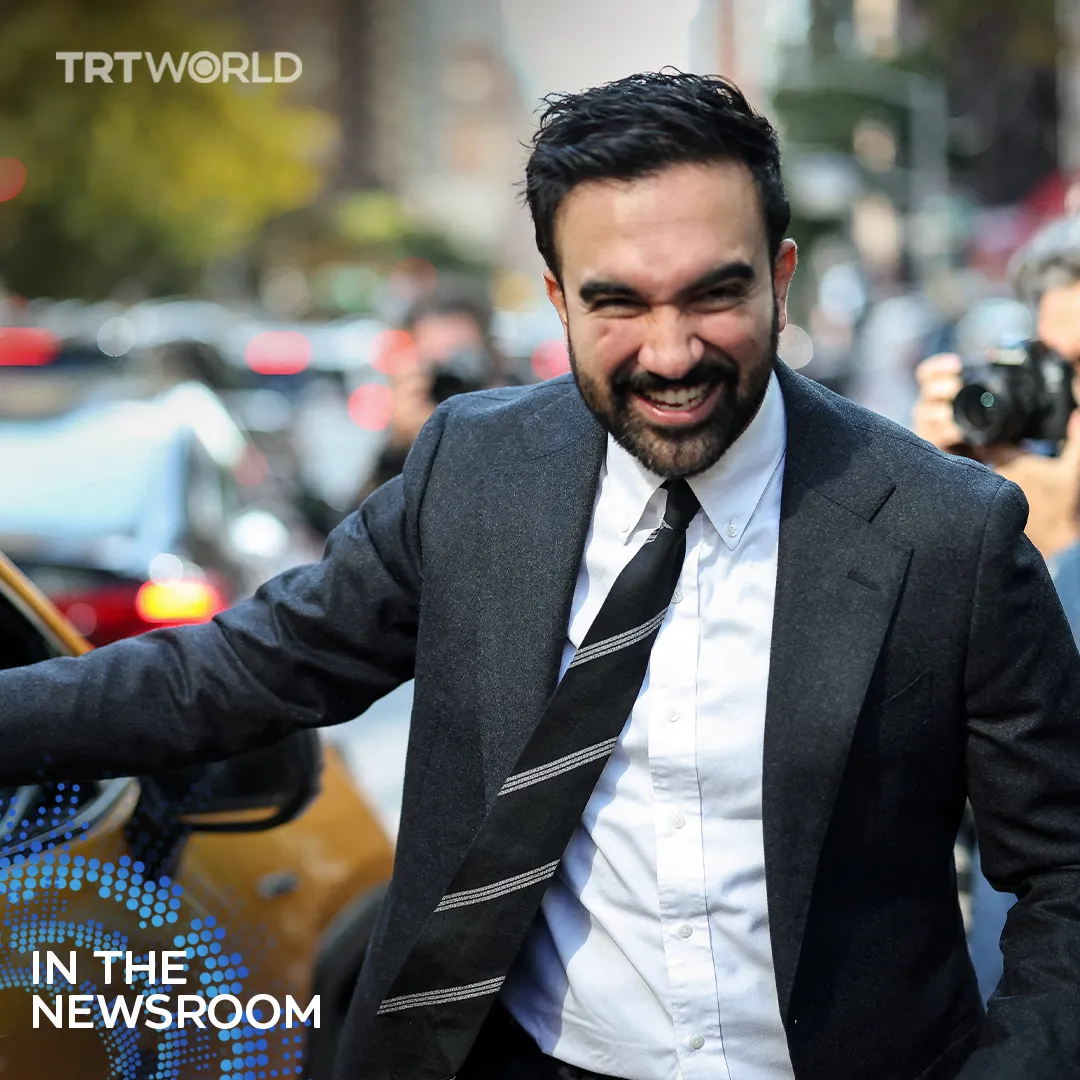
Host/Producer: Ezgi Toper
Guest: Mikail Malik
Craft Editor: Nasrullah Yilmaz
Production Team: Afzal Ahmed, Ahmet Ziya Gumus, Mucteba Samil Olmez, Khaled Selim
Executive Producer: Nasra Omar Bwana
TRANSCRIPT
MIKAIL: I think if you put 50 other House Democrats in exactly Zohran Mamdani's position, like the snazzy digital team and the videos. I don't think it would make much of a difference. It's his personal style, his charisma, his insane communication skills, his ability to stay on message. His opponents have tried to strawman him or bring him into a more politicised discussion, he goes right back to his message, which is affordability. And I think his ability to do so it has made him kind of like a once-in-a-generation type of candidate.
EZGI: You’re listening to “In the Newsroom”, and I’m Ezgi Toper. In this podcast, we have conversations with colleagues and experts that go beyond the headlines.
The New York City mayoral election is just days away, on November 4th, and it’s already shaping up to be one of the most talked-about races in recent memory. At the centre of the spotlight is Zohran Mamdani, the 34-year-old Democratic nominee who’s made history as the first Muslim to secure his party’s ticket for mayor.
MAMDANI: I will be your Democratic nominee for the mayor of New York City! (cheers)
EZGI: Mamdani’s victory in the Democratic primary was historic: he defeated a field of established politicians, including former governor Andrew Cuomo.
So how did Mamdani go from outsider to front-runner, and what does his rise tell us about the future of political leadership? To unpack that, I’m joined by Mikail Malik, a producer at TRT World who has been following the race closely and watching Mamdani’s historic campaign unfold.
MIKAIL: What drew me very closely to this campaign was one that this was a South Asian candidate, someone who looked like me, sounded like me, had a similar story as me. So seeing a candidate like him, you know, break through, in a campaign for the one of the largest cities in the world where it's such a diverse city was extremely compelling, and seeing him do it in such an authentic way, was really refreshing, and it made me very, very interested to see what, a candidate like him can do in a political scene like New York City.
EZGI: So what do you think has made his message resonate so strongly with New Yorkers, especially younger and more progressive voters?
MIKAIL Yeah, that's a great question Ezgi, and you know what the first thing I think about is Gen Z as a demographic is drowning, you know, they're, they're among the highest average personal debt in the US. Many cannot afford a home and are suffering from rent prices that they cannot afford anymore, and credit traps from their education, paying for university, and etc. So that happening simultaneously with the fact that young people are also more likely to consume information from social media has kind of led to this Mamdani effect, where he has been able to speak to young people in a way that more establishment politicians like Cuomo, like Eric Adams, haven't been able to form that connection. He's able to speak to the fact that rent prices, grocery prices are the main issues affecting young people in a city like New York, and with the establishment politicians, they've been talking about reducing the cost of living, but nothing has happened. And so this new, fresh candidate gives young people some semblance of hope that maybe this time is different.
EZGI: How do you think his background also shapes his political identity and appeal, you know, being the son of Uganda-India immigrants, how does that all factor into that charisma, like you were saying?
MIKAIL: I was reading an article recently that did a profile of Mamdani, and he said that in Uganda I was Indian, in India I was Muslim, and in New York, I'm all of those things. And I think that kind of encapsulates how he's used his identity and his background, as the strength because New York is such a diverse city, it has people from all walks of life, and he's capitalised that through his content, you know, posting in Urdu, Hindi, Spanish, even a bangla, to the Bangladeshi community, aimed at immigrant communities that are often overlooked:
MIKAIL: And I think he, his background also as a, a child of professor of a mother who made films about, Indian diaspora communities I think that that's had a huge, huge impact on his worldview and the mere fact that his middle name is, after a Ghanaian revolutionary, you know, so he brings so many different aspects of identity that really represents the city, an immigrant, but also someone who's really grounded in global justice movements, that New York so often tries to emulate.
EZGI: Mamdani’s mother is acclaimed film director Mira Nair, known for “Mississippi Masala” and “Queen of Katwe.” His father, Mahmood Mamdani, is a prominent scholar and professor of government, anthropology, political science, and African studies. So Mamdani has brought his immigrant experience, his family’s intellectual and artistic background, and his own public service, from working as a foreclosure prevention counsellor to serving as a state assemblyman, into the spotlight.
MIKAIL: If you look at his website, if you look at the content he's posting. The branding isn't necessarily blue like the Democrats or red, like the Republicans, it's this really interesting like colourful, almost like cobalt, gold, colouring inspired by like New York City's bodegas and signages and Bollywood posters, and it's really just been in a very unique sort of campaign where if you were just watching from afar, you wouldn't know necessarily think this guy is, the Democratic nominee because he's really created an entire brand, for himself that's leaning into his identity instead of, you know, shying away and being a bit afraid that, oh, I wasn't born in the United States. He's instead said that the fact that I'm not born in the United States, the fact that I'm someone, a son of immigrants, someone who's, you know, seen a lot of different cultures exist in the city, that's my strength. And even before entering as an assemblyman, Mamdani worked as a foreclosure prevention counsellor in Queens, helping low-income owners avoid eviction. So that kind of that path that he's been on really fits in what his message is today, which is affordability, and I think it's one of those rare candidates where he's been able to leverage his identity in a way that his opponents aren't able to, you know, be like, you're not an American.
EZGI: So you bring up affordability. Let's dig, let's let's dig deeper into his campaign. What does he want to actually change in New York? What is his vision for the city?
MIKAIL: Yeah, so let's just create some context first. So in 1970, the average house cost was 2 to 3 times the average annual income. Today it's 7 to 9 times. And Mamdani's come out and he said, we're going to create 200,000 affordable homes by 2030. We're gonna make sure that your landlords aren't screwing you over with the rent prices, and we're also gonna make sure our public transport system is way more efficient. Our buses are gonna be faster, they're gonna be free.
MIKAIL: So I think his focus on affordability is very interesting because it is similar to this Trumpism as well, because, like the Trump side of politics, is very populist. Similarly, Mamdani is a populist, but instead of using immigration or blaming certain communities or certain factors for those issues. Mamdani's focusing more on a structural issues campaign about redistributing the wealth. He says he wants to get the top 1% of New Yorkers to pay their fair share of taxes. Really, really popular ideas that Bernie Sanders and Alexandria Ocasio-Cortez have also championed, but I think Mamdani's ability to talk about the American dream the same way you have the Trump is also talking about the American dream. And doing it in a way that says we're gonna make sure you can afford a home, you can afford public transport, that your rent is not gonna make you choose between a dinner or like school materials for your children. So those types of ideas he's leaned into them in a way that's more pragmatic and has decided that instead of, instead of following the Democratic Party establishment's cues, which is let's tone it down, let's be more moderate, let's try to be more centre. Mamdani said the response to Trump needs to be politics of almost left-wing populism and leftist politics, and I think it's shown that that is the way the Democratic Party should move because Mamdani's success from someone who had 300 volunteers to now having millions of people knocking on doors. And becoming the Democratic nominee, defeating a politician as established as Cuomo as much as he is disgraced, but still, like the fact that Mamdani came in and was able to cause such a political earthquake shows that those ideas have a lot of popularity within the Democratic Party.
EZGI: But it’s his online strategy, multilingual content, memes, and influencer engagement, that has captured national attention, helping him mobilise younger voters and communities often overlooked by traditional campaigns.
EZGI: So when we look at the way that he has used social media to connect directly with these young voters, how do you kind of view that digital strategy and how it kind of helped him rise to this position of popularity?
MIKAIL: I think that if you put 100 other House Democrats in those videos. It would not have the same effect. It does not matter how snazzy your videos are. It's the person behind it. It's the messaging, and Mamdani is an exceptional orator. He has the ability to unpack complex topics in a very, very dynamic way. And you know, just with one week less than one week to go until election day, Mamdani has now just did a press conference with a bunch of content creators, at his campaign headquarters and basically allowing these influencers to asking questions about his campaign promises and whatever, and more than 70 of these content creators came all across Twitch, YouTube, Instagram, TikTok, with a combined audience of 77 million people. You know, he's been able to…
EZGI: Crazy.
MIKAIL: It's unbelievable. It's unbelievable. And it's interesting because Mamdani is not the only one doing this. If you look at the Trump administration and Karoline Leavitt's press conferences, she's inviting, you know, these MAGA influencers and, and they're doing a lot of these like engagements with influencers online because mainstream media has kind of been like upended by this, the growth of like podcast journalism, citizen journalism, where a lot more eyeballs are going on to those and Mamdani has been able to capitalise that on a way that maybe Kamala Harris tried but failed with Kamala Harris with the brat movement.
EZGI: Mikail brings up the “Brat movement”, a Gen Z–driven internet and cultural trend that emerged in 2024. Originated from American artist Charli XCX’s album, whose neon-green aesthetic and messy honesty resonated deeply with young people. But when Harris’s campaign tried to tap into that energy in their branding, it came across as forced and failed to resonate with the younger voters.
MIKAIL: And it makes you see how it didn't matter, it doesn't matter how great your digital team is, because Harris wasn't able to succeed, and Mamdani has been able to succeed because he's authentic and he speaks and he has this energy, and you know, a smile can go a long way. He's got a good smile, and people are really drawn to him as a human being, because what they see in him is like a kind person and a pathetic person, a compassionate person.
MIKAIL: I saw one of his videos about halalflation…
MAMDANI: New York is suffering from a crisis, and it’s called Halalflation (eats). Today we’re going to get to the bottom of this.
MIKAIL: Or the scavenger hunt that got 2 million views.
REPORTER: Thousands of Zohran Mamdani supporters took to the streets on Sunday. They were taking part in a scavenger hunt. The hunt was part walking tour, part history lesson with clues leading to landmarks named after former New York City mayors.
MIKAIL: You know, he's, he's found a way to kind of create, to talk about these really, really big issues that are difficult to discuss, but in a more meme and like very, almost a lighthearted way, and that's really brought in Gen Z in a way that no other candidate has. I mean, he's, he's leading up with people under the age of 45, so I think his digital strategy is fantastic, but without his personality, it would be like it would make no difference.
EZGI: So, when we look at this kind of rise that Mamdani is experiencing right now, what do you think that tells us about the greater generational shift in how young people are seeing power and leadership today?
MIKAIL: Yeah, that's a great question because just 16% of young people believe democracy is working well for them, and trust in political parties and other institutions is an all-time low. So candidates like Mamdani, who are challenging the status quo, rather than trying to emulate it, are becoming extremely attractive. And I think his movement really is a symptom of a more general type of disgust with a risk-averse democratic establishment. Like, just think about Chuck Schumer, a leader of the Democratic Party. He's straight up refusing to endorse the Democratic nominee for New York City's mayor, and the opponent is an alleged serial sexual abuser funded by Trump's billionaire friends. So it's a very interesting shift that's happening, and Mamdani represents this new brand of authenticity, of courage, which doesn't really exist much in politics these days. Cuomo often says Mamdani has no experience, but I think in this generation, and in the Gen Z's generation, it's more about whether you're real, if you're accessible, and whether you're accountable, and Mamdani kind of checks all those boxes.
EZGI: His rise to popularity has also made him a threat. Mamdani’s faith and immigrant background have become recurring targets, particularly from his opponents on the right, and even from some within his own party.
Current mayor of New York, Eric Adams, referred to Mamdani as “the communist” and linked him to so-called “Islamic extremism.”
ERIC ADAMS: Am I angry that I’m not the one taking down Zohran the socialist and the communist? You’re darn right I am.
EZGI: And Cuomo called him a “terrorist sympathiser” and even said Mamdani would “cheer” another 9/11 attack in a radio interview that went viral:
RADIO HOST: Any given morning, there’s a crisis, and people’s lives are at stake. God forbid another 9/11. Can you imagine Mamdani at the seat and…
CUOMO: I could. He’d be cheering (laughter).
EZGI: Do you think that these kinds of attacks are still working in shaping voter perception?
MIKAIL: The ads that Cuomo put out of him, you know, darkening his beard, making him look more, more scary. It's been an attack and a smear campaign that I think no other religious or racial group would tolerate, and I don't think the politics at large would tolerate it. But unfortunately, we live in a world where one of the most normalised forms of bigotry and discrimination is still anti-Muslim hate, but I think a city like New York City, if this was a national election, I would say that those attacks would probably have more currency. But in an election with like New York, the city is traditionally extremely Democrat. They're a very, very liberal city. They are not accustomed to the type of ad hominem attacks that the Trump type of politician lays out.
MAMDANI: This is all the Republican party has to offer: cheap jokes about Islamophobia so as to not have to recognise what people are living through. Attempts to pit people’s humanity against each other. And I think, whether it’s JD Vance or it's Andrew Cuomo, it is the same kind of politics. It’s the politics of division.
MIKAIL: I think New Yorkers, especially younger voters are allergic to that kind of like dog whistle politics now that it's like a lazy form of politics and it kind of reads of desperation, because if anything it made Mamdani's campaign stronger, people rallied around him even more, and Mamdani has been so eloquent in his ability to respond to those attacks that he has instead of, instead of, you know, turning it into I'm a victim, he's just gone right back to message which is affordability.
EZGI: Alongside terrorism and communism, much of the rhetoric against him has invoked anti-Israel sentiment. Wealthy donors, including Bill Ackman and Michael Bloomberg, have poured millions into anti-Mamdani Political Action Committees. But Mamdani framed this as proof that his movement challenges entrenched elites.
MIKAIL: You have that iconic moment during the first debate where every candidate for mayor is asked a question about what where their first foreign visit would be, and, almost every single one of them says Israel and Mamdani is one of the only candidates who says, I'm gonna stay in New York and I'm to respond to the concerns and needs of Jewish New Yorkers who are here. I don't need to go anywhere else.
HOST: Mr. Mamdani,
MAMDANI: I would stay in New York City. My plans are to address New Yorkers across the five boroughs and focus on that
MIKAIL: And I think that landed across the political spectrum. You had people like Tucker Carlson and Candace Owens backing that someone, someone who completely disagrees with Mamdani's economic, political positions, but they were able to be like, you know, that was the only person on the stage that said that they would be most interested in the people that they are set out to represent. So I think on one end, Mamdani's done a really great job of deflecting the Israel-Palestine issue to a concern that's not one of his as mayor, but at the same time he's been able to tie in themes of global justice, international law, and human rights by saying that those are values that New Yorkers believe in, and as a mayor, I'm going to support those values. But I think he's had to toe a very, very, like fine line when it comes to this because there's such a large and affluent population of Jewish New Yorkers and Zionist New Yorkers.
EZGI: Beyond ideology, one of the biggest critiques Mamdani faces is his lack of experience. At 34, he’s being painted by critics as too young, too idealistic, and untested to run a city as complex as New York. But his supporters argue that’s exactly what makes him compelling.
CUOMO: To put a person in this seat at that at this time with no experience is reckless and dangerous
MAMDANI: To Mr Cuomo, I have never had to resign in disgrace. I have never cut Medicaid. I have never stolen hundreds of millions of dollars from the MTA. I have never hounded the 13 women who credibly accused me of sexual harassment. I have never sued for their gynaecological records. And I have never done those things because I am not you, Mr Cuomo. And furthermore, the name is Mamdani. M A M D A N I. You should learn how to say.
MIKAIL: Whenever he's been criticised of his policies being too kind of idealistic, is that he says that he wants to try them and that if they, you know, kind of like a trial and error. But I think at the end of the day, Momdani is a 33 year old youngster who doesn't have experience running a city, and I think that that is ultimately a huge challenge that he'll face, when he, if, if he wins, because, you know, running a campaign is very different than when you, when, when you have to actually run the city and I think he'll have to negotiate and compromise a lot of his issues, which I think is a huge kind of part of this this movement right now is that a lot of people are so excited about Mamdani's policies, but I'm also a bit concerned that they're going to be a bit disappointed because a lot of the times when politicians come into power in this way, they end up moderating a lot of their positions and end up coming to a lot of compromise, and you already see that happening with Mamdani. He agreed to keep the same police chief as Eric Adams has, who's a billionaire, very, very politically connected to the elite. So you are already seeing Mamdani kind of shifting his positions, to get elected, and we don't know whether or not that's just Mamdani's tactic to get into power and to actually enact real positive change for New Yorkers. But unfortunately, this is the game of politics, and politicians are chameleons and they're always metamorphosing into different skeletons for different needs.
MIKAIL: I think the polls are suggesting that Mamdani will win. He set to do it. I just saw a poll pretty recently that he's down 8%. So he was at like he was in the over 90s, and now he's down to 82%. So I think also the last debate was a bit. Like Cuomo kind of got back on his feet, and I think that they were able to kind of attack Mamdani in a way that he was kind of you, it was 2 against 1 almost. So I think it'll be interesting to see whether or not this victory, if it's as comprehensive as it was back when he became the nominee.
EZGI: Win or lose, his campaign has already forced conversations about race, faith, and belonging in American politics, even as we're having right now. So what do you think his legacy will be for the future of leadership in cities around the world, even if he doesn't win?
MIKAIL: I think his legacy is gonna be that that the politics of radical love and empathy and compassion and positivity and authenticity can win big, and I think that is a message of hope to people from every corner of the globe is that that a man like Zohran Mamdani, born in Uganda, moved to the United States had a rapper career and and entered entered into, you know, domestic politics in the United States and then ended up as the Democratic nominee to the to the one of the most important cities on the planet. That's a story of hope. That's a story and, and for that, and that campaign be built on love, be built on empathy and caring for your neighbour, and not hatred and division and blaming immigrants or any other community for the issues facing your city. And I think it also shows how popular policies that are pro-people can be, because the other end of politics in the United States right now is divisive and polarised, and Mamdani's tried to respond to that with unity and reaching out to communities no matter what their race, color, creed, anything is. So I think regardless of whether he wins or loses, whether his politics makes it to the finish line. Mamdani will be a massive, massive figure in American politics for times to go. And I think we're gonna see a lot of politicians emulating his style of politics in the years to come as well.
EZGI: Thank you so much for joining me on the podcast, Mikail.
MIKAIL: Thank you, Ezgi, appreciate you having me.
EZGI: By building a movement rooted in authenticity, empathy, and digital engagement, Mamdani has shown that voters, especially younger generations, are demanding a new kind of leadership.
He has challenged entrenched power, redefined how campaigns connect with communities, and put issues like affordability, social justice, and inclusivity at the centre of the conversation. His rise is a reminder that politics can be about more than tradition and experience; it can be about heart, vision, and courage.
Thanks for tuning in. Until next time, I’m Ezgi Toper, and this was “In the Newsroom”.
[CREDITS]