Host/Producer: Ezgi Toper
Guest: John Kitime, Edward Qorro
Craft Editor: Nasrullah Yilmaz
Production Team: Afzal Ahmed, Ahmet Ziya Gumus, Mucteba Samil Olmez, Khaled Selim
Executive Producer: Nasra Omar Bwana
TRANSCRIPT
JOHN KITIME, HISTORIAN AND MUSICIAN: Music has always been side by side with politics. During colonialism, there were lots of songs that sang about “we should be free, we don't want the white men” and everything. And actually, the British government had to start what it called Ngoma Declaration in 1930. Just to make sure that the musicians wouldn't talk about the bad things about the government.
EZGI TOPER, HOST: You’re listening to “In the Newsroom” and I’m Ezgi Toper. In this podcast, we have conversations with colleagues and experts that go beyond the headlines.
Tanzania is gearing up for its general election on October 29th, with 17 candidates cleared by the Independent National Electoral Commission. The leading opposition parties have been barred from contesting.
CHADEMA, the leading opposition party was disqualified in April for failing to sign the electoral code of conduct, and its leader, Tundu Lissu, faces treason charges for declaring, “no reforms, no election.”
Another presidential candidate, Luhaga Mpeena of ACT-Wazalendo, also had his forms rejected.
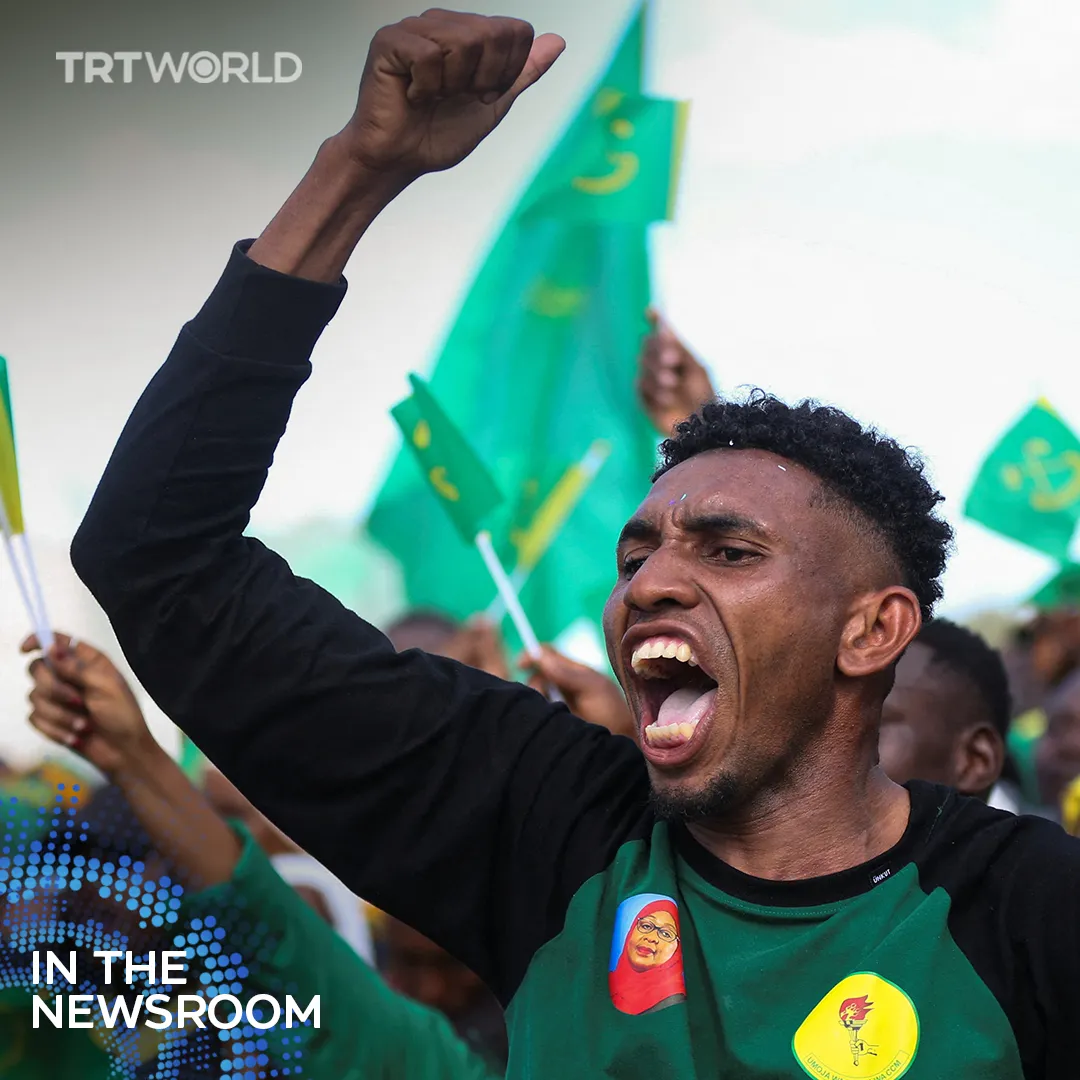
Underneath all of this lies another story: music. In Tanzania, the rhythm of politics has always been set to music, from liberation songs of the independence struggle to today’s campaign jingles being played at rallies. So, as the country prepares for another election, the question remains: who sets the beat? The people or the politicians?
To help us make sense of the political landscape and the role of music, we spoke with John Kitime, historian and musician, and Edward Qorro, a Senior Editor at TRT Afrika Swahili. Edward explains the current state of music and politics with the upcoming elections.
EDWARD QORRO, JOURNALIST: Music continues to garner a lot, a lot of influence in the political arena at the moment and as I told you, as we speak now, there's a big contingent of artists who are tagging along with the ruling party. You know, they've been traversing with the presidential candidate all through. Somebody like Diamond. I'm sure you've seen him featuring in all the CCM campaigns.
EZGI: CCM is Tanzania’s ruling party. It is the second longest-governing party in the history of Africa. It remains the dominant force in the country’s politics and is led by President Samia Suluhu Hassan.
We also have other small artists here who have been taking along President Samira Suluhu’s presidential entourage. So I think the politicians know that these artists have massive following so they can not just afford to lose this following, so that’s why they choose to tag along these artists. But it's not just this year. It's been happening as back as 2005, I think, during Jakaya Kikwete's era, I think so because I don't remember seeing Mkapa tagging along these artists, but as far as I know it started with Jakaya Kikwete.
But before that, the ruling party had its own band called Tanzania One theatre Tot. Tot used to be a mouthpiece of the ruling party. I remember growing up listening to that band. My dad also had a number of cassettes because my dad is of CCM. So I remember seeing those cassettes when we used to have those radio cassettes at home. It would be so common to see those. But I think that group was lastly used in the 2000 general election, the second term, Benjamin Benjamin Mkapa's second term.
EZGI: Many of the high-profile celebrities appearing at campaign rallies, particularly those supporting the incumbent president’s party, are Bongo Flava artists. But what exactly is Bongo Flava? Our second guest John Kitime explains.
JOHN: Bongo flavour is many things. The word bongo flavour started being used, I think in the late, early 2000s or late 2000, and basically it was used for any music that was recorded by the younger generation, the new generation musicians at that time. And it was mostly studio music, I mean the background was mostly studio, not, not like instruments, and that's basically it was Bongo Flava and it was just so many things. Anything that could be played could be reggae, could be whatever, and they're just calling it bongo flavour. But mostly it's sung in Kiswahili. That's the common factor in all the Bongo Flava songs is Kiswahili.
EZGI: The name “Bongo Flava” literally means “Flavor of Bongo,” with “Bongo” being a slang term for Tanzania. When Bongo Flava emerged it quickly became the voice of Tanzanian youth, addressing everyday life, social issues, love, and politics in catchy and relatable ways. But music in Tanzania’s political space predates Bongo Flava.
EDWARD: It goes back as late as during the liberation struggle. Music played a very crucial role during those times. I remember when Mwalimu Nyerere and other Freedom fighters were fighting for the country's independence. They used to involve musicians. Back then, we did not have Bongo Flava. We had more of orchestra bands. I'm talking of bands like Juwata Jazz, the old, old musicians.
They would actually sing in different languages. I've known of songs done in Portuguese when Tanzania used to be the chairperson of fore front countries fighting for Africa's liberation struggle. So, Tanzania was the chairperson of that particular group. So the musicians back then they would compose songs to, you know, to, to advocate for freedom and independence in the countries like Zimbabwe, Zambia, South Africa itself, Mozambique, Angola, the rest of SADC region. So music played a very, very crucial and instrumental role.
EZGI: In the 1960s, under President Julius Nyerere, Tanzania became a safe haven and training ground for freedom fighters from across the continent, including movements for countries in Southern African. Dar es Salaam served as a hub for liberation organisations and exiled leaders, earning Tanzania a reputation as the “cradle of African liberation.”
JOHN: Before independence, even before independence, there was this movement to have all of Africa be free. There were organisations like Puffmaker, it was an organisation of leaders from all over Africa trying to work out so that all Africa would be free. There was even a move in the beginning that Tanzania should postpone its elections so that they can all be in line with Kenya and Uganda and then try to form with the idea of having East African one country dream.
But then in the end, when Tanzania became independent, right from the early 60s, it started in one way or the other, helping all the other neighbouring countries to be free. And musically, thousands of songs were made playing by the bands, by school choirs, by village choirs. And then that also came because in schools we were taught about this liberation, we were taught about this, so it was easier for people. Even the villages, in school villages, they knew about that and they could make songs about it. Unfortunately, it's now all forgotten. It's forgotten by the Tanzanians. It's forgotten by the countries that were liberated.
EZGI: After independence, Julius Nyerere, Tanzania’s first president and prime minister saw the power of music as a unifying force. State-sponsored choirs and cultural troupes were created to spread the message of Ujamaa: Tanzania’s socialist vision of collective development.
JOHN: In the middle of the 60s, I think 1967, we are running a socialist policy, Ujamaa policy, and we had a one-party state. So most of the direction of the music about the singing, political singing was very straightforward that you have to mostly singing about the party. They used to be some strong singers who would sing exactly what they thought and some would sing straight to the president's face. So there were some guys singing out here and there singing what they really thought and not just singing the songs as the party wanted them to sing. But then when there was one party state, I think thousands of songs were made of different subjects, praising the party, praising the Ujamaa policy and these songs right from the village level to the national level.
EZGI: The 1990s marked a turning point for Tanzania. As the country moved away from Julius Nyerere’s socialist Ujamaa policies, it embraced political liberation and economic reform. This shift opened up space not only for multiparty politics but also for artistic expression. Musicians, no longer bound by the ideals of collective identity promoted under Ujamaa, began exploring more individual and urban sounds.
JOHN: And Bongo Flava actually became famous after the introduction of the private radio stations in the early 90s. For us who are musicians playing the live music, that was the end of live music because what happens is that when the new radio stations came, they said they couldn't couldn't play in the stations the Tanzanian music because it was badly recorded. So, they started playing mostly foreign music. And in African foreign music was mostly the Congolese foreign music. And actually in the early 90s you had Congolese three or four big bands, Congolese bands, being around in the country playing and performing almost every month. So, and because they were not playing the Tanzanian songs and they were playing foreign music. Tanzanian artists at that time, the young artists at the time, started using the foreign music and putting the Kiswahili words in it and that's how the Bongo Flava was sort of born.
EZGI: By the late 1990s and early 2000s, Tanzania’s music and the country in general was finding its footing in a new political and economic reality. As the country moved further into an era of liberalisation, musicians began to play a more visible role beyond entertainment, stepping onto the political stage themselves, using their influence to shape public discourse and even joining party politics.
EDWARD: Some musicians who have crossed over from music to become politicians. Somebody like Mr. Tu. Somebody like Professor Jay, you know, he's a household name in East Africa. He used to do Bongo Flava, and then he joined politics. He became an MP and from the opposition party. And though he did not win last year's election but he's still doing politics so he's actually doing both at the same time.
EZGI: Others from the music and entertainment industry also made their way into politics. Among them was rapper Hamis Mwinjuma, also known as Mwana FA. But it didn’t stop with musicians, radio presenter Amina Chifupa and Babu Tale, the co-founder of the WCB music label, also entered the political arena, eventually becoming Members of Parliament. With artists stepping directly into politics, it raised an important question: music has always had the power to sway hearts and minds, but is the kind of singing we see today the same as it was in the past?
JOHN: No, it's a bit different. I think it's a bit different. One: during the Ujamaa period, there are really people singing not for the money of it, but for the real belief of the policy. Now, most of the songs people sing thinking about the financial gains they're going to get there. You know, it's not really coming from the heart. That's a huge difference. And there's the new, what they call uchawa, these are like praise singers. They've always been praise singers in African history. But then sometimes you find this is crazy because these guys are just – the praise singing is getting too much.
In the 70s - 80s, the government would want to talk about something. They would give out either some written notes of what explaining to you what it was. For example, there was a problem in harvesting of cloves in Zanzibar, and so the Zanzibari government hired our band to go there and go around different village trying to teach the people to go back to the old ways of harvesting cloves, but then we had to go into a seminar or a class to be taught. What it was and so we could make songs that would fit what we're told. So it was something to do with the government, but then we, we were we're given some information about it and so we sing about it. But now you just sing, it's like somebody's just singing, something that would sound good to the guy singing about praise singing, mostly they call it.
EZGI: A majority of recent political songs in Tanzania lean heavily toward praising the current leadership, highlighting achievements across sectors like infrastructure, education, healthcare, and labour. A notable example is Harmonize’s 34-minute album Muziki wa Samia, in which all nine tracks celebrate President Samia Suluhu and her administration.
Reactions online, however, are mixed. While some fans welcome the tribute, others express disappointment at the overtly flattering tone. As Kitime points out, commercial considerations play a major role in shaping this kind of content, influencing artists as much as politics does.
JOHN: Mostly the benefits are that they make money. That's one of the benefits. So if you're in a good part, you could get your – I know there's some bands that will only survive that have started just because of the elections, and they're now going all over the country. But as soon as the elections are over, that will be over with those bands, at least I know a band or two, and I know artists who are now travelling all over the country with candidates and so they're making money. That's the benefits, but there’s a fear that singing for the opposition might not be the best idea.
For example, the CCM has got a huge budget, so it has got lots of musicians going around singing. And then you have, I think, the other parties that don't have such big budgets. So some of them would just have a choir, maybe in the village or something, not something really big. And then I think also the big artists like sitting on the fence and saying, “oh, if I sing for the opposition and if the ruling party wins, this might be a problem for me.” Yeah, so there are very few, for example, artists who have really come out and then said something from the opposition or made songs from the opposition, but mostly, almost everybody is on the ruling party.
EZGI: Over the years, some Tanzanian musicians have faced bans or censorship for songs considered too critical of the authorities. Others have been detained, while many have opted for self-censorship to navigate the country’s regulations, notable examples include Nay wa Mitego and Roma Mkatoliki. But how is music and the arts formerly regulated to align with Tanzania’s national vision? Edward sheds light on the role of BASATA, the government body currently overseeing the industry.
EDWARD: So basically BASATA stands for “Baraza la Sanaa Tanzania” or “Bara la Sanaa Taifa”. It's a National Arts Council, so it’s merely charged with regulating the arts industry in the country. So it's a regulator in the same way as having many mobile phone companies, but eventually you have a, you have an, a body that is mandated to regulate those companies. So, basically its main responsibility is to check the kind of work that these artists release, if it's up to standard, if it meets the required criteria and prerequisite if it is par with Tanzanians culture and tradition. Yes, so we've had a number of cases where some artists have been summoned by BASATA because their work left out much to be desired. Yes, yes, but its main role is charged with arts. That’s it.
EZGI: Researchers argue that many of the policies shaping post-colonial societies today are, in fact, colonial legacies. The case of BASATA, for example, can be traced back to earlier regulatory frameworks, including the Ngoma Declaration, a point Kitime highlighted:
JOHN: The British government had to start what it called Ngoma Declaration in 1930. Just to make sure that the musicians or the ngoma at that time most of the music was mostly Ngomas would talk about, wouldn't talk about the bad things about the government, something, something like that, yeah. So it's always been there and. And when we got our independence, this Ngoma declaration did not go away because you had to get a permit to hold any kind of an event. In particular, in Ngoma, you had to get from whatever maybe the local government or the local society, they were responsible for seeing that you're talking, you're not breaking the rule or you're talking what is supposed to be talked about.
And so at first we're all against the colonialists, but then after independence, of course people started getting disappointed. And the way, there was, I know there was one person who was one musician was imprisoned in Mwanza in early 1963 for singing something about his district commissioner that he had grown fat since he became a district commissioner or something like that, you know, the same, they were complaining that we took out the European thinking the African brothers would come and help us, but we're just getting fat. So that was as early as 1963.
EZGI: Another noticeable change is in the lyrics themselves. Researchers suggest this shift is driven largely by commercialisation, with artists increasingly making songs that sell rather than reflect deeper social or political commentary.
JOHN: It looks like a huge biggest percent of the music compositions talk about just love and lifestyle and And actually not love, but more about like sex rather than love. So, very, very few songs, if ever, that ever talk about anything political. Yeah, so most of the music is centred around well, the young life, the supposed life of the youngsters here. That's about what I can say about a huge percent of Bongo Flava
During our childhood, we had what was called a civics class from standard five. What we learned all the civilians rights and wrongs and so we could make songs because we knew about it. Now, civics was phased out from primary schools and I think also secondary schools. Now, this is so you have people who don't really know their rights, who just know their rights either from reading through newspapers or listening to some politicians, at least say that instead of really knowing what civics is about. So, I'm very worried that if people don't ever get to know and especially in the young age, get to know what their rights are, what they, we call them civic rights, what their rights are. They will not compose songs that will claim for their rights because if you don't know something, how do you, do you start declaring you want that thing.
EZGI: Throughout Tanzania’s history, music has mirrored the nation’s journey right from liberation songs to today’s Bongo Flava. Now, as praise singing accompanies campaigns and rallies, it shapes not only public perception but also the way politics is experienced. How this influences civic engagement and the country’s future remains to be seen, but the voices behind the music continue to play a role in Tanzania’s story.
Thanks for tuning in. Until next time, I’m Ezgi Toper, and this was “In the Newsroom”.