In Turkey, Recep Tayyip Erdogan is known as bizden biri or "one of us." He first became politically active during his university studies in the 1970s and has continued to rise through the ranks to ultimately to become Turkey's leader.
Turkish citizens voted for 18 constitutional reforms on Sunday, one that includes moving from a parliamentary to a presidential system.
The outcome of the referendum was close, with 51.4 percent voting in favour of the changes, which his supporters believe endorses Erdogan's leadership.
Here is a look at Erdogan's journey from Istanbul's working class Kasimpasa district on the city's European side to the presidential complex in Ankara.
1954
Born on February 26, 1954 to Ahmet and Tenzile Erdogan. Ahmet was in the coast guard and the family lived in Istanbul's Kasimpasa neighbourhood.
1965
Graduated from Kasımpasa Piyale Primary School.
1969
Started a career as a semi-professional football player at the local Kasimpasa club. He said that his love for football taught him the importance of teamwork and character. His father apparently refused to allow him to make a transfer to Fenerbahce, one of Turkey's biggest teams. It was during his stint as a soccer playerthat he became interested in politics.
1973
Graduated from Istanbul Imam Hatip School, a religious vocational high school. Later received a diploma from Eyüp High School for additional courses.
1975 to 1981
Played football for the Istanbul Electric Tram and Tunnels (IETT) sports club.
1976
Active member of National Turkish Student's Association, a nationalist and youth organisation. He then joined the National Salvation Party, the Milli Selamet Partisi (MSP), and became the head of the party's Beyoglu youth branch. In the same year he became head of the party's Istanbul youth branch. He held both positions at the MSP until the September 1980 coup, when political parties were banned.
1978
Married Emine Gulbaran. They have four children, two sons, Necmettin Bilal and Ahmet Burak, and two daughters, Esra and Sümeyye.
1981
Graduated with a diploma from the Faculty of Economics and Administrative Sciences at Marmara University.
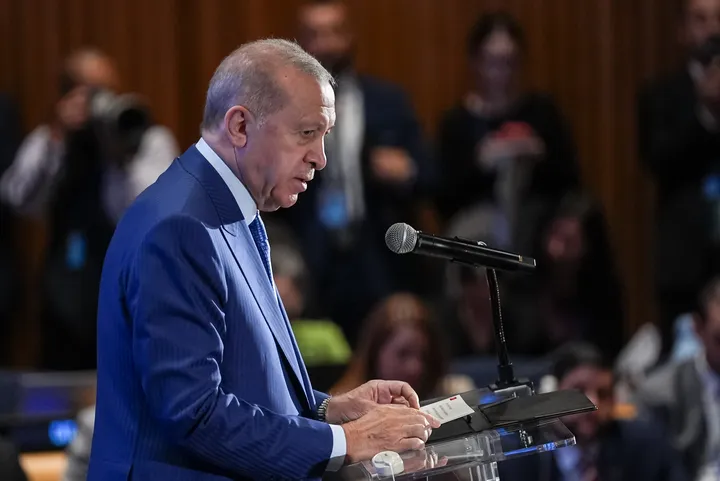
1984
Elected Beyoglu district head of the Refah Partisi, the Welfare Party, founded by the then-prime minister, Necmettin Erbakan in 1980.
1985
Elected Refah Partisi's provincial head as well as a member of the party's central executive board.
1994
Elected mayor of Istanbul on March 27, 1994. During his tenure, he introduced various reforms aimed at improving the quality of life.
1997
Arrested in December for reciting a poem. He served four months of a 10-month sentence.
2001
Founded the AK Party (Justice and Development Party) on August 14, 2001, with his friend and former president of Turkey, Abdullah Gul. The central conservative party focused on political, social and economic reforms.
2002 to 2003
Elected prime ministerafter the AK Party swept the polls and won a majority of the parliamentary seats. He held the position for 11 years until 2014. Under his leadership, Turkey started talks with the European Union to join the bloc.
2014
Elected the 12th president of Turkey in the first-ever direct elections for head of state, held in August 2014, garnering more than 51 percent of the vote.
2016
Survived attempted coup on July 15, by a military faction that left 249 people dead and more than two thousand injured. Speaking to CNN Turk, Erdogan addressed the nation, urging citizens to take to the streets and stand up against the coup plotters.
April 2017
Erdogan wins supportfor 18 proposed constitutional amendments after a referendum.