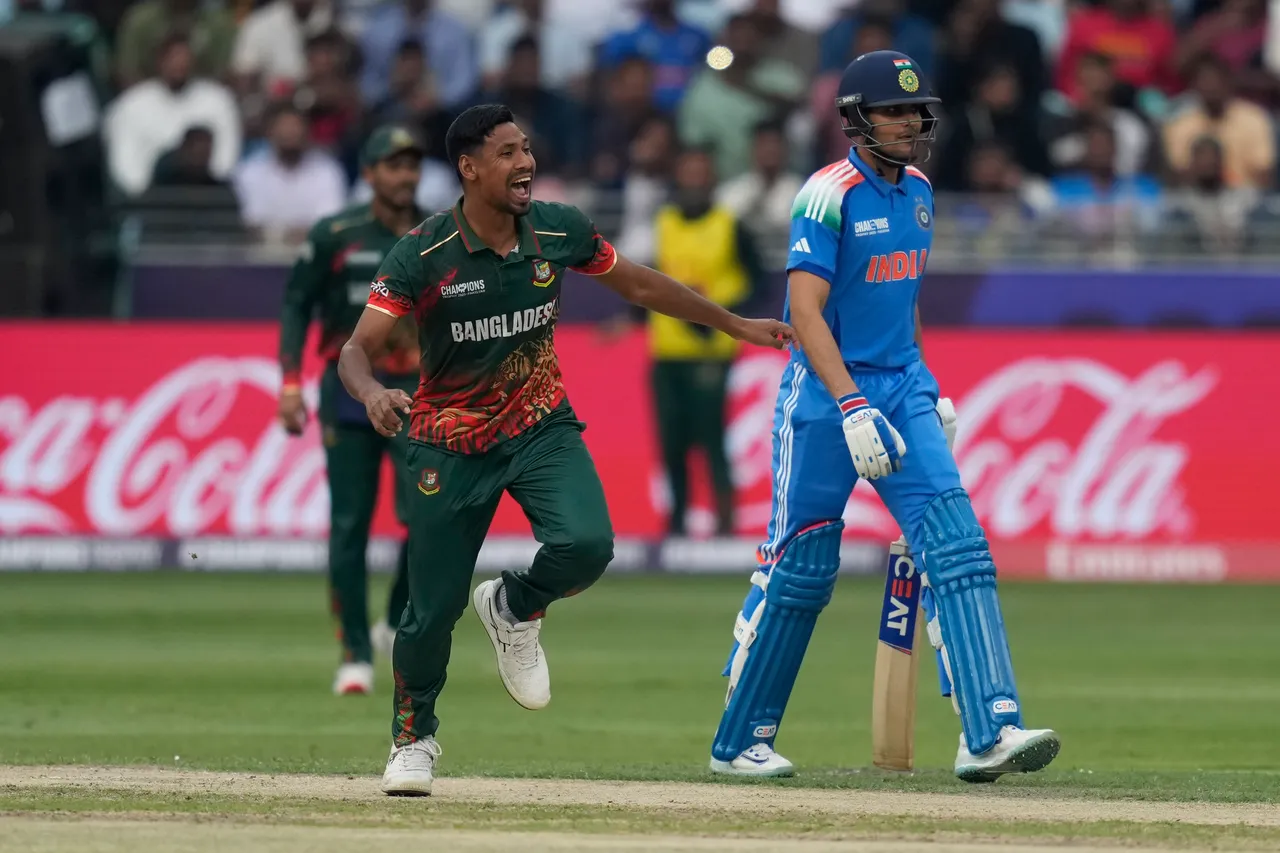
The worsening political fallout between India and Bangladesh has spilled decisively onto the cricket field, with Dhaka refusing to send its national team to India for the 2026 Men's T20 World Cup — a move that threatens to redraw yet another major ICC tournament around regional fault lines.
Bangladesh's decision came after its star fast bowler Mustafizur Rahman was abruptly released by his Indian Premier League (IPL) franchise, Kolkata Knight Riders (KKR), following instructions from India's cricket board, the BCCI. The episode triggered a diplomatic and sporting backlash that now places the International Cricket Council (ICC) under fresh pressure to expand cricket's growing "hybrid model" in South Asia, which allows matches to be played at neutral venues.
After an emergency meeting on Sunday, the Bangladesh Cricket Board (BCB) said it had "formally requested" the ICC to shift all of Bangladesh's matches out of India, citing security concerns and government advice.
"The Board of Directors resolved that the Bangladesh National Team will not travel to India for the tournament under the current conditions," the BCB said in a statement. "In light of this decision, the BCB has formally requested the International Cricket Council (ICC), as the event authority, to consider relocating all of Bangladesh's matches to a venue outside India."
Bangladesh were scheduled to play three T20 World Cup matches in India, including fixtures in Kolkata and Mumbai, with the tournament set to run from February 7 to March 8 and co-hosted by India and Sri Lanka.
The decision was publicly endorsed by Bangladesh's Youth and Sports Adviser Asif Nazrul, who linked the move directly to India's domestic politics and cricket governance.
'Days of slavery are over'
"We welcome this decision taken in the context of the extreme communal policy of India's cricket board," Nazrul said, adding earlier that "the days of slavery are over".
Nazrul also ordered Bangladeshi broadcasters to explore blocking IPL coverage, saying, "We will not accept any insult to Bangladeshi cricket, cricketers and Bangladesh under any circumstances."
At the centre of the storm is Rahman, who was bought by KKR at the IPL auction in December for more than $1 million. The franchise, majority-owned by Bollywood actor Shah Rukh Khan, confirmed on Saturday that the Bangladesh pacer had been released.
"Mustafizur's release has been carried out following due process and consultations," KKR said.
But BCCI Secretary Devajit Saikia acknowledged that, "considering recent developments", the franchise had been "advised to release" the 30-year-old bowler. The BCCI has not publicly explained what those developments were, nor why security concerns applied to one player but not an entire tournament.
A senior BCB official was blunt. "India said that they are unable to provide security for one player, so how can they give security for the whole team?" he told ESPNcricinfo.



No longer an exception
The standoff now risks pushing Bangladesh into a growing list of teams unable, or unwilling, to play cricket in India or Pakistan due to political tensions.
Last year, the ICC allowed India to play its Champions Trophy matches in the UAE because of strained ties with host Pakistan.
Under the same arrangement, Pakistan will play all its T20 World Cup matches in Sri Lanka.
The so-called hybrid model, once treated as an exception, appears to be fast becoming a structural feature of international cricket.
If Bangladesh's request is accepted, it would effectively turn the India-Pakistan compromise into a three-country problem, further fragmenting South Asia's biggest sporting spectacle.
Crucially, the 2026 T20 World Cup was not originally designed as a hybrid tournament, raising questions about scheduling, logistics and precedent. The ICC did not immediately respond to requests for comment.
Politics behind the pitch
The cricketing rupture mirrors a deeper political breakdown between New Delhi and Dhaka following Bangladesh's 2024 mass uprising that toppled then-prime minister Sheikh Hasina, long seen as India's closest ally in the region.
Relations soured further after India granted asylum to Hasina, who has since been sentenced to death in absentia over a crackdown on protesters that killed more than 1,400 people, according to the United Nations.
Bangladesh's interim leader, Nobel Peace Prize winner Muhammad Yunus, has accused India of exaggerating violence against minorities, while New Delhi has condemned what it calls "unremitting hostility" in Bangladesh.
For decades, India proudly described Bangladesh as its "closest partner" in South Asia.
Today, that strategic leverage appears to have lost, and cricket, once a shared passion bridging borders, threatens to become another arena of confrontation.