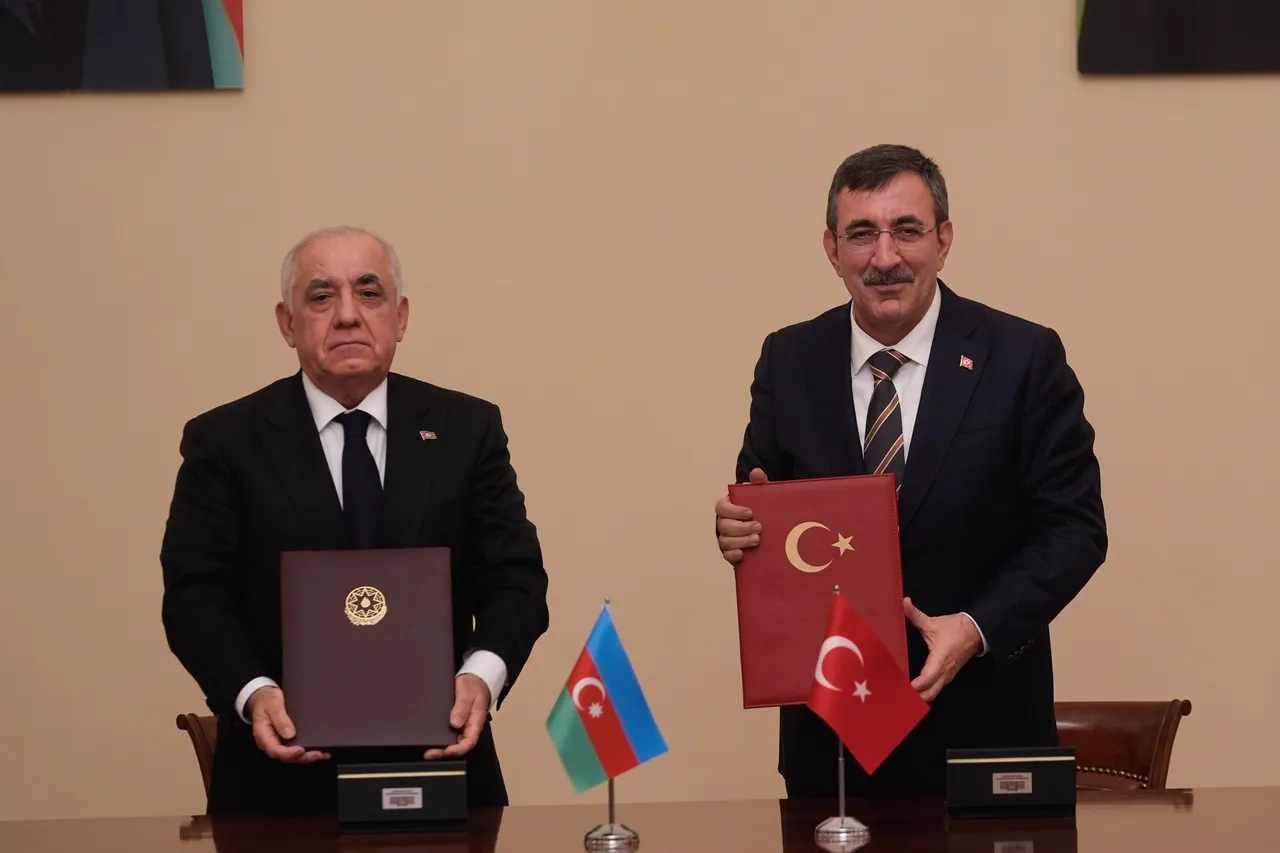
Türkiye and Azerbaijan have signed the 12th Joint Economic Commission (JEC) protocol, which includes a 110-point action plan covering fields such as energy, trade, investments and tourism.
The deal was signed on Monday by Turkish Vice President Cevdet Yilmaz and Azerbaijani Prime Minister Ali Asadov in the Azerbaijani capital, Baku.
Yilmaz, recalling that the Shusha Declaration signed by Turkish President Recep Tayyip Erdogan and Azerbaijani President Ilham Aliyev on June 15 2021 formally elevated relations to the level of a strategic alliance, said the current cooperation aims to contribute to the prosperity of the entire Turkic world by strengthening activities primarily under the umbrella of the Organization of Turkic States (OTS) on a regional and international scale.
With this understanding, Yilmaz said the JEC meetings provide a roadmap for producing concrete projects and moving confidently towards common economic goals, ensuring that cooperation translates into tangible results.
"This new action plan includes concrete actions such as exploring the possibilities of signing a Free Trade Agreement, establishing cooperation in investment/service trade in third countries, establishing a Joint Working Group for the integration of Azerbaijan into the New Computerized Transit System, establishing joint industrial training centres, signing a cooperation agreement in the field of agriculture, developing cooperation in oil and natural gas projects, and organising experience-sharing programs in a wide range of areas from health to tourism, banking to public procurement," Yilmaz said.
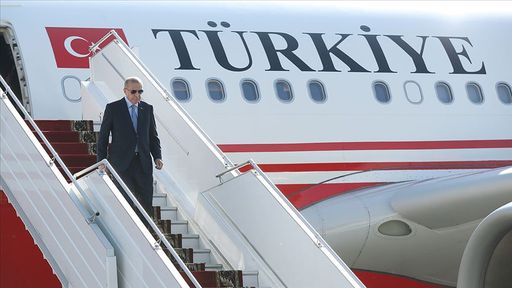
Yilmaz said that the trade volume with Azerbaijan reached its highest level last year at $8 billion.
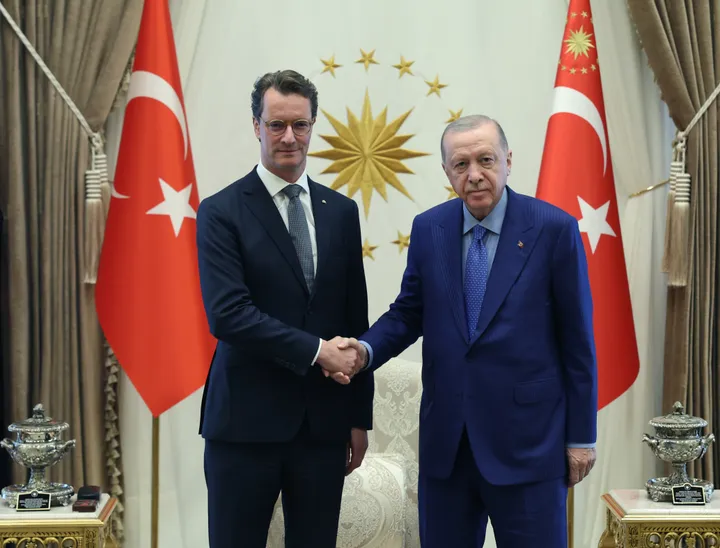

"In this context, our $15 billion trade volume target is only a medium-term goal showing our potential. Our main goal is to reach the capacity for joint production, joint investment and joint project development in third countries. While pursuing this goal, removing bureaucratic obstacles for our business communities and accelerating customs and logistics processes will be our top priority," he said.
"Considering Türkiye's investments made through third countries, Türkiye's investments in Azerbaijan have reached $18 billion, while Azerbaijan's investments in Türkiye have reached $21 billion.
"We should not be mere 'transit countries' delivering the riches of the Caspian Sea to the West; we should be strategic centres where energy is managed, and supply security is ensured. In this context, we should diversify our energy cooperation to include renewable energy sources and strengthen our alliance in the energy sector by implementing the energy corridor we have planned through Nakhchivan as soon as possible," he emphasised.
Yilmaz said that, looking at the concrete indicators of cooperation between the two countries today, an increase of cooperation between state-owned Turkish Petroleum (TPAO) and the Azerbaijan State Oil Company (SOCAR), the opening of the Igdir-Nakhchivan Natural Gas Pipeline, the agreement they reached for Turkish Petroleum Pipeline Corporation (BOTAS), SOCAR and TPAO to conduct joint activities in third countries, and the Green Electricity Transmission and Trade Project and the Türkiye-Azerbaijan, Nakhchivan Interconnection Project clearly demonstrate how visionary the cooperation between the two countries actually is.
"Another important aspect of our bilateral relations is the Middle Corridor, referred to as the Silk Road of the 21st century, which has gained unprecedented vital importance today, turning eyes to the East-West route via the Caspian Sea," he noted.
Yilmaz emphasised that potential alone is not enough and that it is in the hands of both countries to transform this potential into a sustainable logistics architecture. He underlined that in this way, the keystones of the Modern Silk Road will be laid and the fate of trade extending from the Great Wall of China to Europe will be shaped by the unwavering alliance of Türkiye and Azerbaijan.