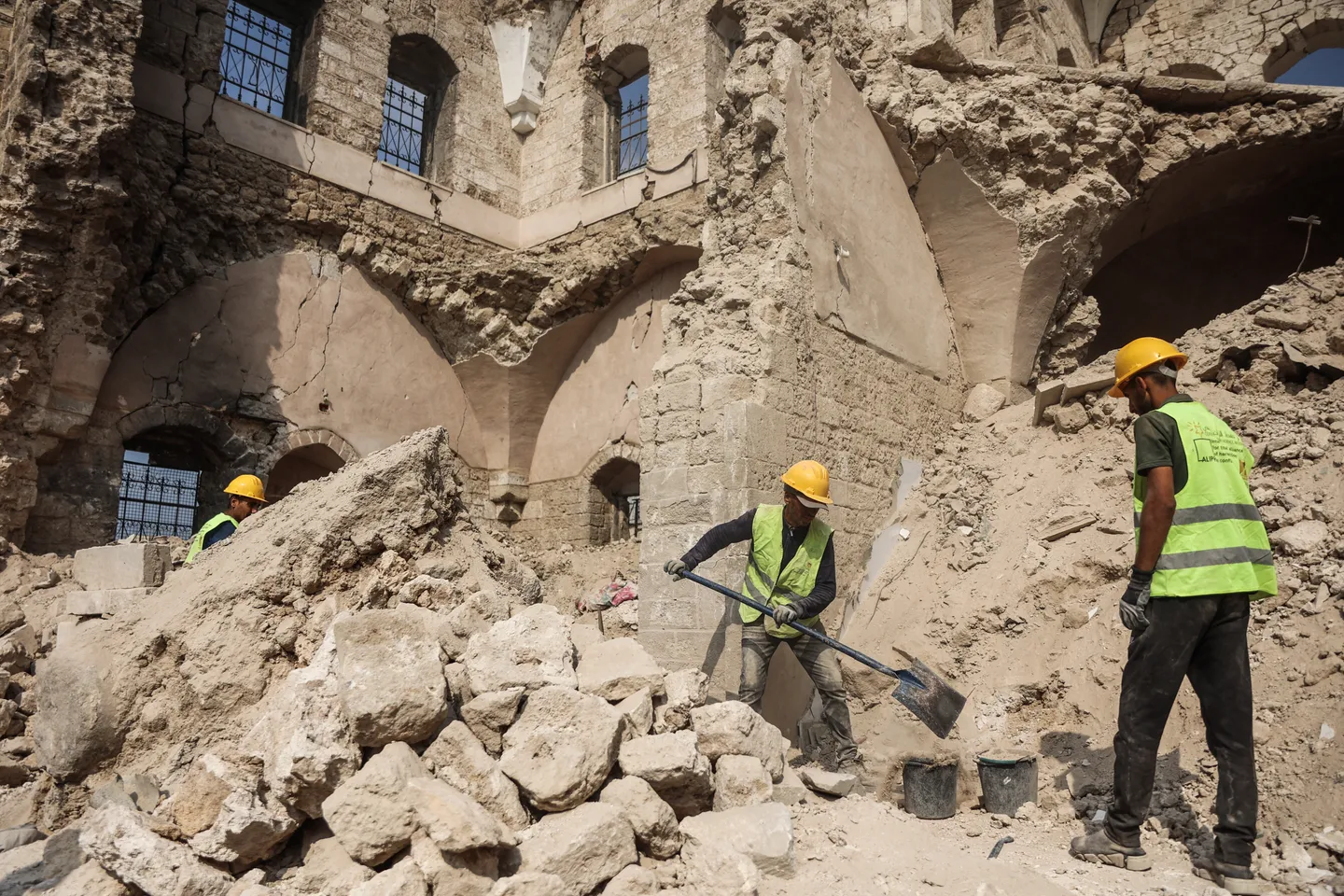
One bucket at a time, Palestinian workers cleared sand and crumbling mortar from the remains of a former medieval fortress turned museum in Gaza City, damaged by two years of Israel’s genocidal war on the Palestinian enclave.
A dozen workers in high visibility jackets worked by hand to excavate the bombarded buildings that remain of the Pasha Palace Museum — which reputedly once housed Napoleon Bonaparte during a one-night stay in Gaza — stacking stones to be reused in one pile, and rubble to be discarded in another.
Overhead, an Israeli surveillance drone buzzed loudly while the team toiled in silence.
"The Pasha Palace Museum is one of the most important sites destroyed during the recent war on Gaza City," Hamouda al-Dahdar, the cultural heritage expert in charge of the restoration works, told AFP, adding that more than 70 percent of the palace's buildings were destroyed.
As of October 2025, the UN's cultural heritage agency, UNESCO, had identified damage at 114 sites since the start of Israel’s war on Gaza on October 7 2023, including the Pasha Palace.
Other damaged sites include the Saint Hilarion Monastery complex — one of the oldest Christian monasteries in the Middle East — and Gaza City's Omari Mosque.
'No more materials'
Issam Juha, director of the Centre for Cultural Heritage Preservation, a nonprofit organisation in the Israeli-occupied West Bank, who is helping coordinate the castle's restoration at a distance, said the main issue was getting materials into Gaza.
"There are no more materials and we are only managing debris, collecting stones, sorting these stones, and have minimal intervention for the consolidation," Juha told AFP.
Israel imposed severe restrictions on Gaza at the start of the war, causing shortages of everything, including food and medicine.
After a US-brokered ceasefire deal came into effect in October, aid trucks began flowing in greater numbers, but each item crossing into Gaza must be approved by strict Israeli vetting, humanitarian organisations say.
Juha said the ceasefire had allowed workers to resume their excavations.
Before, he said, it was unsafe for them to work and "people were threatened by drones that were scanning the place and shooting".





Juha said that at least 226 heritage and cultural sites were damaged during the war, arguing his number was higher than UNESCO's because his teams in Gaza were able to access more areas.
Juha's organisation is loosely affiliated with the Palestinian Authority's ministry of antiquities, he said.

'Memory of the Palestinian people'
"Our cultural heritage is the identity and memory of the Palestinian people," Dahdar said in Gaza City.
"Before the war, the Pasha's Palace contained more than 17,000 artefacts, but unfortunately all of them disappeared after the invasion of the Old City of Gaza," he said.
He added that his team had since recovered 20 important artefacts dating back to the Roman, Byzantine and Islamic eras.
Gaza's history stretches back thousands of years, making the tiny Palestinian territory a treasure trove of archaeological artefacts from past civilisations including Canaanites, Egyptians, Persians and Greeks.
"We are... salvaging the archaeological stones in preparation for future restoration work, as well as rescuing and extracting any artefacts that were on display inside the Pasha Palace," Dahdar said.
As the pile of excavated rubble already several metres high grew, one craftsman carefully restored a piece of stonework bearing a cross mounted with an Islamic crescent.
Another delicately brushed the dust off stonework bearing Islamic calligraphy.
"We are not talking about just an old building, but rather we are dealing with buildings dating back to different eras," said Dahdar.