 Ayesha Erkin
The plane from London to Tashkent was filled with a particular energy – families reuniting, children pressed against windows, the cadence of greeting in languages that shifted between Uzbek, Russian, and English.
It felt like everyone was going home. Everyone except me, who had never been to Uzbekistan, yet was returning all the same.
My grandfather, Noman Jan Erkin, was born in Osh (modern-day Kyrgyzstan) in 1922, but fled the Fergana Valley in the late 1920s with his father, a freedom fighter escaping Tsarist and Soviet persecution — a journey that kept him from ever returning home.
They moved to Kashgar, in present-day western China, for a decade, then to Ladakh, which was part of undivided Kashmir at the time, and finally settled in what is now Rawalpindi, just before the 1947 Partition, where they adopted the surname Erkin – meaning ‘free’ in Uzbek. In Rawalpindi, my grandfather bought a wool factory and named it Watan, meaning homeland.
I never got to meet my grandfather, but my father occasionally recounts a memory: finding him late at night, this tall, broad, powerful man with a deep voice that scared many, listening to the poetry of Alisher Navoi, the legendary 15th-century Turkic poet whose words could conjure a profound longing, and tearing up. The only time he ever saw his father cry.
My grandfather loved his homeland with an ache that never healed, yearning to return until he passed. He did not live to see Uzbekistan gain independence.
Growing up, I knew whispers of this country. I knew I was part Uzbek, part Uyghur, part Arab, part Turk - a constellation of identities that intersected but didn't always meet.
Being mixed race across four cultures felt less like being a tree with roots and more like a bird in perpetual migration. The right to claim your heritage felt fragile when history's winds scattered that heritage.
So when the chance came to visit Uzbekistan, I seized it. What I didn't anticipate was how emotional it would be – or how much my grandfather would return through me.
The architecture of empire
When I studied architecture at university in the United States, my curriculum worshipped at the altar of Modernism - Mies van der Rohe, Le Corbusier, the International Style. In my own time, I'd stumble across images of the Registan in Samarkand, impossibly ornate madrasas that seemed to defy everything I was learning about “less is more.”
I was mesmerised, but kept it quiet. That wasn't the architecture we were being trained to value.
Fifteen years later, standing in that very square in Samarkand, I had to take a minute to steady myself. My heart welled up, and the joy came as tears. This wasn't just beautiful architecture; this was where the world converged.
The three madrasas - Ulugh Beg, Sher-Dor, and Tilya-Kor - frame a square that once pulsed with scholars, traders, and travellers from across continents. The Tilya-Kori madrasa, the "school of gold," took fourteen years to build but only reached one floor before the builder died, yet its interior dazzles with gold leaf and intricate geometric patterns that seem to hold infinity.
The Islamic architecture here tells stories in geometry and symbolism. At the Khudayar Khan Palace in Kokand, I learned the structure originally had 114 rooms - corresponding to the surahs in the Quran.
The muqarnas pillars, each carved differently, create acoustics that intensify sound in the ceiling's carved domes. Blue represents space and the heavens; green symbolises nature; red embodies life and blood. The pargol decorations combine geometric precision with herbal motifs, a merger of mathematical sophistication and organic beauty.
Everywhere, the lion and tiger motifs prowl across tilework and carvings - symbols of power, yes, but also of the region's historical reach.
At a shop in Bukhara, I pointed to Yemeni jewellery and Kashmiri jackets, confused by their presence. The shopkeeper smiled. "Uzbekistan is small," he said. "Bukhara is big."
The Bukharan Empire(1506 - 1920) once stretched far beyond today's borders, a reminder that this land belonged not just to Uzbeks, but to the vast web of cultures that traded, travelled, and intermingled along the Silk Road.
Threads of inheritance
The Yodgorlik Silk Factory in Margilan, in the south of the Fergana Valley, felt like walking into my childhood playground. I grew up in my grandfather's wool factory in Rawalpindi, Pakistan - the clatter of looms, the smell of dye, the careful hands of craftspeople became my normal. Here in the Fergana Valley, watching silk artisans work their ancient craft, I felt that beautiful familiarity wash over me. Different fibres, same devotion.
The process is meticulous: boiling cocoons, extracting single threads finer than hair, dyeing them with natural pigments, then weaving them into ikat patterns that seem to shimmer with captured light.
The valley produces four types of cotton alongside its silk, and the tradition runs centuries deep - though it nearly died under Soviet rule, when craftspeople were forced into state factories and paid the same meagre wages whether master or student.
Central Asia was incorporated into the Soviet Union in 1924, and Uzbekistan would remain under Soviet control for 67 years until declaring independence on August 31, 1991.
During this time, traditional crafts were collectivised, religious practice suppressed, and the Uzbek language subjected to Russification policies.
Yet paradoxically, Soviet authorities also recognised the cultural value of Central Asia's Islamic architecture, conducting restoration projects on major monuments - even as they repurposed many religious buildings for secular use. This contradictory approach preserved structures while attempting to erase their spiritual significance.




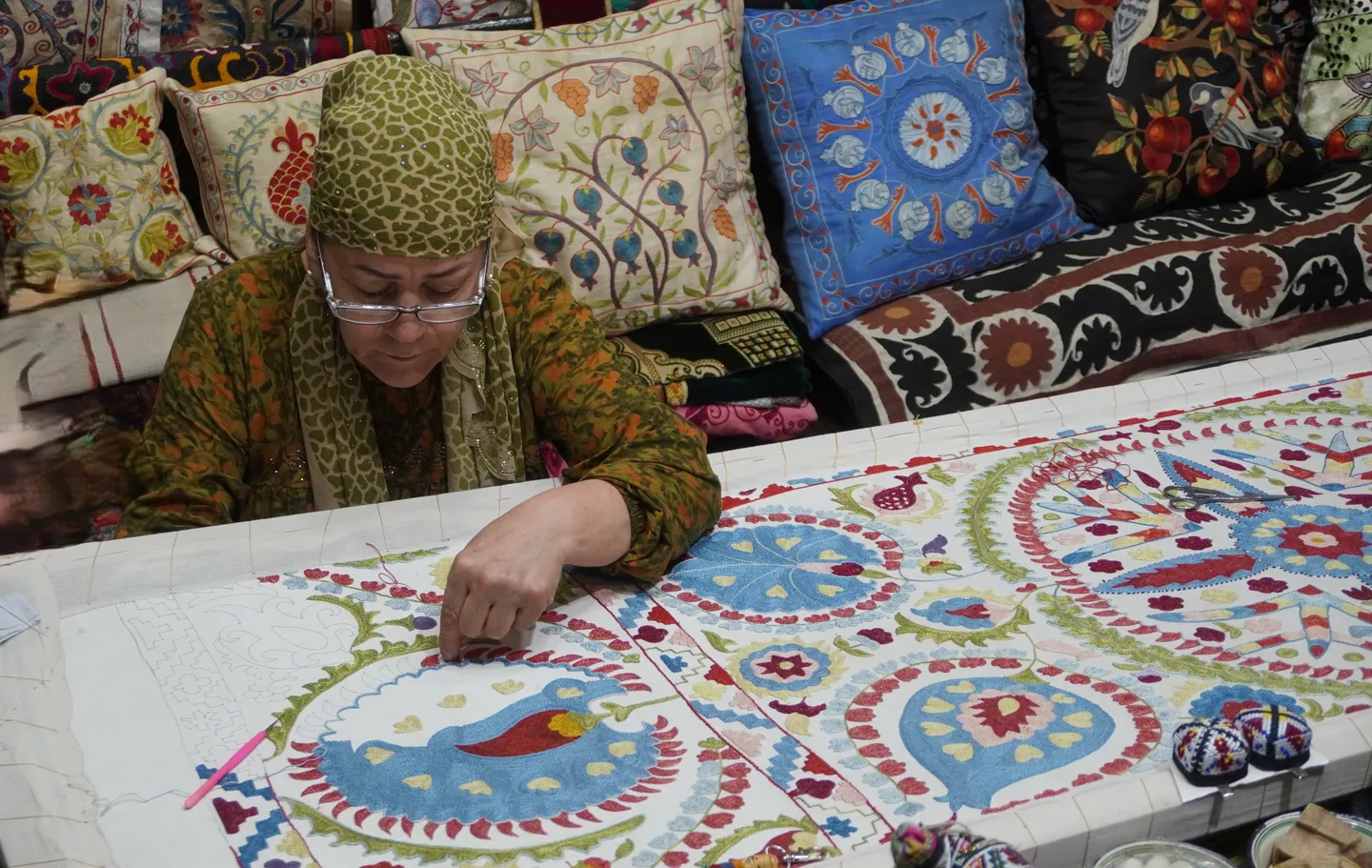
“It’s a revived skill," one artisan told me with a smile, explaining how independence allowed them to work from home again, to export their crafts, to be recognised by UNESCO. The government now covers 50 percent of training courses abroad for ceramicists and weavers, nurturing what the Soviets nearly extinguished.
At the Applied Arts Museum in Tashkent, I was enchanted by the story of suzani embroidery - the traditional textile work that young women once had to master, preparing fifteen different pieces starting from age six or seven.
Nine circles symbolise pregnancy; other patterns echo galaxies. Several women work together on one piece for eleven months, their needles creating cosmologies in thread. The Fergana Valley favours muted greens and blues, while Samarkand and Bukhara glitter with gold and silver kundal thread.
The persistence of tradition
In Rishtan, halfway between Kokand and Fergana and just north of the Kyrgyz border, I stayed at Said's Ceramics Guesthouse and learned that this town's pottery tradition dates to the 4th century.
The blues and green pigments were original; reds and oranges an addition. What makes Rishtan special is its soil - pure enough that artisans add nothing but water, unlike Bukhara or Samarkand, where clay requires stone additives.
Said Aka has travelled the world showcasing his work, even maintaining a shop in Kiev since 2016 as a hub for global exports.
The streets of Uzbekistan taste like convergence. At the Siyob Bazaar in Samarkand and Chorsu Bazaar in Tashkent, I watched breadmakers pull fresh non from tandoor ovens - piyazli, shirmazor, kaynakli - each with its own texture and purpose.
Nearby, families gathered around enormous kazans (cast iron cooking vessels) of Osh, the national dish of Uzbekistan. Osh is more than just rice and meat - it's a symbol of hospitality, community, and celebration, prepared in massive kazan pots for weddings, holidays, and gatherings where sharing food means sharing life - a reflection of Uzbek generosity.
It was mesmerising to see the rice steaming as grains mingled with slow-cooked meat and carrots, the air thick with cumin. I asked if I could join, stirring gently, feeling how the patience required mirrors the craft of silk weavers - both demand devotion, timing, the understanding that some things cannot be rushed.
The food here carries the Silk Road in every bite: jizzakh rice grown specifically for Uzbek osh with influences from Persia, noodles echoing Uyghur techniques that travelled these routes, spices that once made fortunes and built empires. Even the ingredients speak of convergence.
Returning through blood
The Gur-i-Amir mausoleum in Samarkand holds Timur's tomb beneath a dome with 63 sides - the Prophet Muhammad's (PBUH) age at death. Inside, his name and his grandson's appear 3,000 times in calligraphy by the Persian architect Mahmoud Isfahani from the 15th-century. Standing in that cool, echo-filled space, something shifted in me. These weren't just architectural choices; they were acts of devotion rendered in tile and stone.
The Bibi Khanym Mosque, commissioned by Amir Timur - known in the West as Tamerlane, and the founder of the 14th-century Timurid Empire - now stands at half its original height after an earthquake in 1897.
For 400 years, no prayers echoed in its vast space - a monument to both grandeur and loss, yes, but also to resilience.
As a Muslim standing in these prayer halls designed to make you feel both infinitesimally small and deeply held by God's mercy, I understood something my Western architectural education never taught me: that these buildings were never meant to glorify the architects or rulers alone.
They were vessels for the sacred, spaces where geometry becomes dhikr, where repetition of the Prophet's name 3,000 times transforms structure into supplication.
My mixed heritage suddenly felt less like fragmentation and more like convergence. These mosques and madrasas were always meant to welcome the ummah - the global community of believers.
The dovetail joinery in Kokand, the muqarnas that manipulate sound and light to amplify the call to prayer, the pargol that merges mathematics with the organic forms of God's creation - this was sophisticated design born from a spiritual philosophy, one that saw buildings not as monuments to human ego but as thresholds between the worldly and the divine.
My grandfather never returned, but through me, through his children and grandchildren, he has. This land is ours not by residence but by blood, by the stories passed down in tears and longing, by the name ‘Watan’ in a factory thousands of miles away.
Few people here immediately recognise my partial belonging - ironically, they see my other races more readily than Uzbek. But what I can confirm runs deeper than appearance or even ethnicity is the feeling of homecoming that every Muslim feels entering these spaces, regardless of where we're from. The roots were never gone; they were just planted deeper than I knew.
I am Central Asian. Uyghur and Uzbek. But I am also part of something larger - the ummah that these structures were built to house, the Silk Road that never belonged to just one people, the legacy of craftspeople and scholars and believers who understood that beauty is a form of worship.
My grandfather couldn't return to the Fergana Valley, but he has returned through me, walking on the same soil he yearned for, touching the silk that echoes his wool, standing in the shadow of architecture that has outlasted empires because it was built not for power, but for prayer.
Watan. I am home.