 Esra Karataş Alpay
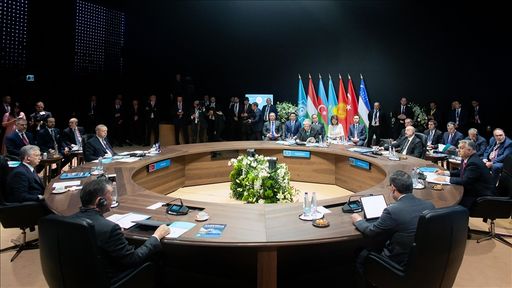
The 12th Summit of the Organisation of Turkic States (OTS) last week was centred on ‘Regional Peace and Security’.
But for many, the most lasting message from the gathering of Turkic leaders may not be about security at all.
It may be about letters.
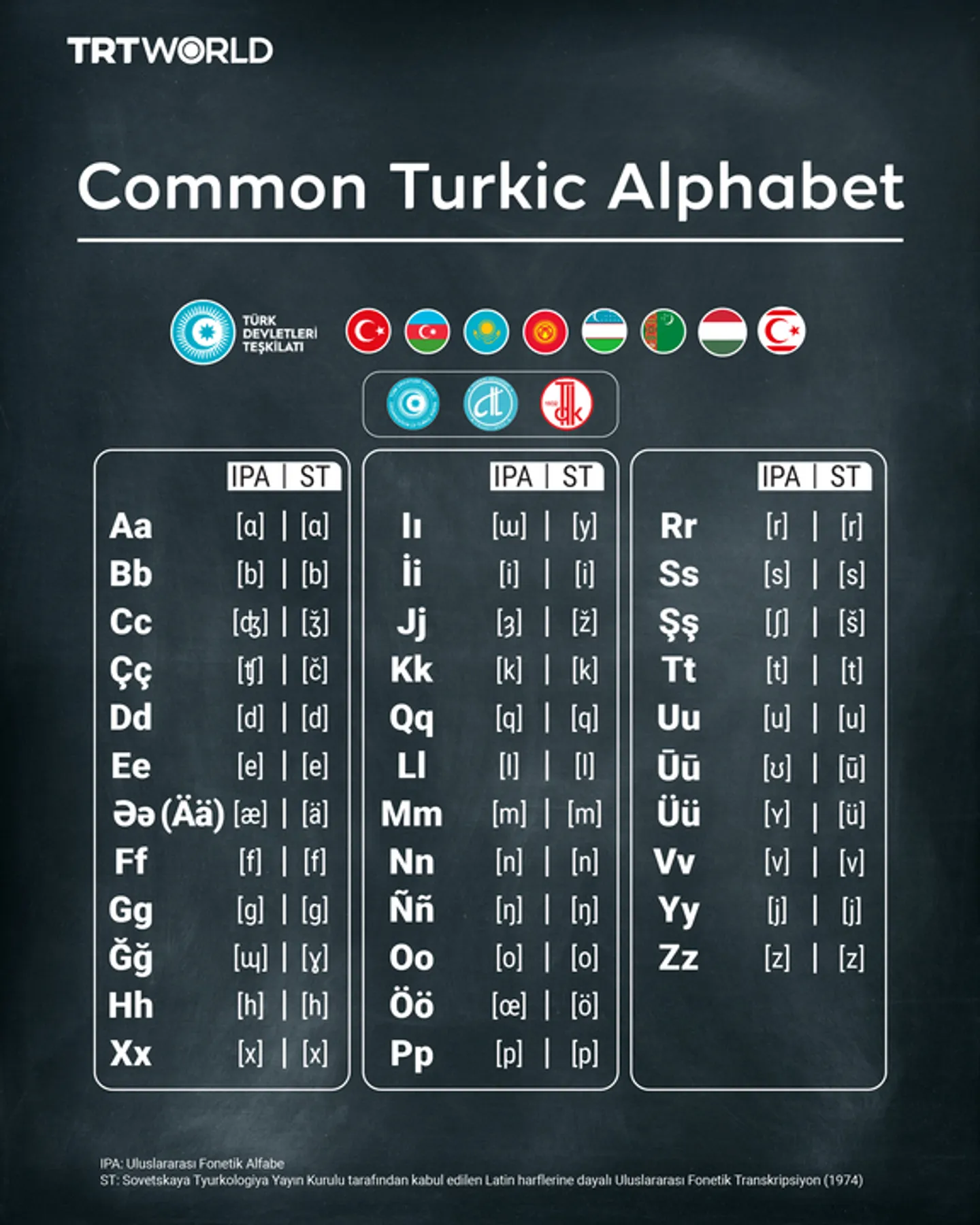
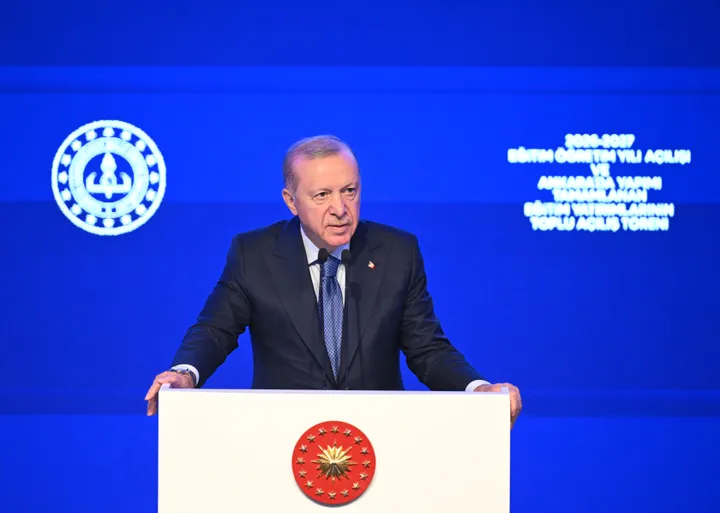
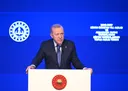
Türkiye’s President Recep Tayyip Erdogan presented fellow leaders with two books — one on the works of Chingiz Aytmatov, the celebrated Kyrgyz author, and another drawn from the Oguznames, the genealogical legends of the Turkic peoples — both were printed in the newly proposed 34-letter Common Turkic Alphabet.
It was a gesture with profound political, cultural, and technological implications.
The quest for a common script among Turkic-speaking peoples is not new.
In fact, it stretches back nearly a century, to the First Turkology Congress held in Baku in 1926, where scholars and statesmen first raised the idea of a Latin-based alphabet.
The project faltered under Soviet rule, when Turkic republics were forced to adopt Cyrillic.
But with the dissolution of the Soviet Union in 1991, the aspiration resurfaced.
Now, under the institutional umbrella of the OTS, the initiative has found new momentum.
In September 2024, the Common Turkic Alphabet Commission met in Azerbaijan and agreed on a standardised 34-letter system designed to respect phonetic diversity across Turkic languages while enabling literacy across borders.
Assistant professor Basak Kuzakci, a scholar of Turkic cultural studies at Marmara University in Istanbul, explains the significance of this long effort.
“The issue of a common alphabet has been an ideal we have contemplated for generations,” she tells TRT World.
“Achieving alphabetic unity is not a technical matter but a cultural rapprochement. If a Turkish student can easily read a text in Kazakh, Kyrgyz, or Uzbek Turkish, the mental walls that divide us will begin to dissolve.”
Kuzakci, however, adds that challenges remain.
“The task requires careful scientific planning and strong coordination among states. Phonetic differences between Turkic languages must be addressed….the 34-letter system must preserve flexibility to safeguard the unique sound systems of each language.”
“The success of the common alphabet will depend on approaching the process not as an ‘imposition’ but as a ‘harmonisation’ project. We envision it as a cultural bridge: one that respects each country’s identity, facilitates communication, and allows diverse dialects to draw nourishment from a common root.”
Alphabet meets technology
Advocates argue that the common alphabet is not merely about cultural preservation but also about digital relevance.
Standardisation, they say, will make Turkic languages more interoperable in databases, software, and artificial intelligence systems.
“A common alphabet will bring Turkic languages closer together in the digital sphere, from databases to AI training models,” Kuzakci adds.
“It creates a broad field of compatibility. In the age of artificial intelligence, language is not just culture — it is infrastructure.”
This technological aspect explains why the initiative resonates strongly at a time when global powers are heavily investing in AI-driven language technologies



For the Turkic states, unifying scripts is a way to ensure their voices are not lost in the digital age.
Professor Yasar Sari, an international relations scholar and Eurasian expert at Ibn Haldun University, emphasises the depth of the project’s roots.
“The alphabet question has been one of the earliest and most consistent debates in the Turkic world,” he tells TRT World.
“As early as the 1990s, scholars had already reached a consensus on the 34-letter system. Its political meaning only emerged more recently, when the International Turkic Academy announced that an agreement had been reached,” he says.
He also emphasises the symbolic significance of President Erdogan’s gesture in the northern Azerbaijani city of Qabala, also spelt Gebele, where the OTC summit was held.
“By publishing a book on Chingiz Aytmatov, who gave voice to the shared emotions of the Turkic peoples, and the Oguznames, which form the genealogical backbone of Turkic identity, Türkiye made these works legible across borders,” he adds.
“It opens the door to addressing not just one nation, but a collective. In the long term, this will allow Turkic societies to develop a shared intellectual framework,” he concludes.
At the Turkish Council meeting in Antalya in 1993, a decision was made to add letters such as ‘Q, X, W, Ñ, Ä’ to the Turkic alphabet as a common standard.
In more recent years, this process has taken on institutional form under the framework of the OTS.
The Common Turkic Alphabet Commission convened in Azerbaijan from September 9 to 11, 2024, and reached consensus on a 34-letter system.
This alphabet both accommodates phonetic differences among dialects and seeks harmony based on syllabic structure.
Thus, the common alphabet goal voiced at the latest summit rests on nearly a century of historical background and a profound cultural legacy.
Culture harmony
Professor Sari highlights that the Gebele meeting marked one of the most concrete steps taken since the OTS formally adopted its current name in 2021.
“Despite different systems of governance and political perspectives, member states are finding common ground. The most fundamental shared value is identity, and the most essential element of identity is language,” he explains.
The push for the common alphabet also entails efforts to have December 15 recognised internationally as ‘World Turkish Family Language Day’.
Such a move would not only institutionalise linguistic unity within the Turkic world but also elevate it on the global stage.
In this light, Gebele may be remembered not only for its declarations on peace and security, but for laying the groundwork of a new cultural and digital architecture.
“When an idea becomes action, it creates a shared mental map. That is the true significance of the common alphabet — not just preserving the past, but shaping the future together,” Kuzakci says.
Ultimately, the common alphabet represents more than a linguistic reform; it is a bridge to a future of deeper unity and shared progress.
By turning a century-old dream into policy, the Turkic states are signalling that they are ready to write the next chapter of their story together — one in which culture, technology, and identity converge.
“In the long term, I believe that the adoption of a common alphabet will enable Turkic communities to think together, to develop a shared intellectual framework, and to cultivate a common consciousness,” Professor Sari adds.