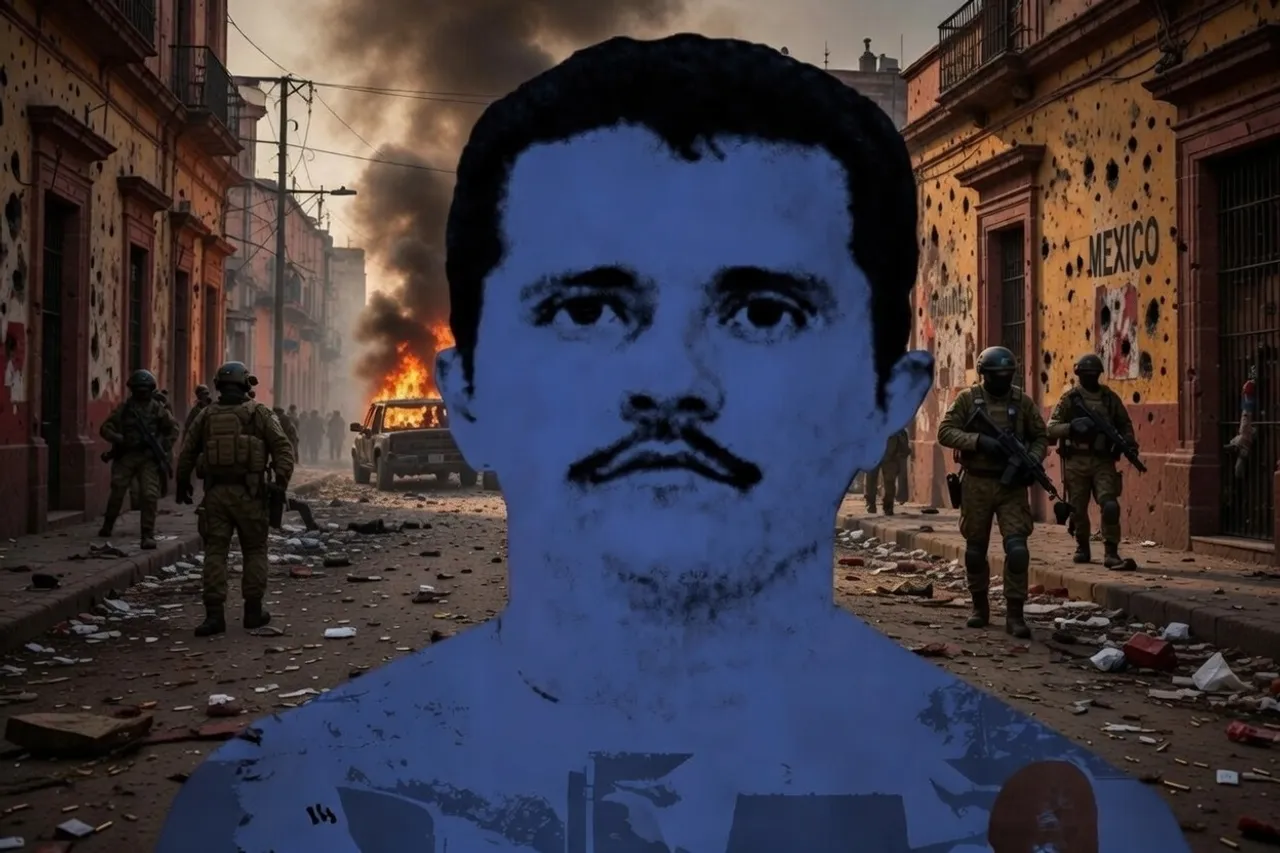
The bullet that killed Nemesio "El Mencho" Oseguera Cervantes on a February morning in Tapalpa, Jalisco, did more than end the life of Mexico's most wanted man.
It cracked open a decades-old secret, one that stretches from the sun-bleached training camps of western Mexico to the corridors of Tel Aviv.
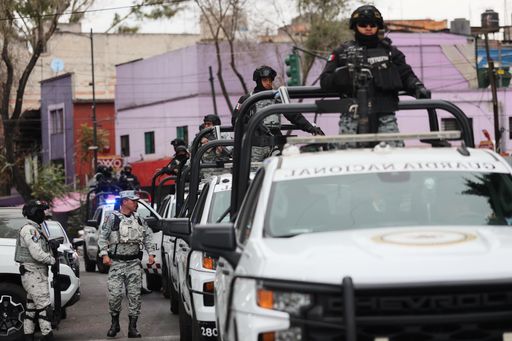
El Mencho, 59, was killed on February 22, 2026, when Mexican special forces, armed with American intelligence, stormed his stronghold. Four of his men died alongside him.
The Trump administration called it a "great development." The streets of Mexico called it the beginning of something far worse.
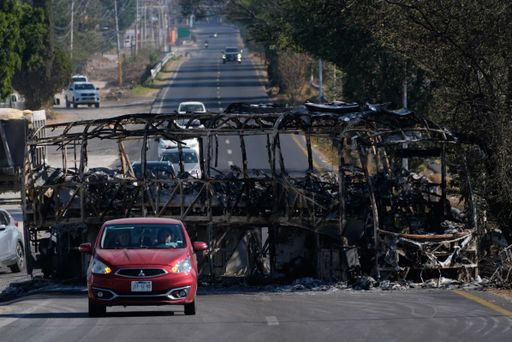
Within hours, roadblocks choked highways. Vehicles burned. Gunfire echoed across multiple states.
Criminal empire built on foreign blueprints
El Mencho did not build CJNG— the Jalisco New Generation Cartel — through brute force alone.
A former police officer who understood the machinery of the state, he transformed what was once a modest splinter group of the Milenio Cartel into a global trafficking empire, methamphetamine and fentanyl flowing through its veins, paramilitary precision running through its operations.
What set CJNG apart was not just its ruthlessness. It was its sophistication.
While CJNG's operations show paramilitary precision: Drones, coordinated ambushes, tactical retreats.
Experts attribute this to a mix of internal recruits from Mexico's armed forces and alleged foreign instructors
The question that has haunted investigators for years is simple: Where did they learn to fight like this?
Alleged Israeli connection?
Allegations of foreign involvement in cartel training have occasionally pointed to Israeli nationals, though these remain largely anecdotal in the context of CJNG.
A former DEA (US Drug Enforcement Administration) agent, cited in a 2017 investigation, reportedly described hearing of individuals from Israel meeting with CJNG members to provide sniper training and tactical instruction.
The agent noted that some observed methods appeared more technically advanced than typical Mexican cartel tactics at the time — describing "a technical use of force you've never seen with Mexican cartels."
Such claims echo earlier, well-documented scandals elsewhere in Latin America.
In 1989, a controversy arose in Colombia when former Israeli army Colonel Yair Klein was implicated in training paramilitary units linked to the Medellin Cartel, including assassination techniques.
The New York Times reported at that time the Israeli government sought to distance itself from the actions of private mercenaries reportedly involved with drug traffickers' killing squads in South America.
By 1991, a US Senate investigation concluded that retired Israeli military commandos had made the Medellin Cartel "substantially more dangerous" by imparting "potentially deadly techniques."
The Los Angeles Times covered the findings in detail.
The US Senate report also traced financing for weapons from Israel Military Industries to a November 1988 transfer of $98,131.50 from a Panamanian bank account, routed through Philadelphia International Bank and Manufacturers Hanover Trust, ultimately reaching Bank Hapoalim and Israel Military Industries.
These historical cases involved private individuals or retired officers in Colombia during the late 1980s and early 1990s, not direct state involvement or links to Mexican cartels like CJNG decades later.
Israeli officials have consistently denied any role in training or supporting criminal groups in Mexico.
No major recent investigations or reports following El Mencho's death have substantiated ongoing or direct Israeli connections to CJNG operations.




Inside the camps
Witness accounts and investigative reporting describe CJNG training camps as highly structured and drawing on a mix of domestic and alleged foreign expertise.
However, much of the cartel's paramilitary capabilities stem from recruits with prior Mexican military or police experience.
In a 2019 Telemundo interview (also covered by Insight Crime), a former CJNG recruit known as "Francisco" described spending three months in a camp in Talpa de Allende, Jalisco.
He alleged that instructors included a diverse group: ex-special operations veterans, Guatemalan Kaibiles (notorious for their brutal training and reputation in Central America), Colombians, and some Israeli citizens.
Recruits reportedly learned weapon handling, firing positions, ambush tactics, and guerrilla warfare before deployment.
These claims, based on a single protected witness's testimony, remain unverified by independent sources.
Broader reporting on CJNG often highlights the central role of Mexican deserters from elite units (including former special forces trained domestically or through international programmes with partners like Israel), who bring tactical knowledge and help train others internally.
The firearms recovered from CJNG operations tell a related but separate story. Between 2006 and 2018, Israel sold more than 24,000 guns and rifles to Mexico. Investigators have noted that some weapons, have been diverted into criminal hands.
Israel has officially denied any direct involvement in cartel training. In response to the violence following El Mencho's death, its Foreign Ministry issued a standard advisory urging Israeli citizens in Mexico to avoid non-essential travel in Jalisco and to follow local authorities' instructions.
War that outlives its generals
El Mencho is dead. CJNG is not.
Experts warn that the cartel's fragmentation — near certain in the power vacuum his death creates — will likely produce more violence, not less, as factions battle for territory and supremacy.
Mexico's cartels have long since ceased to be profit-driven trafficking networks in any conventional sense. They are territorial, militarised forces. They control vast swathes of the country. They deploy drones, improvised explosive devices, and armoured vehicles.
These cartels fight each other more than they fight the state. They operate, as analysts grimly note, less like criminal organisations and more like insurgent armies engaged in a permanent internal conflict.
US officials, whose intelligence apparatus helped make the Jalisco raid possible, have spoken of bilateral cooperation. Israeli officials, meanwhile, have said nothing.
The questions, as they so often do in Mexico's long and blood-soaked drug war, remain unanswered.
The full architecture of international involvement in CJNG's rise may never be fully mapped.
But in the debris of El Mencho's death, the burning roadblocks, the flight cancellations, the gunfire across Jalisco, the outline of something larger and more troubling is in plain sight.
Foreign expertise, investigators say, built this machine. How much of it remains, and who is still supplying it, are questions that the authorities have yet to answer.