 Saad Hasan
My 8-year-old son has never played on Roblox, the gaming platform that has become all the rage among Generation Alpha. Yet, he can’t seem to stop talking about it.
“Baba, you know, I played Roblox once, I really did,” he said to me on a recent evening, despite my reminding him for the umpteenth time that he probably mistook some other online game for one on Roblox (the platform has 13 million different games).
Recently, he has been chirping nonstop about how he heard someone in the school computer lab tell another boy that a high schooler used a VPN to play Roblox. “What’s a VPN, baba?”
We live in Istanbul, Türkiye, where the platform was blocked in August 2024 following a court order that cited concern over exploitation of children. Yet, kids can’t stop talking about it. And there’s a reason why.
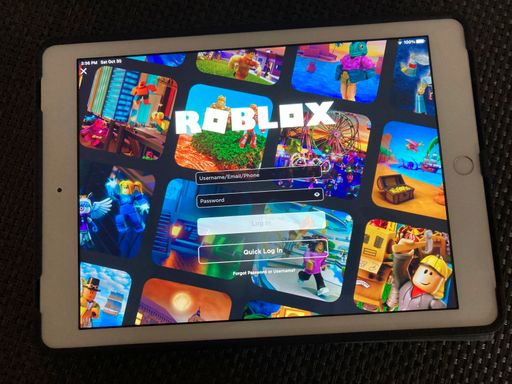
On any given day, the gaming platform has 151 million daily active users (DAU), one-third of them under the age of 13. Until recently, it was very easy to open a Roblox account. All you needed was a unique user name and a password.
It’s hard to think of a time in human history when so many kids mingled, played, chatted and traded stuff with each other at the same time as they do on Roblox. At the same time, nowhere has been so unsafe for them or so daunting for their parents.
Damon De Ionno, managing director of UK-based Revealing Reality research firm, says Roblox’s popularity primarily stems from two factors: number one, the games it offers are free of charge, and number two, it allows children to choose from thousands of games, what in Roblox parlance are known as experiences.
“Kids are always looking for new games to play. They get bored easily, and (on Roblox) it feels like you’re going to get an infinite number of games,” he tells TRT World. “So it’s just like kids getting access to a toy store.”

Risky games
Around 12 countries including Kuwait and Qatar have completely or partially banned the platform due to concerns over child safety.
Lawyers, NGOs and experts are building pressure elsewhere for similar restrictions unless the San Mateo, California-based company takes concrete steps to stem increasing incidences of child abuse and hyper-commercialisation, which is making children spend too much money on the games.
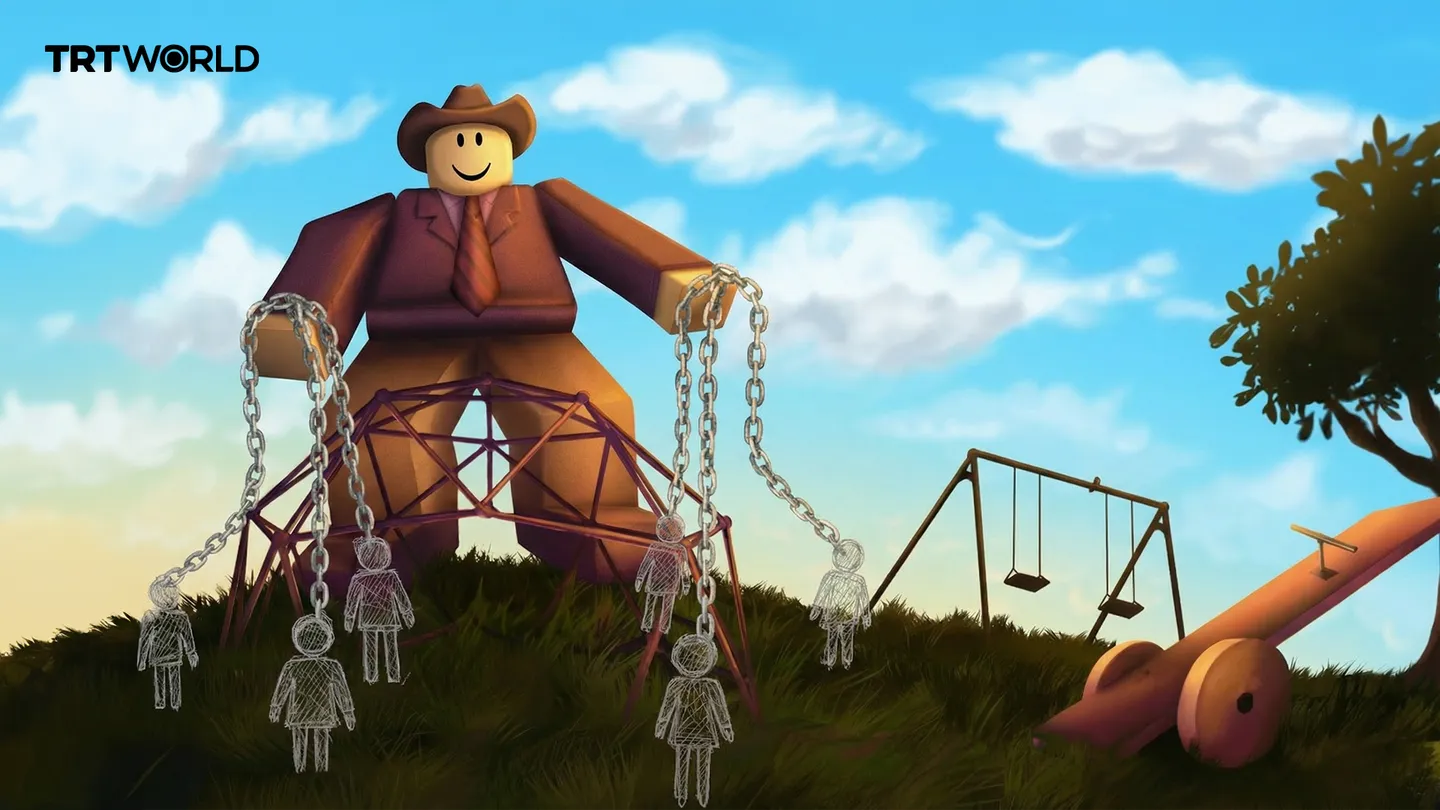
In the US alone, Roblox is facing dozens of lawsuits related to child sexual abuse, cases in which adults groomed or kidnapped children after befriending them in one of the experiences.
The US state of Texas sued Roblox in early November, with Texas Attorney General Ken Paxton calling the platform a “breeding ground for predators”.
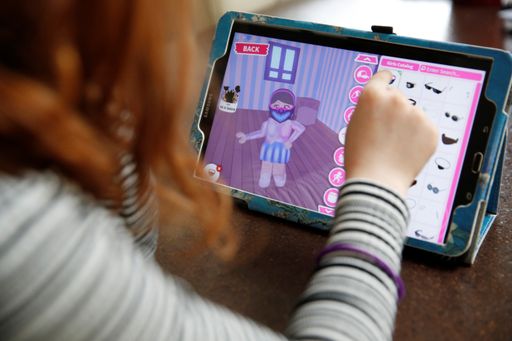
For several years, parents have complained about the platform’s lax safety guardrails and an environment that programmes kids to spend too much of their money on dressing up Lego-like avatars.
On online parenting platforms like this one, they complain that kids get addicted to certain games and then nag them to spend money on avatar clothes and accessories, such as hats, although the game itself might be free.
In the absence of regulations, Roblox’s popularity has spread like invasive lice among preteens across the world.
Games on Roblox with names like Grow a Garden and Adopt Me have become some of the most played in the world, beating blockbusters like FIFA and Need for Speed.
Yet, many adults have no idea about the transformational power and generational impact of Roblox on their children. Perhaps parents don’t even realise that their children, who depend on them to pack lunch, have created a whole culture driving the Roblox craze.
And memes like Tictac Sahur, Tralalero Tralalero and Spaghetti-Tualetti are an important part of it.
The Brainrot era
The most played game on Roblox right now is multiplayer Steal a Brainrot. It goes like this: strange-looking avatars such as Cacto Hipopotamo – which is a walking cactus with a hippopotamus head affixed on it – walk on a conveyor. Players then buy them and try to steal others’ avatars, also known as brainrots.
Brainrot is a term used to describe media of low quality and value – such as meaningless songs or games.
“Brainrot is like candy for your brain. A candy is sweet, it's enjoyable, but it’s dangerous for your health,” says Tuhu Nugraha, an Indonesia-based metaverse expert.
“It’s something easy for the brain to chew, it’s entertaining, but it’s just nothing.”
Brainrots emerged as memes that went viral on TikTok and YouTube. How nonsensical memes like talking toilets became a thing for a generation is a phenomenon social scientists are still trying to understand.
Steal a Brainrot has recorded more than 41 billion visits on Roblox as of November 18. To understand its scale, consider this: Baby Shark Dance, the most viewed YouTube video, has 16.4 billion views.
Multiple studies suggest that Generation Alpha, which represents children born in 2010 and after, are most exposed to internet and social media trends. They spend more time on phones and tablets than in sports fields or playgrounds.
Roblox, a play on the words robot and blocks, was founded by David Baszucki and Erik Cassel in 2004. Before it morphed into an online gaming juggernaut, it was a software to help kids learn physics.
In an interview released on November 4, Baszucki said he aims to connect a billion people playing and socialising with each other at the same time.

The most visited Roblox experience involves players living virtual lives in a town called Brookhaven RP. It’s a role-play paradise where you can be a doctor or a driver and do different things, such as roam around endlessly without any purpose. If there was ever a successful version of the metaverse, then this is it.
Nugraha, the Indonesian expert, says he was doing research on the metaverse as part of a project in 2022. “At the time, I thought the metaverse was not ready. But then, when I see Roblox, I say the metaverse is already here. It’s not 3-dimensional, but that’s the whole point.”
One reason for Roblox’s immense popularity is that it doesn’t need a device with high-tech chips that are essential to run the graphics of modern-era games. You can install Roblox on almost any phone or computer, provided it was manufactured after 2005.
Roblox’s user base exploded during the COVID-19 lockdown when children were spending more time in front of screens. Even though the company has recorded year-on-year growth in daily active users, it hasn’t posted a profit yet.
As per the 2024 financial statements, Roblox posted revenue of $3.6 billion. But it recorded a $935 million loss.
The way Roblox generates revenue has left some parents pulling out their hair.
Roblox has its own in-game currency called Robux that players buy using real currency such as US dollars. The company says that its games are designed by users on its software, a huge draw for the platform, as it claims to encourage children to enhance their coding skills. The company earns money when players spend Robux on game passes or avatar accessories.
Investors see so much potential in Roblox that its market value has shot up to more than $63 billion. In 2021, Time magazine named it among the 100 most influential companies.
A case for stronger regulations
But this hasn’t shielded Roblox from criticism on the matter of child safety, as reports based on insider accounts suggest that the company doesn’t want to spend resources on content moderation and gives precedence to sales.
In October 2024, short seller Hindenburg Research released a damning report, alleging that Roblox exaggerates the number of people who actually visit its platform. The report called Roblox “A Pedophile Hellscape for Kids”.
Joel Scanlan, a senior lecturer at the University of Tasmania, who specialises in cybersecurity and studies social harms of the internet, says adult predators are naturally drawn to games like Roblox because they can hide their age and interact with children.
“I see this as offenders going, ‘Where can I interact with a child and have a really high chance of actually interacting with a child?’ Because it’s easy, it’s full of children, it’s a children’s game.”
Part of the problem stems from Roblox being a metaverse game where children interact and socialise with each other using digital avatars, he says.
Revealing Reality, the research firm, had first-hand experience of how such interactions take place and the ease with which a child can be engaged.
De Ionno says that earlier in 2025, he asked his researchers to join one of Roblox’s social spaces, which are designed to meet and chat with other users, to see what goes on there.
“Within maybe a minute or two, they overheard some conversation which was not child-appropriate. We thought that was a one-off thing. But we went back regularly and quickly established that the concerning behaviour was completely routine.”
De Ionno says his firm doesn’t have any anti-Roblox agenda and understands the challenges tech firms have to face when it comes to protecting children.
However, Roblox founder Baszucki is not so considerate. Faced with criticism that his company wasn’t doing enough to ensure the safety of children, Baszucki told the BBC that parents who are concerned should not let their kids use Roblox.
Stopping a child from being part of the most happening thing is never easy for a parent. A child faces peer pressure and feels left out when all the other kids can name the top brainrots, but he can’t.
“So if their friends at school are playing together on Roblox and say that they’re going to go home and play, you kind of want to be playing with them as well. You wouldn’t want to not be able to do that. So there’s that draw to it,” says De Ionno.
Roblox says it has implemented several child-safety measures, and just this month announced that mandatory age checks have been introduced, which restricts children from talking with adult strangers.
But in the race to get more and more users to hook to your app and turn in a profit, experts say Roblox can not be relied upon entirely to address the issue of child safety.
“It all comes down to dollars,” says Tasmania university’s Scanlan. “They want the platforms to be sticky, they want engagement, they want to leverage the social element of it. The more you use the platform, the more money they make.
“They don’t have an incentive for it to be safe until governments step in and say you’re banned or here’s your regulation.”
Roblox or the industry can’t be expected to self-regulate. This year, multiple countries announced they are considering restricting social media apps such as TikTok for kids under 16.
In the absence of any global consensus on monitoring social media, individual states have stepped in. This is where Roblox is facing its biggest challenge.
“We are gonna see more regulation. I don’t think it’s a bad thing. How many industries exist in the world that have zero regulations? Not many,” says Scanlan.
Until that happens, I need to be content that my son watching Tun Tun Sahur on YouTube is a lesser worry.