 Abhishek G Bhaya
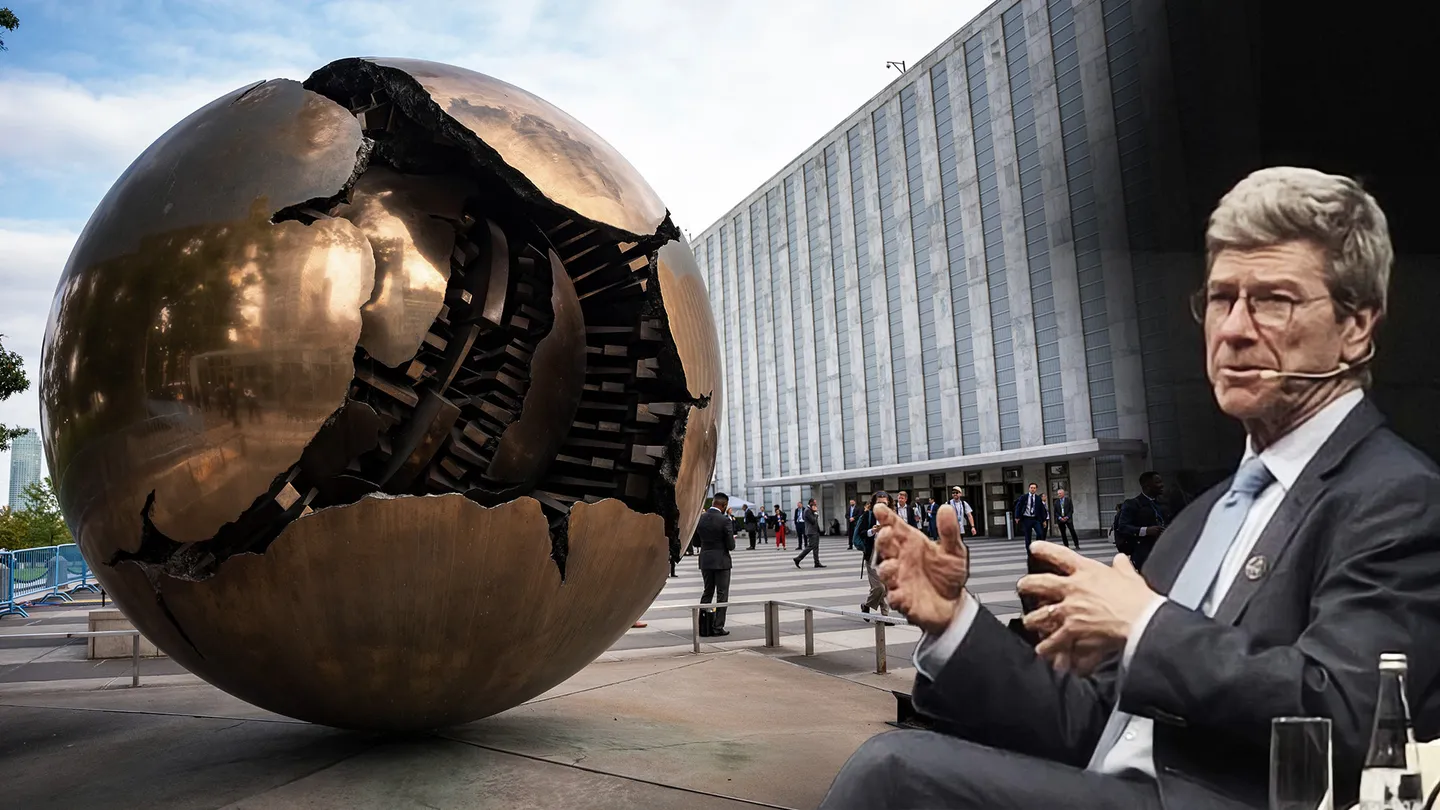
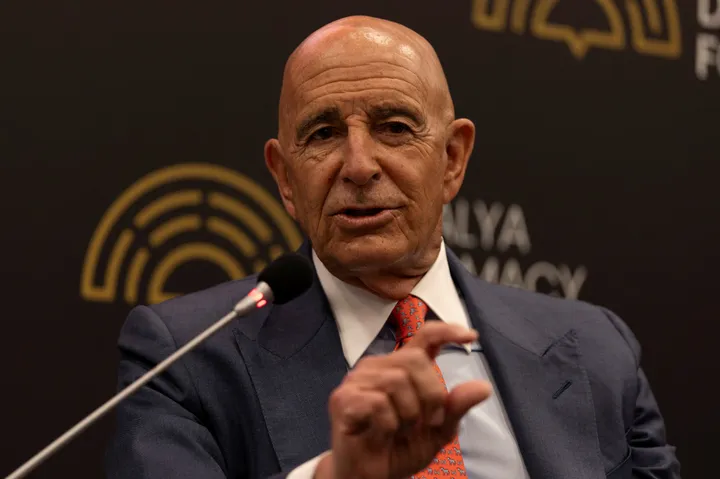
As the United Nations marks its 80th anniversary on Friday, noted American economist and UN advisor Jeffrey Sachs has called for sweeping reforms to the world body, urging the creation of a “UN 2.0” that reflects the rise of the Global South – a geopolitical and economic reality of the 21st century.
In an exclusive interview with TRT World, Sachs argued that the United Nations – which was founded on October 24, 1945, reflecting the post-World War II world order – has never been more essential yet is struggling to function properly due to a crisis of leadership and legitimacy.
“We need the UN more than ever, but of course the UN is not functioning properly right now for a number of reasons,” he said. “The most important reason is the United States is not playing by the rules… the US is the country in the world least aligned with UN principles right now.”
Citing a quantitative index his team produces periodically, Sachs said, “The United States comes out 193rd out of 193 countries because of all the violations of international law, because of all the wars, because of the unilateral sanctions that the US imposes, because the US doesn’t ratify treaties, because the US walks out of conventions, because the US doesn’t participate in particular UN agencies.”
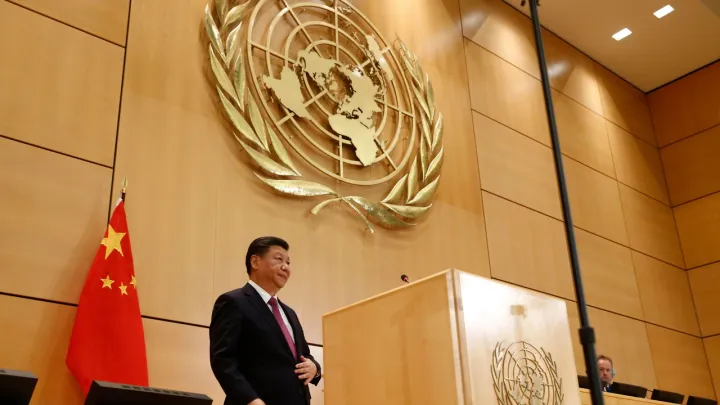
Sachs, who serves as President of the UN Sustainable Development Solutions Network, has proposed the establishment of a major UN campus in China — an idea that, he believes, would both symbolise and strengthen global cooperation. “We need a UN that is embraced by the world… not only by countries participating in UN activities but also hosting major UN activities,” he explained.
“Currently, the United Nations is headquartered in New York… But there is not a significant UN presence in India or in China or in Latin America or in other parts of Africa,” Sachs observed.
“I have spoken about China hosting a major UN campus, especially around sustainable development, because China will be the world’s main producer of green technologies — the electric vehicles, the solar power, the wind turbines, the hydrogen economy — that the world needs for the urgent energy transformation for climate safety.”
From Roosevelt’s vision to a polarised world
Reflecting on the UN’s founding in 1945, Sachs revisited its historical roots. “The United Nations was the brainchild really of US President Franklin Delano Roosevelt, who was, in my opinion, America’s greatest president in history,” he said.
Roosevelt’s vision, he explained, was to create an organisation where “the major powers — which at that time were the United States, Britain, France, Russia, and China — would be friends, cooperating to manage a peaceful world.”
That ideal, Sachs lamented, quickly eroded with the onset of the Cold War. “By the time the UN was born, the US had changed its policies toward a Cold War with the Soviet Union — an ally in World War II — and found itself at odds with China as well. This is tragic because it meant the major powers were already in conflict in the early years of the UN, and that has paralysed a lot of what the UN should have been and could have been.”
The world today, he stressed, is vastly different from the one in which the UN and the Bretton Woods institutions, notably the International Monetary Fund (IMF), and the World Bank were created.
“The relative position of the United States in 1945 and in 2025 is very, very different,” Sachs said. “The US share of world output is perhaps 14-15 percent right now, with China being a larger economy based on purchasing power. The BRICS countries have more output than the G7 countries, and they therefore need representation and voice and place fundamentally in setting the rules.”
This imbalance, he added, “is an absurdity in our world today where the US is about 4.1 percent of the world population and about 14-15 percent of world output. How can one country claim to set the rules for the rest?”

Rise of the Global South: A multipolar, multi-currency future
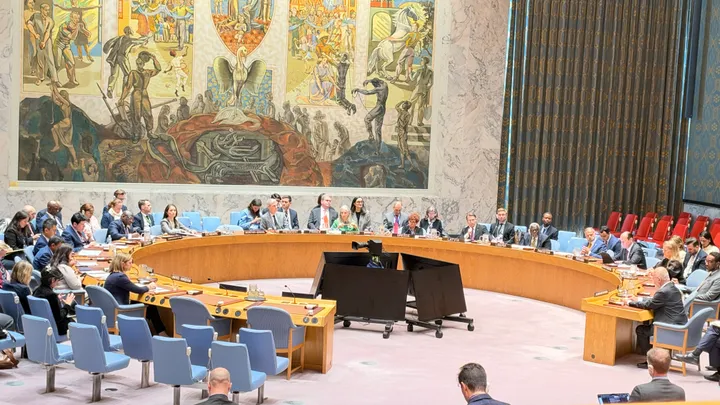
Sachs underlined that the rise of major powers in the Global South is reshaping the foundations of global governance. He called for their rightful inclusion in the reformed UN system. “India should have a seat on the UN Security Council right away. It’s the most populous nation in the world. It wasn’t even an independent country in 1945 when the seats were allocated, but here we are in 2025, and it’s a geopolitical reality that’s very important for the legitimacy and solutions of the UN,” he said.
He also urged China and India to move beyond their political differences in the spirit of multipolar cooperation. “It is in China’s interest to welcome India into the UN Security Council, because that will help make the truly multipolar and multilateral world that China wants — and India wants. I don’t see a conflict between the two,” Sachs remarked.
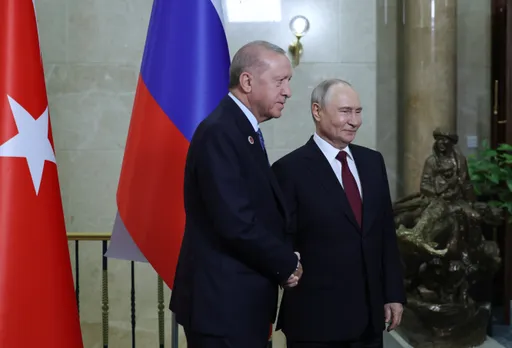
Turning to Türkiye, Sachs emphasised Ankara’s expanding diplomatic role. “Türkiye is an extremely important country… President Erdogan has a very important voice in world affairs and global diplomacy,” he said, praising Ankara’s mediating role in both the Ukraine conflict and efforts to end Israel’s war on Gaza. He opined that Türkiye is bound to play an important role in the emerging world order.
The Columbia University professor added that countries such as Brazil and Indonesia and regions such as Africa and Latin America also deserve greater representation in the reformed UN system.
Looking ahead, Sachs predicted that the growing influence of the Global South would also transform the world economy and lead to a gradual dismantling of the unipolar, dollar-dominated order. “We’re going to move not only to a multipolar world but to a multi-currency world,” he said. “The particular place of the US dollar in the world financial system will diminish significantly.”
He attributed this shift to several factors, including “the relative decline of the US in total output and the rise of China and others… the spread of digital currencies… and the US misuse of the dollar as an instrument for sanctions enforcement.”
In this emerging order, Sachs envisions “a multi-centred IMF with important centres in different regions of the world.” He added, “For the IMF to continue to function effectively, it will have to have the confidence of its members — and that means that it cannot be the US calling the shots as it does today.”
Regional cooperation over rivalry
For Sachs, the path forward lies in deepening regional cooperation. “Neighbours are the countries with whom you trade. Neighbours share rivers. Neighbours share ecosystems. Neighbours trade renewable energy more effectively, and there are countless reasons for neighbours to get along,” he said.
He warned, however, that “the great powers often instigate divisions… a pernicious divide-and-conquer mentality of the big powers.” Washington, he claimed, “plays that game often, trying to pit countries within a region against each other to keep a foothold in the region.”
Sachs’s call for a “UN 2.0” is, at its heart, a plea for legitimacy and fairness in global governance. “When the UN was created, environmental issues were not even recognised as issues… There are many things that need to change. We need an upgrade for the 21st century — a UN 2.0,” he appealed.
In his view, that reform must reflect the political, economic, and moral realities of a world no longer dominated by one power bloc. “We should be hearing many voices,” Sachs said. “But we should especially be aiming at regional cooperation and cooperation across the regions.”