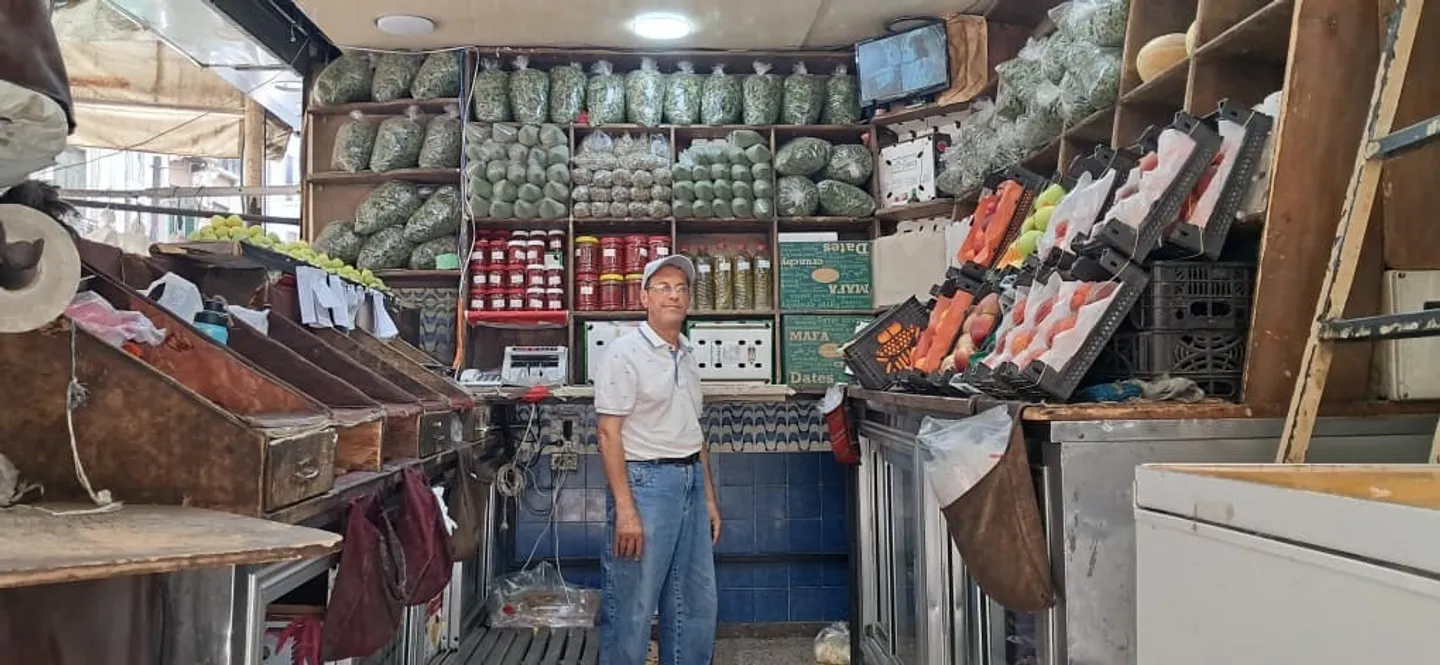
In Damascus’s Shaalan district, the sound of knives striking cutting boards sets the morning rhythm. Mountains of parsley are chopped, zucchinis hollowed and stacked in plastic bags, and okra tips shaved into perfect cones.
Women who once prepared these foods at home now haggle with sellers over piles of ready vegetables. Known to locals as Souq al-Tanabel — loosely translated to ‘lazy people’s bazaar’ — the market is less about laziness than about the economics of time.
“Markets in Muslim cities have always been about more than trade,” says Professor Mohammad Gharipour from the University of Maryland, and editor of The Bazaar in the Islamic City: Design, Culture, and History. “They were designed to bring people together, not just to move goods around.”
For him, the souq embodies Damascus’s social fabric. “It is woven into the life of the city — a place to shop, but also to catch up with neighbours, hear stories, share a coffee,” he explains.
That blend of economic and social life, he adds, is what gave historic bazaars their endurance. By keeping that tradition alive, Souq al-Tanabel serves as “a real community anchor rather than just a commercial space.”
That sense of community is also what continues to draw visitors.
“Walking through Shaalan, I was struck by stalls lined with vibrant vegetables — all prepped and ready to cook. Hollowed zucchinis, trimmed okra, beans with strings removed, even kilos of parsley chopped for tabbouleh,” says Elif Nuran Ozgun, a 26-year-old editor from Türkiye, where she says she’s used to picking up her frozen peas or greens from the local supermarket.
Enchanted by the bazaar during her summer visit to Damascus, she adds: “Seeing traditional Syrian dishes ready-made at the market amazed me. Syrians love enjoying life outdoors, yet never compromise on good food. They’ve truly unlocked the secret to a joyous life.”
The bazaar’s vitality is mirrored in its role as a source of survival. The average income for women working there is about US$5 a day; a small amount on paper, yet a lifeline for families struggling to survive in the post-war economy.
Despite Syria’s economy contracting by 1.5 percent in 2024 and the World Bank forecasting only a fragile 1 percent growth in 2025, the bazaar remains one of the few places weaving together livelihoods, resilience, and social solidarity.
Origins in the 1980s
Souq al-Tanabel’s roots stretch back to the 1980s, when vendor Haitham Al Harith, now 60, first began preparing vegetables for customers with particular culinary needs.
“Some dishes required [extra] preparation, so we carved zucchini and prepared eggplants for him. I liked the idea and continued,” he tells TRT World.
What started as a one-off favour quickly turned into a system. “Later, we expanded the variety: carved zucchini, eggplant, potatoes, shelled peas, peeled carrots… Over time, the business caught on. First, we opened two or three shops, then it spread to other markets,” Al Harith says.
Back then, shopping in bulk was a heavy burden. Carrying 50 kilograms of broad beans home meant hours of shelling for the entire family. Al Harith saw an opening. “We sold ready beans — even boiled them and stored them in freezers,” he explains.
For many households, especially working women, this convenience transformed daily life. It wasn’t just about comfort; during electricity and water shortages, prepared vegetables saved both time and energy.
The market’s popularity, however, soon earned it a nickname, Souq al-Tanabel.
“But I don’t see it as laziness — I see it as development,” Al Harith insists.
“Laundry was once washed by hand, then washing machines arrived. The same with television and the remote control. As the world developed, so did we.”
A regional and global link
By the 1990s, Damascus was seen as the commercial heart of the region. Lebanese, Turkish, and Jordanian visitors flocked to Souq al-Tanabel, drawn by its variety and freshness — products often unavailable in their own countries.
The concept even travelled abroad: in Gaziantep, a market called Tembel Avrat Pazari, or ‘Lazy Wife Bazaar,’ tracing its roots directly back to Damascus’s model.
“I remember many Lebanese coming over on weekends to shop in Souq al-Tanabel, because it was cheaper than what they had at home,” Faedah M. Totah, an associate professor of anthropology at Virginia Commonwealth University, tells TRT World.
Unable, as yet, to return to Damascus to witness firsthand how the market endured during and after the war, Totah recalls the souq was not just a neighbourhood fixture but a regional destination, with visitors carrying sacks of hollowed zucchini and shelled peas back across the border.







In this way, Souq al-Tanabel anticipated the global convenience-food trend by decades.
While frozen meals and pre-packaged salad kits only began filling supermarket shelves in the US and Europe in the late 2000s, Damascene women and traders had already perfected a system that lightened household burdens, saved time and energy, and preserved social bonds. For them, the market was never about laziness — it was about survival, adaptation, and community.
For Dr. Faris Arab, 38, an orthopaedic physiotherapist now living in New Delhi, Souq al-Tanabel is inseparable from the scents and sounds of his childhood. “I used to buy all our groceries there — everything from bread to milk to vegetables,” he tells TRT World.
His fondest memory belongs to the bakery just behind his home. “The smell of fresh chocolate and cheese croissants would rise to our floor. I would rush down like Jerry the mouse,” he laughs, recalling himself as a nine-year-old boy.
Dr Arab, displaced by the war 14-year-old that ended after the Assad regime was toppled in December last year, still carries those memories with him. His family has been scattered, their photographs and belongings lost to fire and the rubble of armed conflict.
“Because of the war, I was deprived of my childhood country, and all my memories are slowly fading away,” he says quietly. What endures are fragments: the smell of bread, the sight of stuffed zucchini, the rhythm of vendors calling out their offers. Arab insists, the market was never about laziness, but served as an economy of care woven into daily life.
Post-war recovery in Syria
After years of conflict, many feared Souq al-Tanabel would fade into silence. Instead, the opposite has happened: its lanes feel more alive than ever. Vendors call out their offers, customers press past one another, and the rapid thud of knives against cutting boards echoes along Shaalan’s narrow streets.
“Before the war, people used to prepare in bulk for the winter,” says Imad Shurba, 47, who has sold vegetables here for nearly 25 years. “Now they buy less, but they come more often. The souq is still alive — maybe even more alive — because everyone depends on it daily.”
For scholars, the vitality of the marketplace speaks to more than commerce. “A place like Souq al-Tanabel can help people reconnect after years of disruption,” Gharipour adds. “It can bring back familiar rhythms — buying bread from the same baker, chatting with neighbours, listening to a storyteller in the corner.” These everyday moments, he says, rebuild trust and a shared sense of belonging.
At one stall, Ummu Hafiz, 60, from the Golan, adjusts her headscarf as she hollows zucchini. Her story is heavier than the sacks of peas stacked beside her. During the war, regime forces targeted her family. “They first took my eldest son while he was sleeping,” she recalls. “Then they came back for my husband.” Two more sons were also taken, another fled abroad — leaving her with six daughters and the daunting task of survival.
“Before, I never worked,” she says. “But when my husband and sons were gone, I had no choice. I came here, started peeling, bagging, and hollowing. It doesn’t bring much, but thanks to God, we never had to beg.” For Hafiz, the souq is not just a workplace but a fragile anchor in a life reshaped by war.
Gharipour notes that markets like Souq al-Tanabel are lifelines for women and small producers. “They don’t require huge investments to get started, so people can sell food or other goods with minimal barriers. That keeps income circulating inside the community. And it’s not just about selling — markets are places to learn new skills, share ideas, and build networks. For women especially, they can be platforms to run businesses, gain independence, and support their families’ and neighbourhoods’ recovery.”
For anthropologist Totah, the change is striking. “Traditionally, women did not usually work inside bazaars. They shopped there, but rarely stood behind the stalls. What we see in Shaalan is a reconfiguration — women becoming vendors themselves, reflecting both modern pressures and the impact of war,” she tells TRT World.
Totah adds that Souq al-Tanabel is more transactional than social in its commerce. “It is good to see more women involved in the souq, but this may not last given Syria’s shifting political and social environment.” Still, she notes, women are drawn to this market more than to traditional bazaars, precisely because it meets the pressing needs of daily life. Here, everything is ready to cook — a relief in households where time is scarce and work never ends.
Among those who keep the souq running today is Um Talal, 68, who has spent the past decade working its stalls. Her day begins at seven in the morning and often stretches until dusk, for her there are no days off. “I work every day out of necessity,” she explains. “From seven in the morning until seven in the evening, then I go home. Most of what we do goes to the shopkeepers, but the hollowed zucchini is mainly for housewives who want to cook quickly.”
Her labour is relentless, but it sustains an extended family. “I take care of my divorced daughter and her two children, my son and his two girls, and two orphaned girls. A whole family, carried together,” she says.
Chronic illness accompanies her shifts. “I have diabetes and high blood pressure, but I keep working. It is tiring, but God provides our sustenance through these stalls.”
For Um Talal and hundreds of others, the souq is both a workplace and a lifeline — a fragile but essential bridge between her family’s survival and the city’s daily rhythm.






_1.JPG?width=512&format=webp&quality=80)