Host: Ezgi Toper
Guest: Maria Ortega
Producer: Ezgi Toper
Craft Editor: Nasrullah Yilmaz
Production Team: Afzal Ahmed, Mucteba Samil Olmez, Khaled Selim
Executive Producer: Nasra Omar Bwana
Transcript
MARIA: Trump said – when he was sworn in – that the Russia-Ukraine war was gonna be over in a day. It's been more than 8 months. It's affecting them on having access to oil and gas. Now, what's the place that is more near to the US with big reserves of oil? Venezuela.
EZGI: You’re listening to “In the Newsroom” and I’m Ezgi Toper. In this podcast we have conversations with colleagues and experts that go beyond the headlines. Lately, tensions have been rising between the United States of America and Venezuela.
TRUMP: They continue to send drugs into our country. Venezuela. They’ve been really nasty and we can’t let that happen.
EZGI: US President Donald Trump is accusing the Venezuelan President Nicholas Maduro of heading a drug trafficking cartel. They’re even offering…
BONDI: …historic $50 million reward for information leading to the arrest of Nicholas Maduro. Maduro uses foreign terrorist organisations like TDA, Sinaloa, and Cartel of the Suns to bring deadly drugs and violence into our country
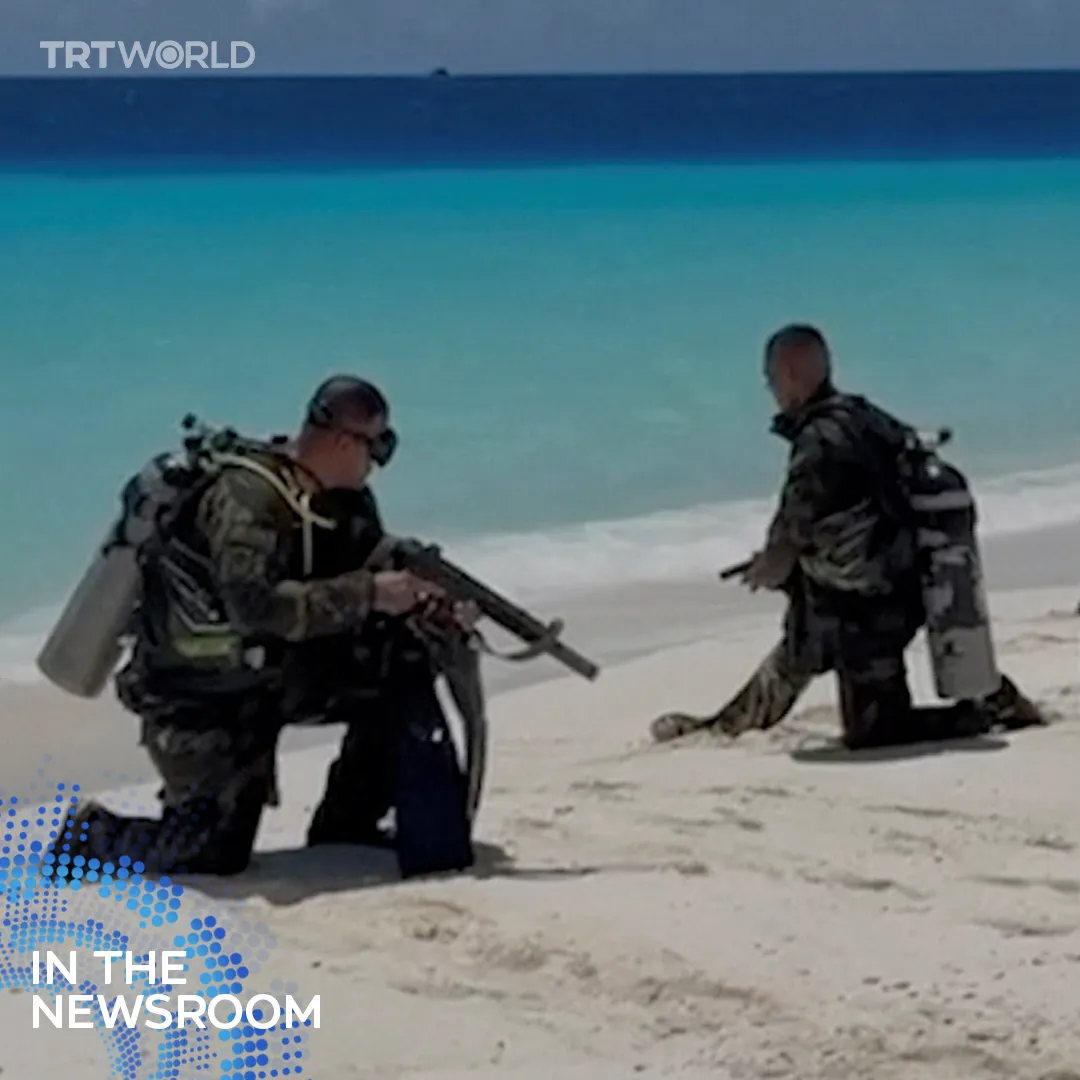
EZGI: Following this announcement by US Attorney General Bondi, there was an escalation of US military presence in the Caribbean. Most recently the US has launched missile strikes on alleged Venezuelan drug boats that left more than a dozen people dead. To better understand the US’ aims in Venezuela, I’m speaking with María Ortega, senior news editor at TRT Español.
Welcome to the studio, Maria. Thank you for being on the podcast.
MARIA: Thank you for inviting me.
EZGI: When news first broke that US forces had struck a Venezuelan boat and killed suspected cartel members, what was your initial reaction?
MARIA: Shock. So being from Latin America and being from Colombia, a country that shares almost 2,000 kilometres of border with Venezuela, I was hoping it was just one of Trump's multiple bluffs. I thought he just wanted to deploy his warships and show how powerful his military is.
Because historically, US and Venezuela relationships have not been good since late 90s. But under Trump's first term, it was the first time that the US offered a reward over Maduro's head. So that time they charged him with narco-terrorism, he and other senior officials, and accused them of flooding the US with cocaine and using drugs as a weapon to undermine the health of Americans.
A little bit of months earlier, a leader from the opposition in Venezuela, Juan Guaido, self-proclaimed as interim president of Venezuela, not recognising Maduro's presidency. When this happened, the US recognised Juan Guaido as the true president of Venezuela, which means the relationship between the two countries, of course, had to break. And the tensions have been, let's say, all over the news since then.
EZGI: Venezuela’s disputed July 2024 presidential election saw Maduro declared the winner, amid contested results. As Maria points out the US refused to acknowledge his win and recognised his opponent instead. In the months that followed, tensions escalated. On February 6th, 2025, the US designated several Latin American groups, including Tren de Aragua – a criminal organisation from Venezuela – as terrorist organisations.
MARIA: So, also, Tren de Aragua it's like an organisation that grew up and fortified itself between the shadows. So, the first time we hear about El Tren de Aragua, it's coming from a jail in Venezuela that the government at some point intervenes because the leaders were ruling the prison. Again it’s very hard to come in and verify that.
Now for years, some authorities in the US, the DEA – the drug office administration – have said El Tren de Aragua has come even to the US, is trafficking, but again, what experts say there are no clues to link El Tren de Aragua with drug trafficking.
There are people trafficking drugs in the Caribbean? Yes, they are. But are they from Venezuela? We don't know that. See, the reality of drug cartels have become so complex and interconnected, like intertwined in the past years that you really don't know where the connections or links or roots are. So in Colombia there are reports that Mexican drug cartels have reached there, but also in Mexico then you have reports that Colombian drug cartels have reached there. So, if you ask me, of course, probably these organisation have made agreements between each other, but to be so sure about how they operate you need investigation for years and this is what several groups of investigators and think tanks devote their life to. But it's not as easy as to say “oh yeah, all the drug is coming from El Tren de Aragua” because there are even new organisations that we still don't know about that can be also meddling in the drug routes.
EZGI: A few months later, on July 25, the US also labelled the Venezuelan-linked “Cartel of the Suns” a terrorist group and said it was led by Maduro, essentially accusing him of being a top drug trafficker, as the White House Press Secretary says:
LEAVITT: The Maduro regime is not the legitimate government of Venezuela. It is a narco-terror cartel. And Maduro – it is the view of this administration – is not a legitimate president. He is a fugitive head of this cartel who has been indicted in the United States for trafficking drugs into the country.
EZGI: Is it possible that he really is, you know, one of the largest narcotics traffickers in the world, as Trump is claiming? Do we have any evidence to back this up?
MARIA: No. So the US is naming the Suns Cartel, El Cartel de los Soles in Spanish. What experts say is there are no evidence of this existence of the Suns Cartel. There's no way. At some point we reported that it was first to mention like to refer to military meddled or involved in corruption cases but it's not a proper organised gang like Cartel de Sinaloa, whose leader we all know is El Chapo. Now El Chapo is in the US and convicted to prison for life. So it’s very hard – At this point, everything has come to Trump says, Maduro says, but what's happening in between lines is very difficult to verify because how can you verify an attack on the sea?
EZGI: Can you walk us through the details about these naval strikes? How many vessels have been hit? What's been targeted, and what's the US's justification for all of this?
MARIA: OK, so, first we need to keep in mind that the information is very little. Until 8 hours ago it was like two strikes. Now Trump is saying there was three, but that we only saw two of them. With which weapons were they executed the strikes? We don't know. The time frame? They released videos, but do we know that they were like actual in those dates? We don't know.
EZGI: As Maria says details on the vessels that were destroyed are a bit sketchy. But according to Insight Crime, a think tank dedicated to the study of organised crime in the Americas, these vessels or so-called “go-fast boats” usually have two to four crew. But in the first strike it was claimed 11 people on board were killed. Having this many people on board suggests there may have been a human smuggling element as well.
Their research also said the first boat appeared headed for Trinidad and Tobago, which is unusual for US-bound vessels. Those shipments typically leave Colombia or Venezuela’s north coast toward the Dominican Republic.
MARIA: Where are the proof or the evidence that these vessels were behind a criminal organisation as they claim? Let’s remember these were people inside those boats. People with family. I'm not saying they're innocent. I'm not saying they're guilty. But even the case, you don't just blow up a vessel on suspicion as you highlight. So, human rights organisations said that the circumstances that surround these attacks raise serious questions about the legality, accountability and respect for international human rights law.
EZGI: Critics also say these actions may be undercutting Washington’s credibility on rule-of-law issues, as Democratic Senator Adam Schiff of California vocalises:
SCHIFF: These lawless killings are just putting us at risk because it means other countries now may decide to blow an American ship out of water and claim it was engaged in drug trafficking. You can imagine what our response to that would be. I don’t want to see us get into some war with Venezuela because the president is just blowing ships willy-nilly out of the water.”
EZGI: And many are asking: why would the US destroy the boats and kill the crew on board anyways? As opposed to intercepting them, confiscating evidence and arresting those on board in an attempt to gather intel on connections to cartels. This may suggest there’s something else at play.
If we're setting aside the official explanation that this was all about drug interdiction, what do you think the US is actually trying to achieve with these strikes, with this escalating military action against Venezuela?
MARIA: Short answer: oil. So, Venezuela has a lot of oil and the United States, we know historically, has been very interested into other countries' oil. Trump said before he got into office that the Russia-Ukraine war was gonna be over in a day. It's been more than 8 months and still not and that war somehow like at the end everything in the world is connected, it's affecting them on having access to oil and gas. Now, what's the place that is more near to the US with big reserves of oil: Venezuela.
EZGI: Venezuela has the world’s most oil, estimated at 303 billion barrels as of 2023. The United States, by comparison, holds about 55 billion barrels, placing it ninth globally. In other words, Venezuela’s oil reserves are over five times larger than those of the US.
MARIA: Maduro has claimed this.
MADURO (DUBBED): But the objective is not the fight against drug trafficking. The objective is to enter and take control of Venezuela to impose colonial authorities, and to carry out regime change in order to sees Venezuela‘s immense oil and gas wealth. That is the objective.
MARIA: He has said this has nothing to do about drug trafficking. This is all about our oil and our gas and our resources, now of course he also needs to put some political weight on it and it's “they want a change of regime.” Which can be or not, but I think their main purpose is to guarantee themselves some oil by pressuring Maduro.
EZGI: American sanctions on Venezuela’s oil exports, imposed in 2017 and tightened in 2019, had cut off access to US markets and forced Venezuela to redirect exports mainly to India, Cuba and of course… China.
MARIA: So over the past years and decades, China has little by little gained some influence over the region, over Panama Canal. They have now agreements with Peru. And it's something that the US came to realise recently. So before he got to office, Trump said he was going to get the Panama Canal again. What's the story of Panama Canal? Panama Canal connects the Pacific Ocean with the Atlantic Ocean.
EZGI: The Panama Canal is a key shipping shortcut that saves ships over 20,000 kms compared to sailing around South America. Between 13,000 and 14,000 ships use the canal every year. And today, some $1.8 billion in tolls are collected annually. So, control or influence over the canal could affect everything from shipping routes to economic leverage.
MARIA: Just yesterday, Richard Grenell, Trump's special envoy, said in the Conservative Political Action Conference that he was troubled about how administration – previous administration — ignored Latin America and allowed China's advance.
EZGI: According to research, China has invested tens of billions in Venezuelan oil, power, and infrastructure under the Belt and Road Initiative (BRI). This is China’s global infrastructure and investment strategy – they launched in 2023.
And while all this is happening internationally, at home the US has also launched a major deportation process that is directly impacting Venezuelans and continuing this false narrative that many of them are criminals and drug dealers
MARIA: Venezuelans have been fleeing for decades of their country for different reasons, main of what they say is economic reasons, and most of them have been in Colombia but also they go all the way up to the north, to the US.
Venezuelans now represent most of the migrants. He promised deportations. He promised to take out of the country what they called criminal immigrants. So, two things: one, they started criminalising undocumented immigrants. So, they start framing every immigrant without a regular situation in the US, making him or her a criminal. So that's what's the way they could deport them.
Now, where are you gonna deport all these people that don't have a regular status if you don't have relationships with that country? Because let's remember that they recognise another president.
US and El Salvador sign a contract, an agreement, to receive “criminal immigrants.” So, some months ago, they sent a flight of 252 people from US to El Salvador to CECOT. And that started breaking the relationship because Maduro's government is “why did you send them there? Give them to us because they don't even have representation” like, you know, you when you are arrested you have the right to legal representation so come back like give it, give them back and like we can you know take care of them and in the first days of that deportation, that was very polemical all over the news.
Maduro's government said these, Venezuelans, not all of them were Venezuelans, but most part of them said that the Salvadorian authorities didn't, let these people have an attorney. And they're still there So you have OK El Salvador like taking the migrants then you have all these facilities you want to build to put the migrants there
Even Guantanamo if you remember this historic prison in a military base in Cuba. He ordered some months ago to construct a facility to also put migrants there and also it's the same context of this prison in a super harsh environment where you cannot escape at any cause.
So, at the end of the day Trump and Maduro: they are leaders, they are in power, they have options, but the more lasting effects are on the regular citizens, people that still need to go out and work and even people that fish in the Caribbean like if that's your way of living like of providing for your family, what are you gonna do if now the Caribbean is full of war ships?
EZGI: Venezuela’s economy has collapsed since 2016 due to hyperinflation, debt, sanctions, and heavy reliance on oil. According to some estimates, 80 percent of the population lives in poverty. So, Venezuela would be extremely ill-equipped to handle a war with the United States.
MARIA: For the region, it could be the worst thing that could happen because we are, Latin America, is a region embattled by violence by drug cartels. Drug trafficking is a reality in Latin America but also poverty but also migration but also a lot of things that a war would only make worse and make families being broken, people being killed.
This is gonna open the road to US establishing more military bases in countries that will accept. So for example, Ecuador. Ecuador now is doing a referendum where they will ask the people if they want to allow military bases again because military bases right now in Ecuador they're unconstitutional. So, the President Daniel Noboa that is being very close to Trump recently he is pushing for this referendum so if the people vote yes then you can basically justify the military bases over this threat in the region of drug trafficking. They will reach an agreement at some point
EZGI: So, while Trump and his administration frame the latest moves in Venezuela as a fight against narco-trafficking, more and more experts are saying it’s more about securing oil, toppling Maduro’s government and countering China’s growing influence in Latin America.
Washington’s recent military moves are sending a clear message to Beijing: the US won’t stand by while China builds investments or strategic footholds in Venezuela. In other words, Venezuela could end up as a proxy battleground in the US–China rivalry, which could really shake up stability in the region
Thanks for tuning in. Until next time, I’m Ezgi Toper, and this was “In the Newsroom”.