 Murat Sofuoglu
Amid escalating trade tensions and growing global financial unease, the United States and China have been forced to confront the limits of their economic brinkmanship.
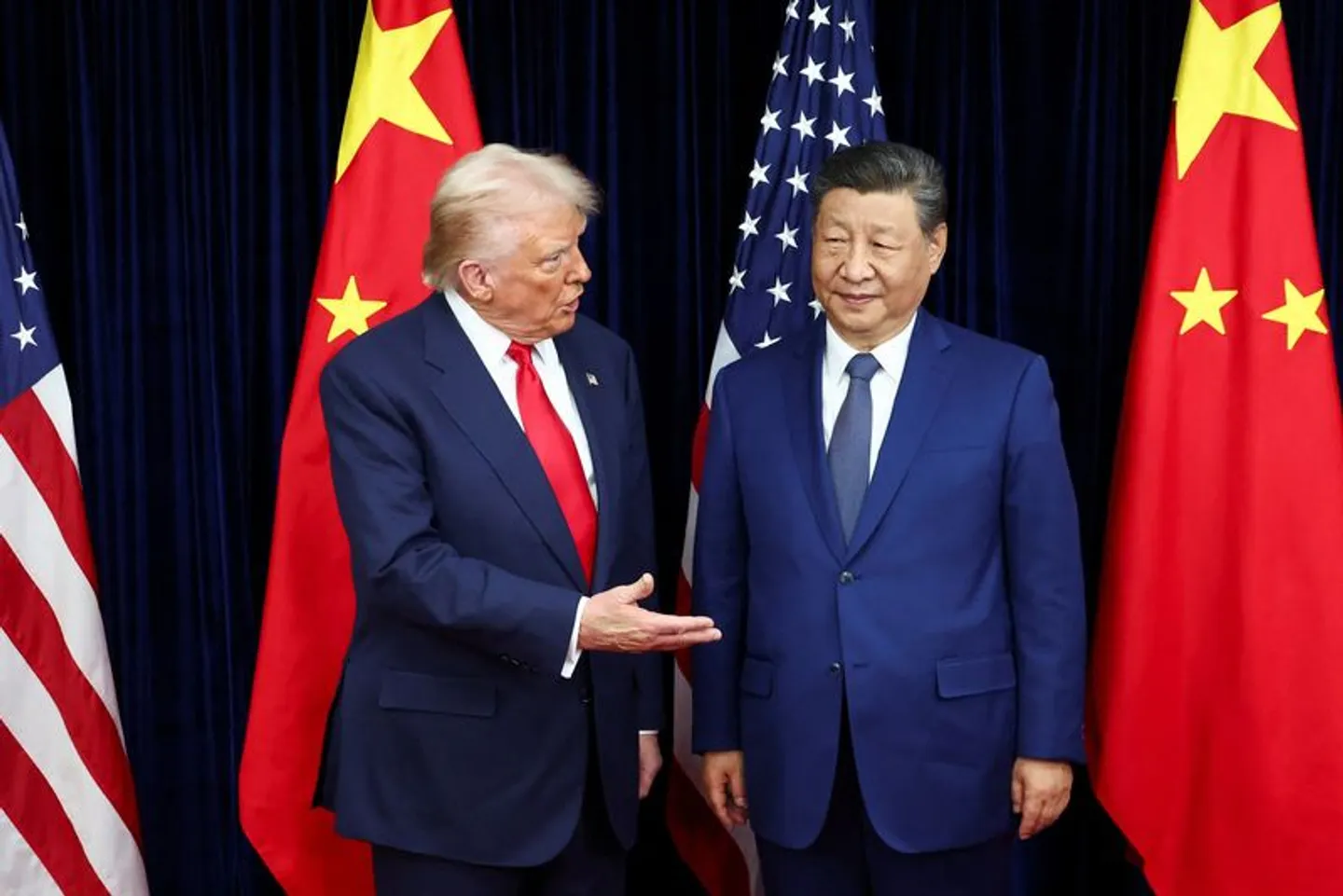
President Donald Trump’s outreach to China’s Xi Jinping has led to a one-year pause in a trade war that has involved retaliatory tariffs imposed by both sides.
Trade tensions have rattled global markets, with the US experiencing a rapid decline in its treasuries during the peak of Trump’s significant tariffs in April, signalling that punishing Beijing could be costly for Washington.
Since then, both sides have attempted to find a solution to issues mainly caused by tariffs and export restrictions. Trump viewed his Asian tour as an opportunity to meet with Xi and break the deadlock, as neither side seems willing to risk the serious consequences of a complete rupture.
“Both sides are dependent on the other in certain areas. A full-blown, precipitate decoupling would have serious consequences for both sides, too great for them to stomach at present,” Charlie Parton, a senior associate fellow at Royal United States Institute (RUSI), a British think-tank, tells TRT World.
As a result, both Trump and Xi “looked into the abyss and thought that it was too dangerous,” to break up for the two states at the current stage, he says.
At the Trump-Xi meeting in Busan, South Korea – their first face-to-face encounter since 2019 –both sides agreed to lift their respective export controls.
Beijing pledged not to implement its new export licensing rules for processed rare earth elements, while the US agreed not to reinstate restrictions on many Chinese companies purchasing American technologies.
China owns 70 percent of the world’s rare earth reserves, but it processes nearly 90 percent of them, which the US defence industry and many American companies producing high-tech products like electric vehicles and phones require.
In early April, at the height of trade tensions between the two countries, Beijing announced restrictions on seven rare-earth minerals in retaliation for Trump’s tariffs on Chinese goods, leading many in Washington to rethink their pressure strategy against Xi.
Beyond US-China economic dependence, various military conflicts from Ukraine to Gaza and increasing political tensions in the Middle East raise trade costs and financial risks, making both states second-guess their trade war, according to Mehmet Babacan, a professor of economics at Marmara University.
“The inflationary effects of a trade war between China and the US also put pressure on financial markets as expectations of easing financial conditions to reduce borrowing costs almost everywhere deteriorate,” Babacan tells TRT World.
‘A truce not a peace deal’
Trump described his meeting with Xi as “extraordinary”, stating that “All the issues have been resolved” as Xi talked about a “consensus”, which has addressed “important economic and trade issues”.
Although both leaders have indicated that the two countries are likely to sign a comprehensive trade deal, mutual mistrust still clouds the ongoing discussions. Analysts say the Busan meeting is more likely to result in a temporary truce rather than a long-term de-escalation of tensions.
The Chinese Communist Party (CCP), which has controlled Beijing single-handedly since 1949, does not fully trust US leadership, suspecting that Washington aims to suppress and contain the rising power of the Asian giant, Parton says, referring to Pacific tensions and global economic rivalry, which spans from South Asia to Africa and Latin America.

“President Trump is hardly consistent in his policymaking, so Beijing must consider that he could change his mind, which is not a basis for long-term trust,” he says, leaving the underlying relations between the two states unchanged at a fundamental level.
Economics professor Nurullah Gur of Marmara University describes the outcome of the Xi-Trump meeting as little more than a temporary pause in tensions.



“It’s a truce,” he says, noting that while Trump rated the meeting “12 out of 10,” it failed to deliver any substantial breakthrough.
“I’d call it a 6 out of 10 for the mid-term,” Gur tells TRT World, adding that both sides fell short of a comprehensive agreement that could produce lasting effects.
According to Gur, the clash between the two powers stems from competing priorities: Xi’s determination to keep China’s economic engine running at full speed both at home and abroad, and Trump’s desire to prove to his “Make America Great Again” base that he is defending US businesses from China’s growing influence.
A “one-year truce” would allow both sides to reassess their next steps.
They cannot reach long-term peace because the two states face serious competition in critical areas, ranging from AI to access to energy sources, particularly rare-earth elements, he adds.
“The US perceives China as a growing threat to its global superpower status. As a result, US-China disagreement is a structural issue which can not be fixed by lowering tariffs or suspending export controls or agreeing to buy more American soybeans,” Gur says.
In recent years, under Xi’s leadership, China has demanded that the US reshape its old relationship into a “new type of great power relations”, urging reforms in international financial institutions like the World Trade Organisation, the World Bank, and the IMF, to align with Beijing’s increasing global influence.
But no real sign has emerged from the recent Xi-Trump meeting that both sides agreed to reform the international financial order or reached consensus on a roadmap to update old trade agreements.
Who has the upper hand?
Experts say no clear winner has emerged from the Busan meeting.
The US, diversifying its access to rare earth elements, holds crucial importance, so at least securing a one-year Chinese suspension on these minerals’ restrictions will give some time to the Trump administration to expand its reach to other countries around the globe.
During his recent Asia tour, Trump signed trade agreements with Japan, Malaysia, Thailand, Vietnam, and Cambodia, which also aim to secure US access to their rare earth minerals. The Trump administration also previously signed such an agreement with Ukraine.
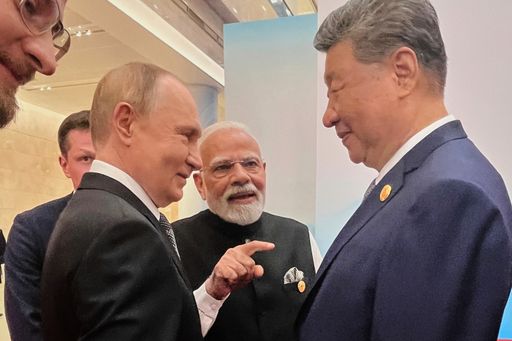
Djoomart Otorbaev, a former prime minister of the Kyrgyz Republic, observes that Xi’s “calm smile” and measured reflection to his meeting with Trump signal Chinese strategic patience and consistency.
“Trump may have stolen the cameras. But Xi quietly took the wheel. In geopolitics, as in history, it’s not the first to speak who wins — it’s the one who can afford to wait,” he wrote in a Linkedin post, saying that Beijing is playing a long game against Trump’s “total success” story aimed for domestic consumption.
For now, nothing indicates a clear winner in this trade war since it is not over yet but merely paused.
If both sides do not fall out over some new or current issue, they will review everything in a year or so, Parton says.
“This is by no means a final settlement.”