 Esra Karataş Alpay
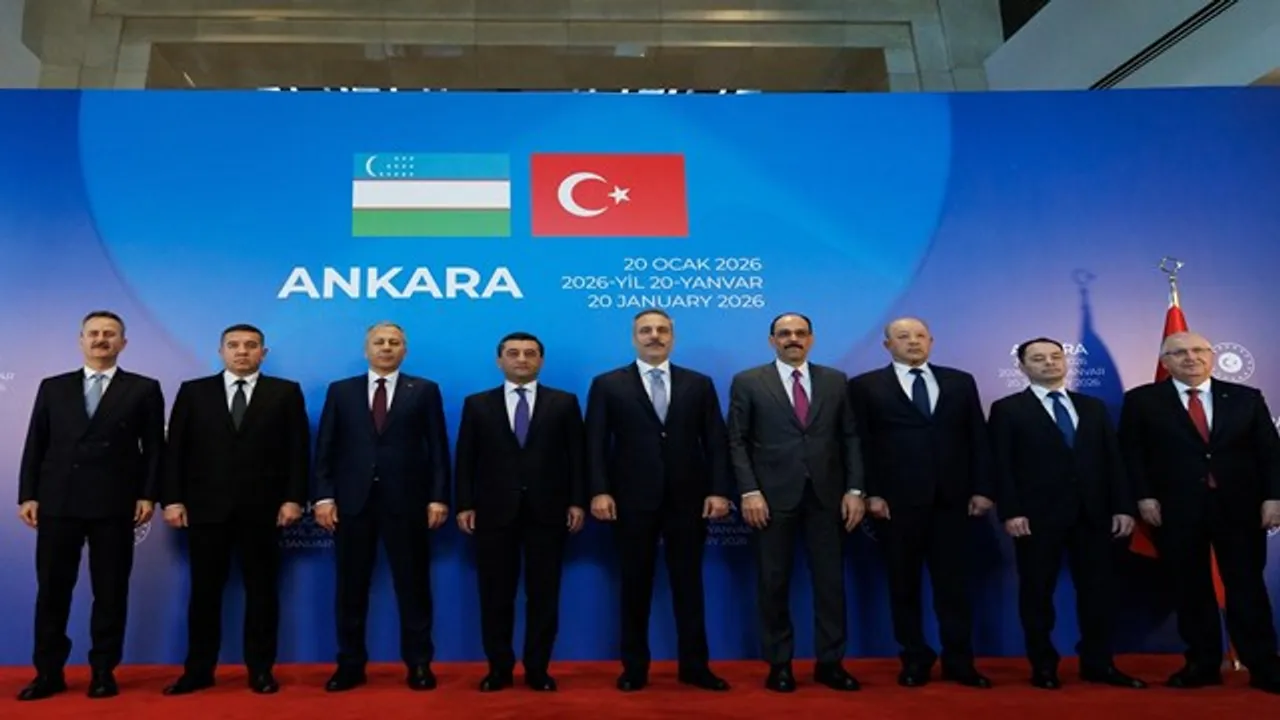
Türkiye and Uzbekistan held crucial talks in Ankara on Tuesday, marking a decisive turning point in bilateral relations and signalling a transition from conventional diplomatic engagement to a fully integrated strategic partnership.
The talks, convened in what was officially termed the 4+4 format, brought together officials from the departments of foreign affairs, defence, internal security, and intelligence—an arrangement that reflects the evolving nature of regional and global security challenges.
The format itself underscored a broader transformation – four crucial sectors are now being handled within a single strategic framework, accelerating decision-making and strengthening coordination in times of crisis.
Türkiye was the first country to officially recognise Uzbekistan when it emerged as an independent nation in 1991 from the ruins of the erstwhile Soviet Union.
A Muslim-majority country, Uzbekistan is one of the world’s only two double-landlocked nations – all its neighbours are also landlocked – along with Liechtenstein. It is also a member of the Organisation of Turkic States.
From bilateral diplomacy to integrated security
International relations professor Oktay Tanrisever of the Middle East Technical University in Ankara says that the mechanism for the Ankara meeting has been designed to deepen the strategic dimension of bilateral ties.
“The 4+4 format meetings that Türkiye has developed with Uzbekistan are of a nature that will deepen the strategic dimension of bilateral relations,” he tells TRT World.
According to Tanrisever, translating cooperation into concrete projects will have effects well beyond the bilateral sphere.
“This approach will not only allow the two countries to revitalise the Middle Corridor,” he adds, “but, through coordination with Azerbaijan, it will elevate Türkiye’s security and strategic cooperation with all its partners in the Caucasus and Central Asia to a regional level, creating a significant force multiplier.”
The regional security context loomed large over the discussions.
Developments along the Central Asia corridor, especially uncertainties and instability risks stemming from terror groups in the region, continue to shape threat perceptions across the region.
Türkiye and Uzbekistan’s decision to assess these risks jointly reflects an emerging shared strategic outlook.
The prominence given to security was also closely linked to economic considerations, as safeguarding transportation routes and connectivity corridors has become inseparable from maintaining regional stability.
Shared threat perception
Associate Professor Basak Kuzakci from Marmara University in Istanbul highlights this integrated approach as a defining feature of the talks.
“The Türkiye–Uzbekistan meeting in Ankara marks the beginning of a new phase in bilateral relations,” she tells TRT World.
“The fact that the talks were held in the 4+4 format demonstrates that diplomacy is now being addressed alongside security, defence, internal affairs, and intelligence. This shows that relations have moved beyond traditional bilateral engagement and are being placed within a strategic framework.”
Kuzakci underlines that fragmented threat assessments are no longer an option.
“Counterterrorism, transnational criminal networks, irregular migration, radicalisation, and cybersecurity cannot be assessed in isolation,” she notes, adding that bringing these issues to the same table as foreign policy decisions strengthens both speed and coherence in crisis response.
“It enhances coordination capacity precisely when it is most needed.”
A strategic gateway
Beyond immediate security concerns, the Ankara meetings also carried broader geopolitical implications.
Uzbekistan’s position as a strategic gateway featured prominently in expert assessments.
Professor Tanrisever describes Uzbekistan as “one of Türkiye’s key gateways to Central Asia,” while also noting its importance as “a critical corridor to South Asia through Afghanistan and Pakistan, making it an indispensable strategic partner.”
In this sense, the bilateral relationship is increasingly viewed as a bridge connecting Central Asia, South Asia, and the Caucasus within a wider regional architecture.
The Turkic world dimension further reinforced the strategic weight of the talks. Kuzakci stresses that the Türkiye–Uzbekistan axis forms one of the structural backbones of Turkic world cooperation.
“The institutionalised security coordination established here offers a model that could also serve as a reference for multilateral platforms,” she says.
“As common threat perceptions deepen, the capacity to produce collective responses increases. This shows that political solidarity is not confined to rhetoric but is translated into practical action.”
The security-focused discussions were complemented by institutional planning. On the same day, the Joint Strategic Planning Group convened and the 2026–2027 cooperation programme was signed, providing a medium-term roadmap for bilateral relations.
According to Kuzakci, this framework demonstrates that the partnership is being built systematically rather than progressing in an ad hoc manner.
“Strategic partnership requires an integrated approach that extends from security to the economy, from energy to cultural interaction,” she says, “and these engagements show that this holistic framework is becoming institutionalised.”
While the most recent meetings resulted in the signing of an agreement in the field of military health, Tanrisever points out that the broader implications go further.
“It is clear that cooperation in regional security and intelligence has also been strengthened,” he says, arguing that close presidential-level cooperation, reinforced by sustained ministerial dialogue, can translate strategic alignment into tangible and institutionalised mechanisms.
Looking ahead, both experts agree that the impact of the 4+4 format will become increasingly visible.
Enhanced security coordination, more systematic defence and defence industry cooperation, and connectivity projects advancing on a firmer security foundation are all expected outcomes.
“This meeting should be seen as a critical threshold—one that strengthens the Türkiye–Uzbekistan strategic partnership and enhances its capacity to contribute to regional stability,” Kuzakci concludes.