Host/Producer: Ezgi Toper
Craft Editor: Nasrullah Yilmaz
Production Team: Afzal Ahmed, Ahmet Ziya Gumus, Mucteba Samil Olmez, Khaled Selim
Executive Producer: Nasra Omar Bwana
TRANSCRIPT
EZGI: Few awards carry as much prestige or provoke as much debate as the Nobel Prizes, most notably the Nobel Peace Prize. Since its inception, the Peace Prize has honoured champions of diplomacy and humanitarianism. Yet behind the gold medals and global applause lies a legacy of controversy and bias. From accusations of Western favoritism to what some scientists call the “curse of winning.”
I’m Ezgi Toper and on this episode of “In the Newsroom” we are looking at the not so noble side of the nobel prizes.
For over a century, these awards have celebrated humanity’s greatest achievements in six categories: physics, chemistry, medicine, literature, economics and peace.
Every October, individuals or organisations are recognised for their groundbreaking work in these fields, with of course the “peace” category drawing the most attention. This year, the Nobel committee said it received 338 nominations for the Peace Prize, up from 286 the previous year.
But the Nobel Peace Prize went to…
Maria Corina Machado is Venezuela's opposition leader and a democracy activist. The Norwegian Nobel Committee hailed her "tireless work promoting democratic rights for the people of Venezuela".
We already know the winners of 5-6 categories of the nobel prize by the time we are recording this podcast.
Among them was chemist Omar M. Yaghi, the first Palestinian to win a Nobel Prize. Raised in Jordan after his family fled Gaza during the 1948 Nakba, Yaghi grew up sharing a room with his siblings and livestock, often without electricity or running water: these hardships that later inspired his groundbreaking work addressing global water scarcity.
The winner of the economic category will be announced within the next few days.
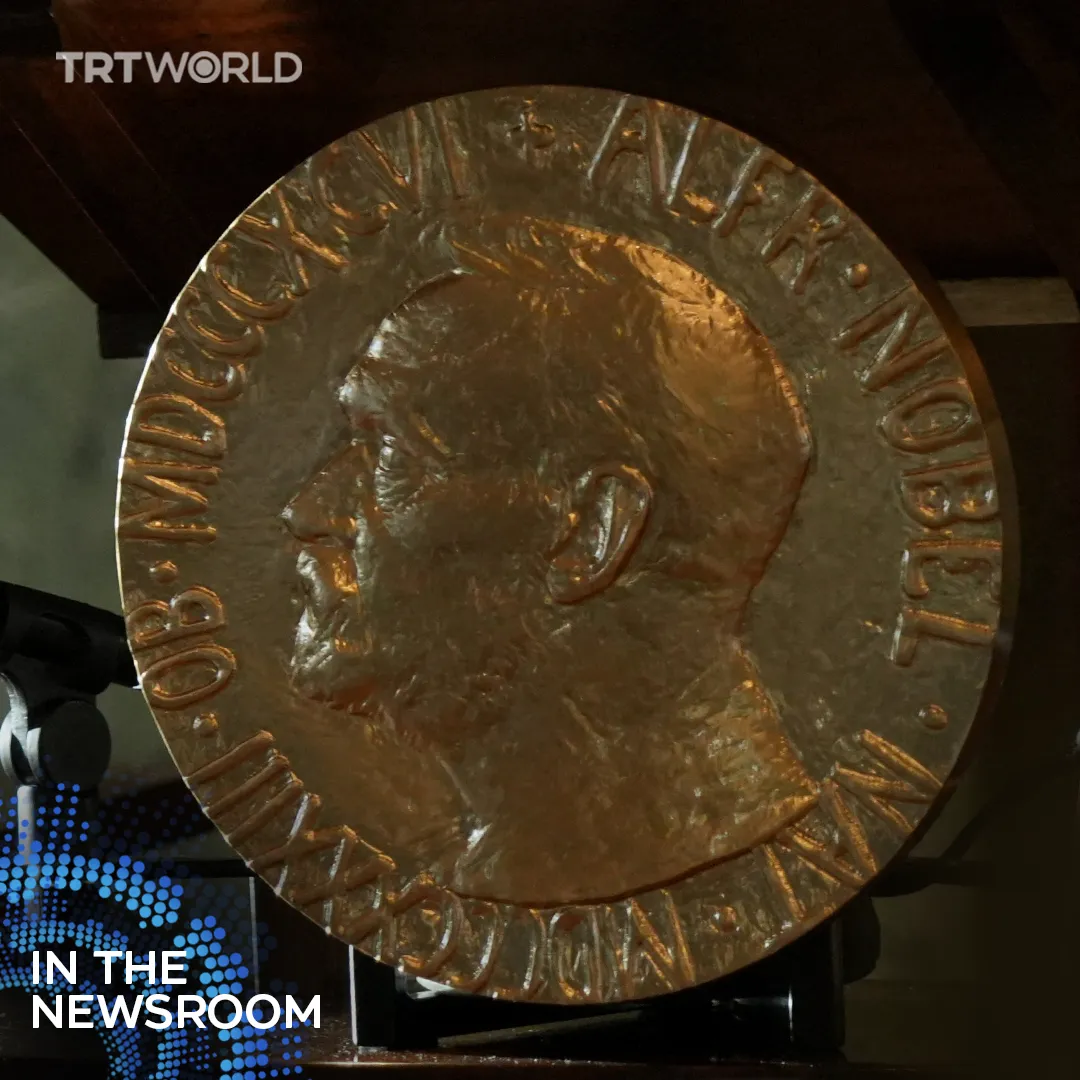
No one can deny winning a Nobel Prize is a big deal. Not only does one gain prestige and recognition for their hard work but winners also get a diploma, gold medal and cash award, worth around $1 million. But controversies go all the way back to the prizes’ founder and financier himself: Alfred Nobel.
So, what do we know about Alfred Nobel?
DEREK MULLER: What do these Norwegians know about Alfred Nobel.
EZGI: This is Australian media personality Derek Muller on his channel asking Norwegians
Derek Muller: I think we was a peacemaker
Presenter: Very peaceful?
Person 1: Yes, I think so.
Derek Muller: He did not make weapons?
Person 1: No.
Derek Muller: No, no weapons for Alfred Nobel?
Person 1: No no.
Presenter: Only peace?
Person 1: Yes.
Derek Muller: Is he Norwegian?
Derek Muller: Ehh yes.
Person 1: He’s Norwegian
Person 2: I think he’s Swedish”
EZGI: Nobel was indeed a Swedish chemist. And the inventor of dynamite, which revolutionised construction and mining in 1867 but it also made warfare much deadlier.
Nobel became extremely wealthy from the sale of explosives, earning him the label the “merchant of death.” In 1895, he left behind a will dedicating his fortune – which was around 337 million euros – to honor those who “confer the greatest benefit to humankind”.
And thus the Nobel Prizes were born. Yet throughout history and even today, the nominees for the peace prize have raised eyebrows, such as Daniella Weiss, a key advocate for Israeli annexation and illegal settlements on occupied Palestinian land.
DANIELLA WEISS: I’m more satisfied that my philosophy has had the upperhand and it indeed blocked the option of a two-state solution.
EZGI: Her nominators claim she helped "reduce violence," even as hundreds of Palestinians have been killed, as journalist Maya Nora reports.
But nominees don’t equal winners. So how does someone actually get a Nobel Prize? That’s something US President Donald Trump had been especially eager to find out.
PRESIDENT DONALD TRUMP “Everyone says that I should get the Nobel Peace Prize for each one of these achievements.”
EZGI: Okay so firstly, to be eligible for the award, a person needs to be nominated by so-called “qualified individuals.” This includes members of national governments, current heads of states, previous winners of the prize, university professors and more. In Trump’s case he was nominated by Israeli Prime Minister Benjamin Netanyahu.
PRESIDENT BENJAMIN NETANYAHU: So, I want to present to you Mr. President the letter I sent to the Nobel Prize Committee. It’s nominating you for the peace prize, which is well-deserved and you should get it.
EZGI: After nominees are submitted, winners are selected by four committees in Sweden and Norway, each with five to ten members. The Norwegian Nobel Committee, composed of five members appointed by the Norwegian parliament, selects the peace award.
The selection process lasts several months. But here’s where our next controversy appears: the public is not privy to the selection process. In fact, the Nobel Foundation prohibits disclosing information on the nominations and deliberation process for the next 50 years after winning.
It’s this very lack of transparency that fuels suspicions of biases and controversions. So let's get into some of these criticisms of the world’s most prestigious awards
And the best way to do this? Handing out controversy badges of our own.
We present the Recognition for biases to…. CONFLICT OF INTEREST
Over the years, a disproportionate number of winners have come from Western countries or align with Western ideas of peace and progress. In fact, data shows about 64 percent of all Nobel laureates come from Western countries, with the United States in the lead with over 400 winners.
Meanwhile, there are no winners from large parts of Africa, parts of Southeast and Central Asia, Central America, and many countries in the Middle East.
Although active Norwegian politicians can’t serve on the peace committee, most members are still retired politicians and not international peace experts. So, critics have said this makes the prizes susceptible to Norway’s political climate and eurocentricity.
Many also argued there can be an economic influence over committee members too. For example, German virologist Harald zur Hausen who won the medicine prize in 2008. Hausen received the award for his discovery of HPV and its link to cervical cancer.
But rumors swirled that pharmaceutical giant AstraZeneca had “bought” the prize awarded to Hausen because the company had financial ties to HPV vaccines and two Nobel Assembly members had relationships with the company.
A Swedish prosecutor did launch an investigation into possible bribery, though no evidence ever surfaced and no formal charges were made.
But while all these biases can affect all the prizes, the Peace Prize’s subjectivity is the most apparent.
and the Recognition for Conflict goes to…. WAR MONGERS
Nobel envisioned the peace prize as an award for those who worked toward ending conflict and fostering global harmony. He wrote that it should go to the person who has done “the most or the best work for fraternity between nations, for the abolition or reduction of standing armies, and for the holding and promotion of peace congresses.”
But over the years the interpretation of “peace” has broadened beyond Nobel’s original vision and resulted in many controversies as it is often awarded symbolically or politically rather than for tangible peace efforts.
For example, in 1973 when Henry Kissinger received the Nobel Peace Prize:
HENRY KISSINGER: Perhaps the most important goal any administration can set itself is to work for a world in which the award will become irrelevant because peace will have become so normal.
EZGI: The former US National Security Advisor and Secretary of State won the peace award alongside Le Duc Tho.
They won for brokering the Paris Peace Accords meant to end the Vietnam War. But Le Duc Tho refused the prize – he’s one of 2 people in history to do this.
He said he declined as there was no true peace in Vietnam. And in fact, the war was still raging, and US bombing in Cambodia and Vietnam continued even after the agreement. And critics accuse Henry Kissinger of enabling war crimes.
Similarly, in 1994, Shimon Peres, Israeli Prime Minister at the time, was honored for the Oslo Accords despite his militaristic record and role in developing Israel’s nuclear arsenal. Then in 2009, Barack Obama won just nine months into office, causing an outrage online as described by “A Special Place in Hell” podcasts hosts.
MEGHAN DAUM: The Obama Nobel thing really pissed me off. I thought he should have returned it.
SARAH HAIDER: Yup.
MEGHAN DAUM: I thought the absolute classiest move he could have made was to say “no I don’t deserve this yet. Thank you but no.” That would have been so high-road.
SARAH HAIDER: That was cringe, that was cringe. But it made me think less of that committee. It devalued all the other winners and their accomplishments
EZGI: Obama’s presidency would then oversee wars in multiple countries.
In fact, Geir Lundestad, the former secretary of the Nobel Peace Prize committee later said it was a "mistake" and "disappointment" to award Obama.
and the Recognition for Exclusion goes to…. THE RULE OF THREE
Perhaps the most common criticism of the awards is that a Nobel Prize can’t be shared by more than three people. But in an era of large, collaborative science projects, many argued that the rule unfairly excludes hundreds of contributors from recognition.
For example, in 2017 the Physics Prize went to three US scientists Rainer Weiss, Barry Barish, and Kip Thorne for the LIGO project, a large-scale physics experiment designed to detect gravitational waves. But over 1,000 scientists contributed to the project.
Also Nobel’s will mentioned awarding both discoveries and innovations, yet 77 percent of Physics prizes have gone to discoveries not inventions. So some argue that life-changing inventions like LEDs, MRI machines, or the development of the Internet do not fit neatly into the Nobel criteria.
And the Recognition in Marginalisation goes to…. GENDER INEQUALITY
The Nobel prizes most definitely have a gender bias, as many critics argue that women have often been overlooked. Nobel data shows that by 2022 the various Nobel Prizes had been awarded to 30 organisations and 960 people, of which only 61 were women.
A famous case occurred in 1974 when British astrophysicist Jocelyn Bell Burnell, who discovered radio pulsars, was excluded from the physics prize awarded to her male supervisor and another colleague.
She’s since had a distinguished career in astrophysics and has been a prominent advocate for women in science but astronomers still dub the moment the “No-Bell Prize.”
And the Recognition in Lack of Variety goes to…. MISSING CATEGORIES
Another criticism of the awards is there are no prizes for key fields like mathematics, philosophy, and social sciences as they weren’t included in Nobel’s will.
One most popular rumor is that Nobel avoided mathematics because of a personal grudge: some stories claim a mathematician had wronged him in some way. However, historians consider these stories largely mythical and instead suggest Nobel may have believed that mathematics was less directly practical.
And finally, the Recognition in Inefficiency goes to….THE CURSE OF WINNING
In 2010 Andre Geim was awarded the Nobel Prize in Physics, and he famously quipped: “The Nobel Prize has interrupted my work.”
And actually, it's been reported that some laureates suffer a decline in productivity post-award, overwhelmed by fame and expectations.
A well-known example is James Watson, co-discoverer of the DNA double helix. After winning the Nobel Prize in 1962, his research productivity slowed and he increasingly focused on public speaking and writing. While he remained influential, the shift illustrates how laureates divert from hands-on work.
In her latest piece, scientist Emma Pewsey argues we should stop venerating Nobel laureates. She wrote about this phenomenon after her visit to the Nobel prize museum in Stockholm, Sweden.
You see prize winners travel to Stockholm to accept their medals on December 10th, the date of Nobel’s death in 1896. While there, they are invited to donate an item to go into the museum’s main exhibit. Some donate things related to their work, others choose more personal items like a jar of peanut butter
She writes, “Nobel laureates are often glorified as geniuses – superior beings whose inherent talent, drive and creativity raise them far above the everyday mob. So it’s disconcerting to stand in a museum and admire at a bunch of ordinary items”
But she says this humanisation is important because while winners deserve to try to enjoy the level of celebrity, they are not infallible and are at the end of the day just human beings.
Despite these criticisms, the Nobel prizes continue to inspire ambition and spark conversations about progress and global value of ideas.
The prizes are as complex and contested as the world they aim to celebrate. So even in honoring the best of us, the story is never as simple as it seems and that’s exactly why it’s worth looking beyond the headlines.
Thanks for tuning in. Until next time, I’m Ezgi Toper, and this was “In the Newsroom”.
[CREDITS]