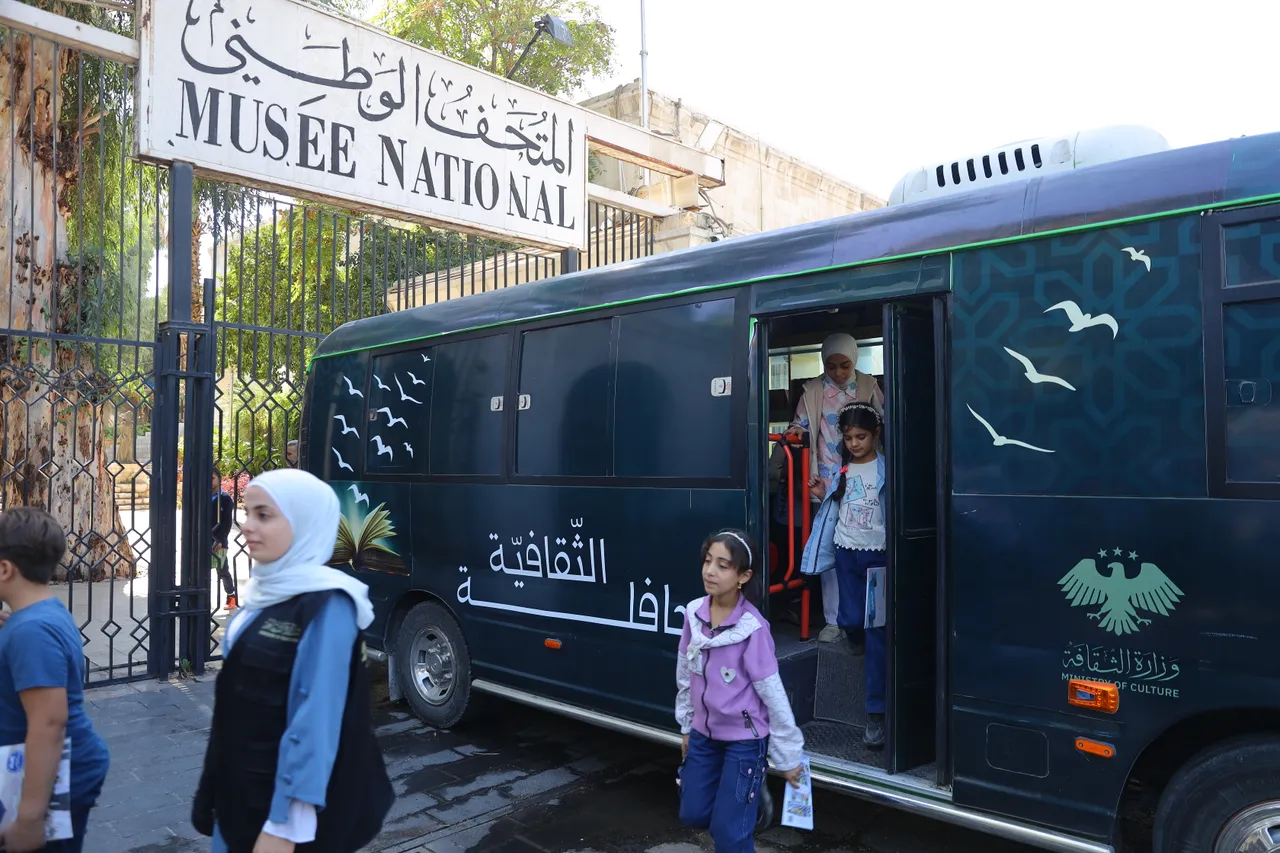
In an open square in the city of Al-Qutayfah, in rural Damascus, children sit on brightly coloured chairs arranged in circles. Their wide eyes follow a man reciting a short story, his voice echoing from inside an unconventional bus parked nearby. Laughter ripples through the crowd, briefly transforming the landscape.
There is no roar of warplanes here, no smell of gunpowder. Instead, for a few hours at least, there is a sanctuary of joy and imagination, and it’s delivered on wheels.
This scene captures the essence of the Cultural Bus initiative launched by the Syrian Ministry of Culture in August 2025. The project currently consists of two mobile buses, each equipped with approximately 1,200 books. Together, the buses function as travelling libraries, bringing books, art, and creative engagement to remote villages and marginalised rural areas long deprived of basic cultural rights.
The ethos behind the Cultural Bus is deceptively simple: culture should not be a privilege reserved for major cities.
Mohammed Murad, director of the project, explains that the bus carries a diverse collection of books, novels, and short stories for both children and adults. “On board, an elite group of volunteer writers, poets, and artists join the bus,” he says. “They help revive local intellectual life through activities that combine entertainment with education."
The broader aim, Murad adds, is to democratise knowledge. By visiting communities regularly, the project hopes to make reading a habit rather than a rarity – an “ordinary social practice, rather than an inaccessible luxury.”
Programming aboard the bus is varied. There are interactive reading sessions, traditional Hakawato stories, art and writing workshops, educational competitions, colouring activities, and even light physical exercises. All designed to create an environment where children can freely explore their talents.
Early field evaluations by the ministry indicate that the model is both effective and adaptable, with the potential for expansion across various governorates.
In recent months, the Cultural Bus has visited the governorates of Quneitra, Deir ez-Zor, Latakia, and Tartous, reaching communities that have long lacked access to cultural and educational resources. The initiative has also built partnerships with local volunteer teams, schools, and community organisations, strengthening its grassroots reach.
Murad says the project is driven by an urgent cultural imperative. Years of conflict under the Assad regime, he argues, fractured Syria’s cultural identity, demolished schools, and deprived children of their right to an education.
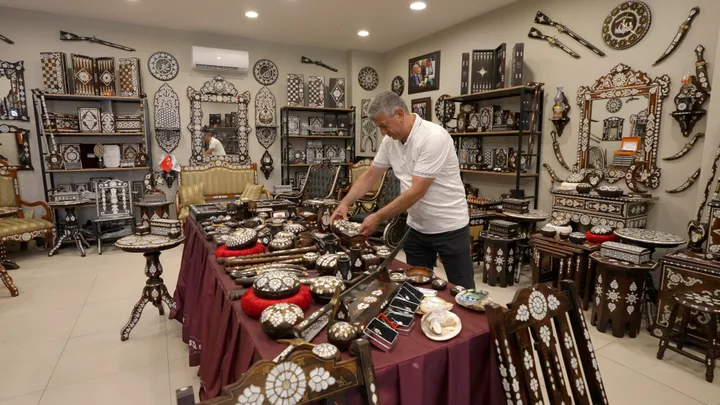
The Cultural Bus seeks to counter that erosion by reconnecting children with Syria’s rich heritage. It’s a chance for them to learn more about their country’s historical sites, and even traditional crafts like glass blowing or soap making, operating under the motto: "Culture… Awareness… Reconstruction."
Support for the project has been widespread. Publishing houses and libraries regularly donate books, while logistical and organisational backing has helped ensure the bus’s continuity.




Since its launch, the initiative has been warmly received, particularly in remote rural villages where cultural infrastructure is virtually nonexistent. According to project officials, the long-term plan is for each of Syria’s 14 governorates to eventually have its own Cultural Bus, creating a nationwide network of mobile libraries that can reach communities far from traditional cultural centres.
Joy deferred, returned on wheels.
Today, more than 8,000 children benefit from the Cultural Bus – an essential service in a country where many schools lack even basic libraries, limiting the development of students' linguistic and intellectual skills.
For 12-year-old Reem Al-Absi, from the city of Al-Hajar al-Aswad in rural Damascus, the bus’s visit was unforgettable. "I love reading stories, but there are no libraries nearby," she says. "The Cultural Bus gave me the chance to read and spend my time doing something meaningful."
Al-Absi describes the day the bus visits as a celebration. Children choose their own books, play group games, and take part in interactive art sessions. “The drawing and colouring workshops really let our imaginations and creative abilities run wild,” she adds. “We feel free to express ourselves.”
Beyond its educational role, the Cultural Bus represents a quieter, deeper form of resistance.
Noura Al-Raslan, a 41-year-old teacher from Aleppo, describes it as 'White Resistance'—one that uses words, colours, and melodies instead of bullets.
“After years of devastating conflict, we needed a different kind of resistance,” she says. “The bus left the silence of a garage and crossed the Syrian landscape, carrying dreams stacked on wooden shelves.”
Al-Raslan argues that the initiative challenges decades of cultural centralisation, in which libraries and institutions were largely confined to Damascus and Aleppo. “Cultural justice means that a child in a distant village has the same right to a colourful book as a child in the heart of the capital,” she says.
In a country fragmented by displacement and war, this mobility is crucial. Under the former Assad regime, cultural production and access to public libraries were tightly controlled, with strict censorship policies and security oversight limiting the circulation of books and ideas deemed politically sensitive. Cultural activists and educators have long argued that this environment restricted free reading and independent cultural initiatives, particularly outside major urban centres.
In today’s Syria, the Cultural Bus is more than a service; it is a social philosophy. It recognises that children in remote villages and displacement camps possess the same inherent right to knowledge as children anywhere else.
The urgency of such initiatives is underscored by stark realities. According to UNICEF, more than 7,000 schools in Syria have been damaged or destroyed, leaving around two million children out of school. Many of them are among the most vulnerable, including those displaced by violence and insecurity.
In this context, alternative cultural and educational projects are no longer optional; they are essential. The Cultural Bus has become a mobile sanctuary for literature and art, reconnecting children with a fundamental right too often denied.
As it winds through Syria’s countryside, the bus serves as a living bridge—returning books to children’s hands and culture to its rightful place at the heart of the community.