 Kazim Alam
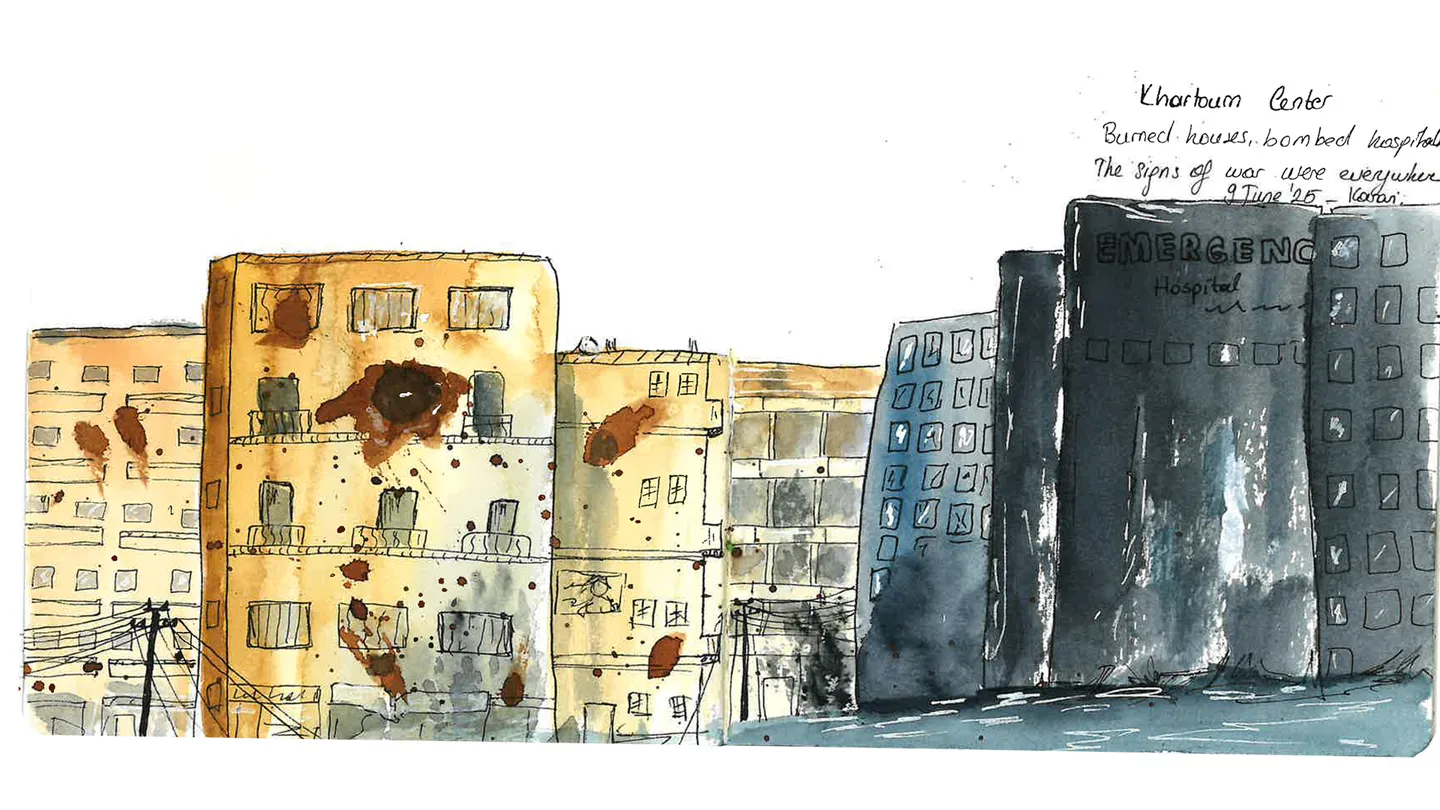
Narin Fandoglu keeps a small watercolour journal in her backpack, which has travelled with her from refugee camps to the dusty roads of distant towns in Africa.
For 36-year-old Fandoglu, an operational adviser for Doctors Without Borders (MSF) based in Geneva, sketching is not just a hobby.
It is her way to process emotions as she bears witness to the horrors of war, famine, and devastation across continents.
“My drawings are not about tragedy,” she tells TRT World.
“They’re about humanity, about the quiet strength I recognise in people rebuilding their lives, just as my family once did. It’s my way of saying: I see you,” she says.
Fandoglu’s drawing talent came to the fore in 2023 as war and destruction descended upon Sudan, a country in Northeast Africa that she would visit more than once as part of her job.
Deadly clashes between the Sudanese Armed Forces and the Rapid Support Forces (RSF) paramilitary group over the last three years have unleashed widespread ethnic violence, resulting in the displacement of more than 12 million people.
Described as one of the world's worst humanitarian crises, the strife has triggered a famine in parts of the country, while the health system lies in ruins.
Fandoglu has visited Sudan twice this year. First West Darfur, where she helped launch a malnutrition and child health project. Later Port Sudan and Khartoum, where she witnessed access restrictions and the stubborn determination of MSF teams on the ground.
Most of the world has looked away. But Fandoglu refuses to.
“Sudan has become invisible to much of the world. There is limited media coverage, little diplomatic effort, and too few attempts to ensure that humanitarian aid reaches people,” she says.
To reach Khartoum, she flew from Geneva to Nairobi, caught a flight by the UN Humanitarian Air Service to Port Sudan, then endured a two-day journey by road. When she finally saw her colleagues – who had waited over a month for visas and paperwork – relief washed over her.
“I was so happy to hug them,” she says.
A migrant child
Fandoglu was six when her family left Bulgaria for Türkiye. She was angry for years at her parents for uprooting her and leaving her grandparents behind.
“At that age, I couldn’t understand their decision or imagine how hard it must have been for them, too,” she says.
She felt isolated in her first years in Türkiye. That loneliness lodged deep. Years later, working with MSF in migration responses, the memory resurfaced.
“It struck me that I was a migrant child too,” she says. The realisation changed how she saw the people she met.
“Each person carries many stories that we cannot see,” she says.
Sketching pain and resilience
One sketch that is close to her heart shows men riding on the back of a pickup truck, travelling from Port Sudan to Khartoum just before Eid. They wore their finest clothes.
“The road was full of people returning,” she says. “I imagine some were going back only to celebrate the holiday and others to try to rebuild their lives,” she adds.
She watched them and wondered if they felt excitement, fear, uncertainty, or “perhaps a quiet hope”.
She painted them quickly, as the truck kicked up dust. “Sketching that scene helped me process all of that,” she says.
“It was a way to hold onto a moment that carried both the pain of what Sudan has endured, and the resilience of those still finding reasons to hope, to go home, and to begin again.”
More than just victims
On the road to Khartoum, Fandoglu met a woman making coffee.

Displaced three times since the war began, she had rebuilt her small business each time with a few plastic chairs and a metal stand. A baby and a toddler stayed with her all day.
The media, she says, too often shows Sudanese women only as victims.
“But anyone who spends time in Sudan quickly realises that this is not the full reality. Sudanese women are outspoken, they run community kitchens, build solidarity, and lead social movements at the heart of their communities,” she says.
The Sudanese woman spoke with courage, not as a victim, but as someone choosing to begin again. “While leaving her coffee stall, I remember feeling a huge admiration for her,” Fandoglu says.
“I thought that the world should hear stories like hers.”
‘Crisis of compassion’
Fandoglu sketches markets, coffee shops, and ordinary places, where life continues despite war and destruction.
“When I was sketching in Sudan, I never thought about sharing those drawings,” she says.
“They were personal, something I kept for myself, my friends, and my family.”
Then an MSF communications colleague saw her sketches and encouraged her to share the same publicly.
Her drawings show how Sudanese people survive a bloody war. “I realised (the drawings) could perhaps help ease, even in a small way, what I call the crisis of compassion,” she says.
By the crisis of compassion, she means the world’s collective ability to see and care for others – a quality that she says is fast disappearing.
“Compassion begins with seeing, with choosing to look, to acknowledge, to not turn away,” she says.
The survivor’s guilt
While crossing from Chad into Darfur, Fandoglu saw men carrying fuel barrels on donkeys under a merciless sun.
Once back in Geneva, the contrast in the quality of life around her is stark. Unlike Darfur, Geneva is a city of luxury cars and material abundance.
“That difference can be difficult to process,” she says.
In Geneva, Fandoglu likes to walk in nature, paint, and write. “It helps me digest the emotions and find some balance,” she says.
But she does not try to push the contrast away. “I remind myself that it’s a privilege to live in safety, and to be able to use that safety to help others.”
One special sketch
When asked if any sketch holds a special place in her heart, she mentions one that shows the famous clay pots of El Geneina, the capital of West Darfur. The sketch shows large earthen vessels filled with cool water, placed on street corners for anyone to drink.
It depicts a tradition that has stayed alive even through war and famine.
“People in the neighbourhood take care of (the vessels), so that anyone passing by can stop and have a drink,” she says.
“It’s a simple but powerful reminder that solidarity is always possible,” she says.
“Even in the hardest times, people find ways to care for one another, sometimes through the smallest, most ordinary gestures,” she says.