 Montadhar Naser
Baghdad, Iraq - Baker Al Almani runs his fingers along the weathered brick walls of his family's 145-year-old house, feeling the grooves carved by time and history.
“Every morning when I open these wooden doors, I'm not just starting a business,” he says, watching steam rise from traditional Iraqi tea glasses. “I'm keeping alive a piece of Baghdad's soul.”
Built in 1880, the Al Almani House in Baghdad's Al-Sarai district has witnessed the rise and fall of empires, survived wars and sanctions, and now serves as one of the city's few heritage cafés.
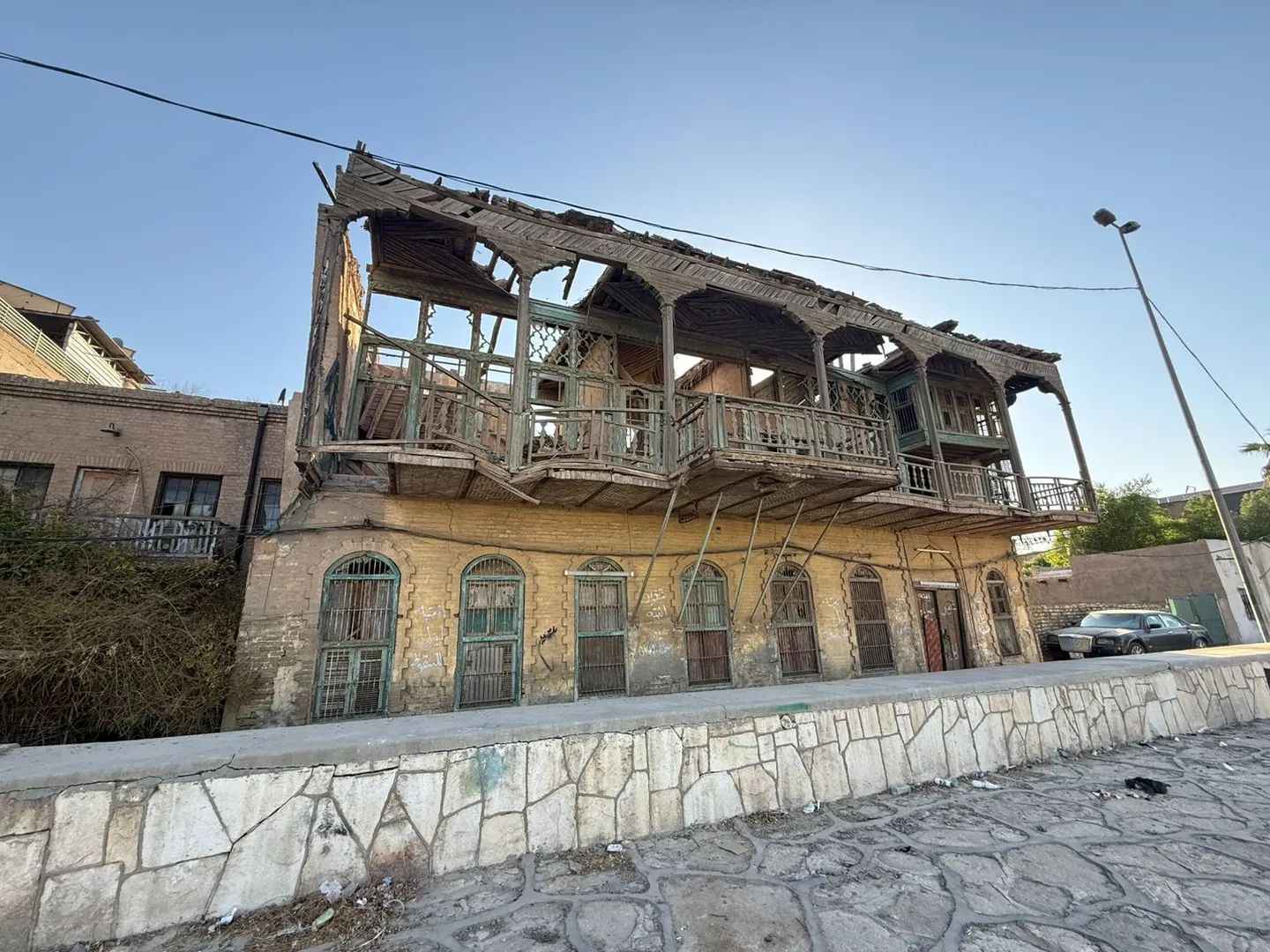
Al Almani's story exemplifies the delicate balance facing hundreds of heritage-house owners across the capital, where traditional architecture crumbles under relentless urban expansion and commercial pressure.
His decision to convert his ancestral home into a café represents one possible path forward, though not without controversy among purists who believe these structures should remain untouched monuments to the past.
A vanishing architectural memory
Across Baghdad, traditional houses – some nearly two centuries old – are disappearing as the ancient city transforms into a congested commercial space.
The remaining heritage homes cluster in the older neighbourhoods on both sides of the Tigris – in Karkh and Rusafa districts, in districts like Al-Kifah, Al-Betaween, Al-Karrada, Al-Waziriya, Al-Adhamiya, Al-Saadoun, Haifa Street, and Al-Rashid Street.
Many of these homes once belonged to prominent Iraqis who helped shape the nation’s political and cultural history: the house of sculptor Jawad Selim, creator of Iraq's famous “Freedom Monument”; and the residence of celebrated poet Mohammed Mahdi Al Jawahiri, considered one of the greatest Arab poets of modern times.
Beyond their cultural significance, these houses represent remarkable examples of climate-adapted architecture that modern construction has largely abandoned.
With thick walls, shaded courtyards, wind towers, and elevated rooms designed for natural ventilation, they were engineered to withstand Iraq's extreme heat long before mechanical air conditioning.
UNESCO guidelines note that such traditional Middle Eastern designs can reduce energy consumption by up to 40 percent compared to modern buildings – a relevance that grows as temperatures rise across the region.
Iyad Kadhim, Director General of Iraq's Heritage Department, says there are roughly 7,000 registered heritage houses nationwide, with Baghdad holding the largest share, followed by Nineveh and Basra provinces.
“The department is implementing a comprehensive plan to protect and maintain heritage buildings and areas in Baghdad and several provinces, in cooperation with the Ministry of Culture, the Antiquities Authority, and partner agencies,” Kadhim explains.
However, a significant portion of these houses has already been lost to urban expansion and commercial development, with many disappearing entirely.
Among the notable survivors is the house where British mystery writer Agatha Christie stayed during archaeological missions in the 1930s. Located on the Tigris riverbank in Karrada Mariam, the house is privately owned but monitored by the Heritage Department.
Christie lived there with her husband during archaeological expeditions in northern and southern Iraq, writing some of her works there, including her famous play The Mousetrap, which premiered in London in 1952.







Another significant structure is the house of Mahmoud Subhi Al-Daftari, located in Al-Shawaka overlooking the Tigris.
Al-Daftari was a prominent politician and administrator who served in high positions during both Ottoman and royal periods, becoming Baghdad's mayor in 1930. The house has been in his family's ownership since the early 1930s, but it suffers from neglect and deterioration.
Al-Watar House, built by Dawood Al-Watar in 1917, remains one of the most prominent heritage houses, still maintaining its original features. Located in Al-Shawaka on the Tigris in Karkh, it continues under the care of the original family's descendants.
Al-Naqeeb House, where Abdul Rahman Al-Naqeeb, Iraq's first prime minister in the modern era, lived in 1921, now serves as headquarters for the Theatre Forum. Located in Al-Sinak area on the Tigris in Rusafa, it represents one of the publicly-owned heritage houses.
Heritage defenders
With limited official support, researchers, heritage enthusiasts, and civil society groups have become the most vocal defenders of Baghdad's architectural memory.
Dhikra Sarsam, president of the Tower of Babel Organisation for Heritage Protection – herself previously dispossessed of a heritage home on Abu Nawas Street – says the core problem is “the absence of sufficient government budgets to compensate or rehabilitate privately-owned buildings, despite Iraqi law obligating the state to support owners of such houses”.
She points to examples elsewhere in the region, particularly Egypt, where heritage houses have been successfully converted into libraries, cultural forums, restaurants, and public institutions without compromising their identity.
Some owners like Al-Almani have made significant efforts to preserve their ancestral heritage while finding sustainable uses for these ageing structures.
“I fully support reviving authentic Baghdadi houses and turning them into tourist destinations,” Al Almani says, “but this should be done according to conditions set by the owner first, before any state directives, while completely preserving the building's architectural and aesthetic character.”
Others disagree. Fouad Al Watar, whose family built the well-reserved Al Watar House, opposes commercial reuse. “These houses were created to be heritage landmarks and should be visited and respected on that basis, not exploited for commercial purposes,” he tells TRT World.
Baghdad Municipality spokesman Adi Al-Jandeel says the city is rehabilitating the houses of poet Mohammed Mahdi Al-Jawahiri and scholar Sheikh Ahmed Al-Waeli, converting them into cultural museums.
But the financial burden is immense. “Many heritage houses require large amounts to maintain their original identity and architectural style,” he says. “This is our biggest challenge.”
As Baghdad grows denser and hotter, its historic houses face mounting threats from collapsing roofs, commercial encroachment, and inconsistent enforcement of heritage protections.
The race to preserve these cultural and climate-smart structures grows more urgent each year.
Back at his heritage cafe, Al Almani serves his last customers of the evening. Their conversations echo through rooms that have witnessed more than a century of Baghdad's history.
His compromise, preserving the past while adapting to present needs, may not satisfy everyone, but it reflects a larger struggle: one family's determination to keep a piece of Baghdad alive in a city where so much has already been lost.
This article was produced in collaboration with Egab.