 Murat Sofuoglu
While international human rights organisations, UN experts, and international courts have called for investigations into Israel’s genocidal conduct in Gaza and its crimes against humanity across the occupied Palestinian territories, Human Rights Watch (HRW) has been embroiled in an internal dispute over a report examining the denial of Palestinian refugees’ right of return.
The unpublished report described Israel’s long-standing refusal to allow Palestinian refugees to return to their homeland as a “crime against humanity” under international law.
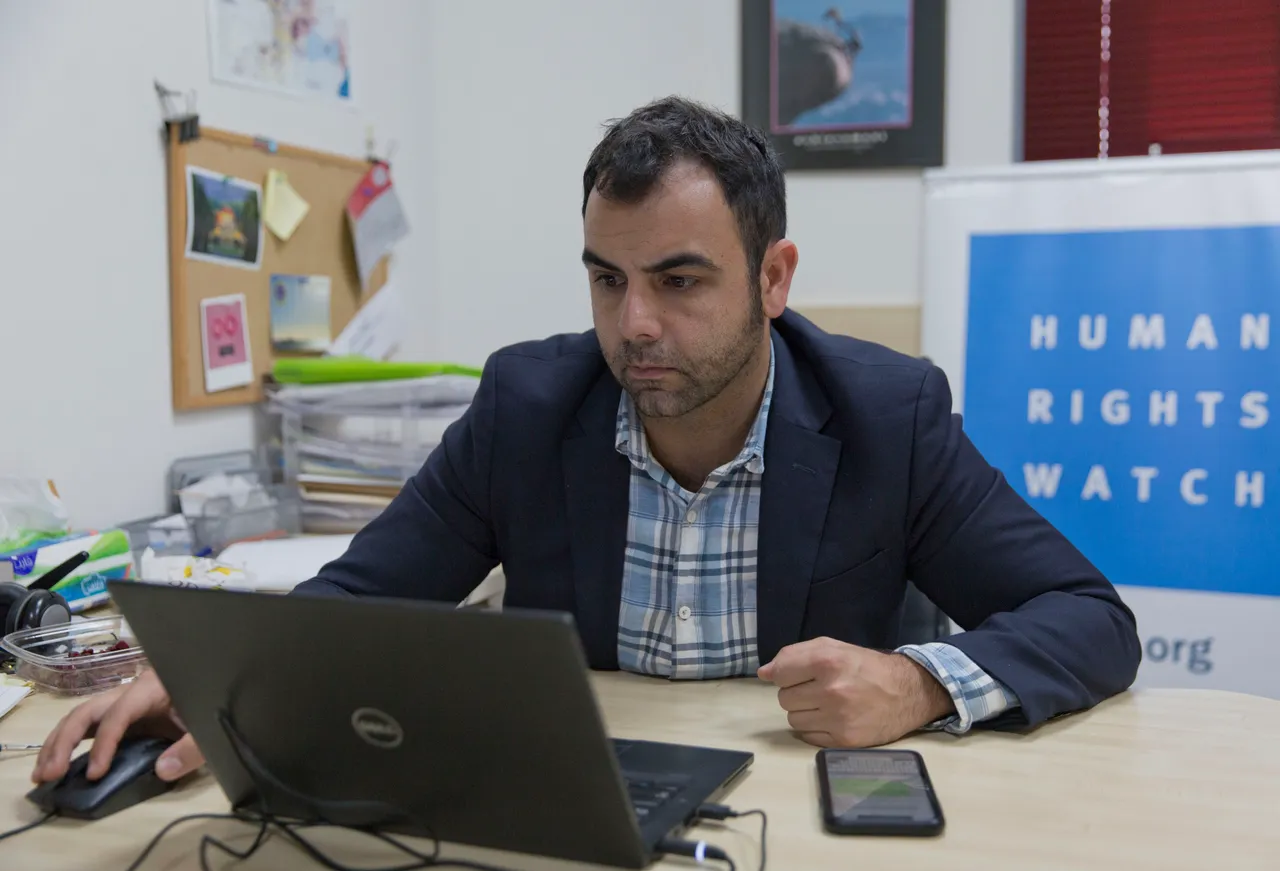
The dispute led to the resignation of Omar Shakir, who spent more than 10 years at Human Rights Watch and most recently served as director of the organisation’s Israel-Palestine section, alongside Milena Ansari, an assistant researcher known for her work on Palestinian prisoners.
Shakir, an American citizen, has previously faced retaliation from Israeli authorities. In 2019, Israel expelled him from the country, citing his support for the Boycott, Divestment and Sanctions (BDS) movement.

At that time, Shakir described the decision as “shocking”. But, he says, the treatment of his unpublished report by HRW’s leadership was even more alarming.
Shakir shared his resignation letter with TRT World, offering a rare account of internal deliberations within one of the world’s most prominent human rights organisations.
“Throughout my time at Human Rights Watch, there were, at different times, efforts by some in the organisation – driven by bias, pressure, politics, or cowardice – to manipulate our findings to arrive at their outcome,” Shakir told TRT World.
“But every single time, the review process ensured that we published the facts as we documented and the findings that derived from our principle and consistent application of the law. But that's not what happened here.”
According to Shakir, HRW’s senior management blocked the publication of his team’s report on Palestinian refugees’ right of return, despite months of research and interviews.
So, why did HRW act differently this time?
Israeli demographics
Shakir says the controversy centres on Israel’s precarious demographic concerns.
Israel defines itself as a Jewish state, a status successive governments argue depends on maintaining a Jewish demographic majority.
The Israeli state has long tried to justify its existence in Palestine on the basis of a Jewish majority – something that did not exist in historic Palestine for centuries prior to 1948, when Zionist forces expelled more than 750,000 Palestinians in what is known as the Nakba.
Since then, Israel’s expansion and military occupations have resulted in repeated waves of death and displacement, forcing Palestinians into exile across Jordan, Lebanon, Syria and beyond.
Shakir’s report focused on the legal status of these refugees and argued that the right of return is an individual and collective indigenous right under international law – and that its denial amounts to a crime against humanity.
The right of return for Palestinian refugees is referenced in the UN General Assembly Resolution 194 and grounded in international refugee and human rights law, but Israel has consistently rejected the application.
During a review exchange with a senior HRW manager acting as the programme reviewer, Shakir was told that while it was “a timely moment to be making the case” on crimes against humanity, the organisation needed to consider how such findings would affect its advocacy.
“The question is how we are going to make this argument in our advocacy without this coming off as HRW rejecting the state of Israel,” the manager argued, according to Shakir.







Following that exchange, the same manager became “a lead voice calling to halt the report’s publication”, Shakir wrote in his resignation letter.
HRW’s new executive director, Philippe Bolopion, supported this position, urging Shakir to remove the argument on the right of return from the report.
At the heart of the disagreement, Shakir says, was HRW leadership’s concern that recognising Palestinian refugees’ right of return would be seen as challenging Israel’s identity as a Jewish state.
Shakir insists he was not an inflexible or uncompromising employee. He says he repeatedly sought common ground with HRW’s leadership and proposed revisions intended to address management’s concerns, while preserving the report’s legal integrity.
However, in mid-December, Shakir’s team was informed that the executive director was unwilling to accept his proposed changes. According to Shakir, management said the only path forward would be to sharply narrow the report’s scope – limiting its crimes against humanity determination solely to Palestinians recently displaced from the occupied West Bank and Gaza.
In his resignation letter, Shakir argued that such a limitation would fundamentally undermine the report’s legal logic.
“Such a limitation means we would be saying that the suffering caused by the denial of return for a Palestinian displaced for a year from a West Bank refugee camp would meet the threshold of sufficient gravity to be a crime against humanity,” he wrote.
“But not those denied return for 78 years, refugees disconnected for generations from their homeland and their familial/community ties and living in refugee camps with precarious or no legal status and restrictions on their ability to work, own property and access basic services.”
In some sense, the main argument of HRW against Shakir is that the organisation should not come across as embracing a position which amounts to the rejection of the state of Israel’s Zionist vision of a Jewish majority in Palestine for the sake of defending the rights of return of Palestinian refugees.
“Through months of back-and-forth engagement with senior management, it became clear that a paramount concern to the executive director and several other senior leaders was that HRW would be seen as challenging the status of Israel as a Jewish state,” Shakir told TRT World.
Repeatedly, he said, publishing the report was treated as politically inconvenient.
“A principled organisation, human rights organisation, does not allow concern to be seen as challenging a political preference, the maintenance of a Jewish state, one of course forged through ethnic cleansing and maintained through apartheid, trumped the call for the respect of a people's fundamental rights, like for Palestinians the right of return,” he said.
What does this mean for human rights advocacy?
For Shakir, the episode reflects a broader dilemma facing international advocacy groups operating under intense pro-Israel political and financial pressure.
He argues that adopting pragmatic positions to avoid controversy risks narrowing the scope of research and legal findings – undermining the very principles human rights organisations claim to defend, “It’s antithetical to Human Rights Watch's core values.”
“Cooking the books to arrive at a desired outcome and really to let a judgment call on advocacy, one that many people disagree with, be the basis to shelve a report is really an open door to the sort of selectivity more characteristic of politics than human rights.”
Shakir emphasised that Israel-Palestine has long served as the “litmus test” for major institutions.
“It gives me great pride that, as difficult as it has been, Human Rights Watch has risen to that challenge,” he said. “But this time, we failed under this new leadership.”
He warned that what he described as “Palestinian exceptionalism” risks normalising compromises elsewhere.
“It often opens doors to other unprincipled compromises.”