 Sadiq S Bhat
New York City — On the morning after Zohran Mamdani's victory, New York City's skyline blushes pink, and the streets smell faintly of roasted chestnuts and diesel. It is as if the city is holding its breath, unsure whether to exhale in relief or disbelief.
At a construction site off Northern Boulevard, four men lean against a half-built wall, sipping coffee from paper cups. They are discussing the only thing everyone is talking about: Mamdani.
“Not talking fancy,” says Joe Dwyer, a foreman. “I knew he was real. Today, I come to work tired but happy.”
Next to him, Luis Ortiz nods. “I didn’t believe he’d win,” he says. “But this one? This one feels different.”
They talk about the rising price of everything. When asked by TRT World what Mamdani’s victory means to them, Dwyer grins. “It means,” he says slowly, “we are not invisible anymore.”
Across town, in Astoria, the rhythm is softer. Inside Farid’s Deli, the owner Farid Khan, originally from Lahore, Pakistan, pauses as he talks.
“Yesterday, I cried,” he says. “I never voted before. Always thought my voice was small. But this time I saw a brother standing up.”
Farid has run this corner deli for years. He’s seen the city change faces and flags. The morning regulars filter in: construction workers, nurses, a postman, a teacher. Everyone says the same thing in different words. Hope feels new, and heavy, and deserved.
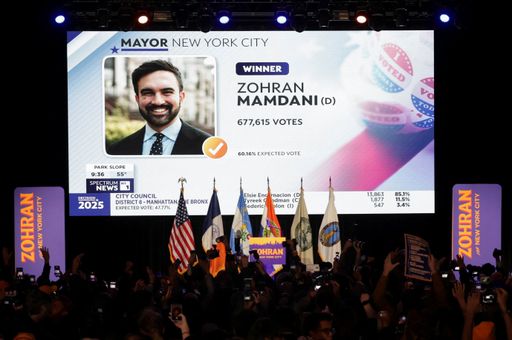
Ahead in every borough
A young woman waits outside the deli, scarf around her neck, latte in hand. Leah Rosen, a social worker, says she voted for Mamdani because, “he talks about the city as if it’s a community, not a business.”
Her parents live in Long Island, lifelong Democrats who hesitated at the name Zohran Mamdani. “They worried about his politics,” she says, “but I told them, he’s talking about housing, fairness, peace. That’s not radical. That’s humane.”
Outside, traffic surges down Steinway Street. Someone honks. The city is awake again.
Mamdani pulled off a solid win in the New York City mayoral race, taking four out of five boroughs with 50.4 percent of the citywide vote against independent and billionaire-backed Andrew Cuomo's 41.6 percent and Republican Curtis Sliwa's 7.1 percent.
He crushed it in Brooklyn by a whopping 20 points, racking up over 658,000 votes there, his strongest showing. The Bronx was another bright spot, where he edged out Cuomo by 11 points with about 223,000 votes, leaning hard on working-class neighbourhoods.
The iconic Manhattan gave him a comfortable 10-point lead, pulling in 522,000 votes amid the urban buzz, while Queens was tighter at five points ahead with 504,000 votes, still enough to flip it his way at 94 percent tallied.
‘Like Eid morning’
By noon, a small crowd gathers outside City Hall. Not the kind of crowd that usually fills a victory square. There are cleaners in grey uniforms, gig drivers with tired eyes, and students with stickers on their jackets that read “NYC Won.”





Among them stands Amina Yusuf, a graduate student from Brooklyn. “It feels like Eid morning,” she says, laughing. “I’m walking lighter.” Her family came from the Levant when she was a child. Her father drove a taxi for two decades.
“When the medallion crisis hit, I saw him break,” she says. “But kept driving. So when Mamdani stood with the drivers, I felt he was standing for my father.”
“We’re proud he’s honest,” she says.
Later in the afternoon, I find Eli Cohen on 31st Avenue. He’s Brooklyn-born and not much for politics. “I didn’t vote for years,” he admits. “Then this kid shows up, talking about small business like he knows our struggle.”
He taps the heel gently against the bench. “People talk about division. I don’t see it here. Muslims, Jews, everyone’s paying too much rent. Everyone’s tired. Maybe this guy can fix one thing. Even one thing would be a start.”
Overnight, Mamdani won big among the Black and Hispanic communities, snagging 61 percent from Black voters (a 26-point blowout over Cuomo) and 57 percent from Hispanics (up 20 points), which sealed deals in the Bronx and Queens.
He scored with Asians at 47 percent (four-point edge) and 38 percent with White New Yorkers. Renters, public transit folks, young urban grinders and progressives stood firmly behind Mamdani.
‘A new era’
Iconic spots like Bedford-Stuyvesant in Brooklyn (77 percent for him, whopping 57-point margin) and Harlem in Manhattan (71 percent, up 45) lit up as his cultural strongholds, alongside artsy Bushwick (massive 82 percent, 67 points), family-friendly Park Slope (77percent, 56), and the punky East Village (69 percent, 42).
Places like Crown Heights, Williamsburg, and Fort Greene followed suit, with margins over 40 points, showing his pull in some of NYC’s left-leaning soul.
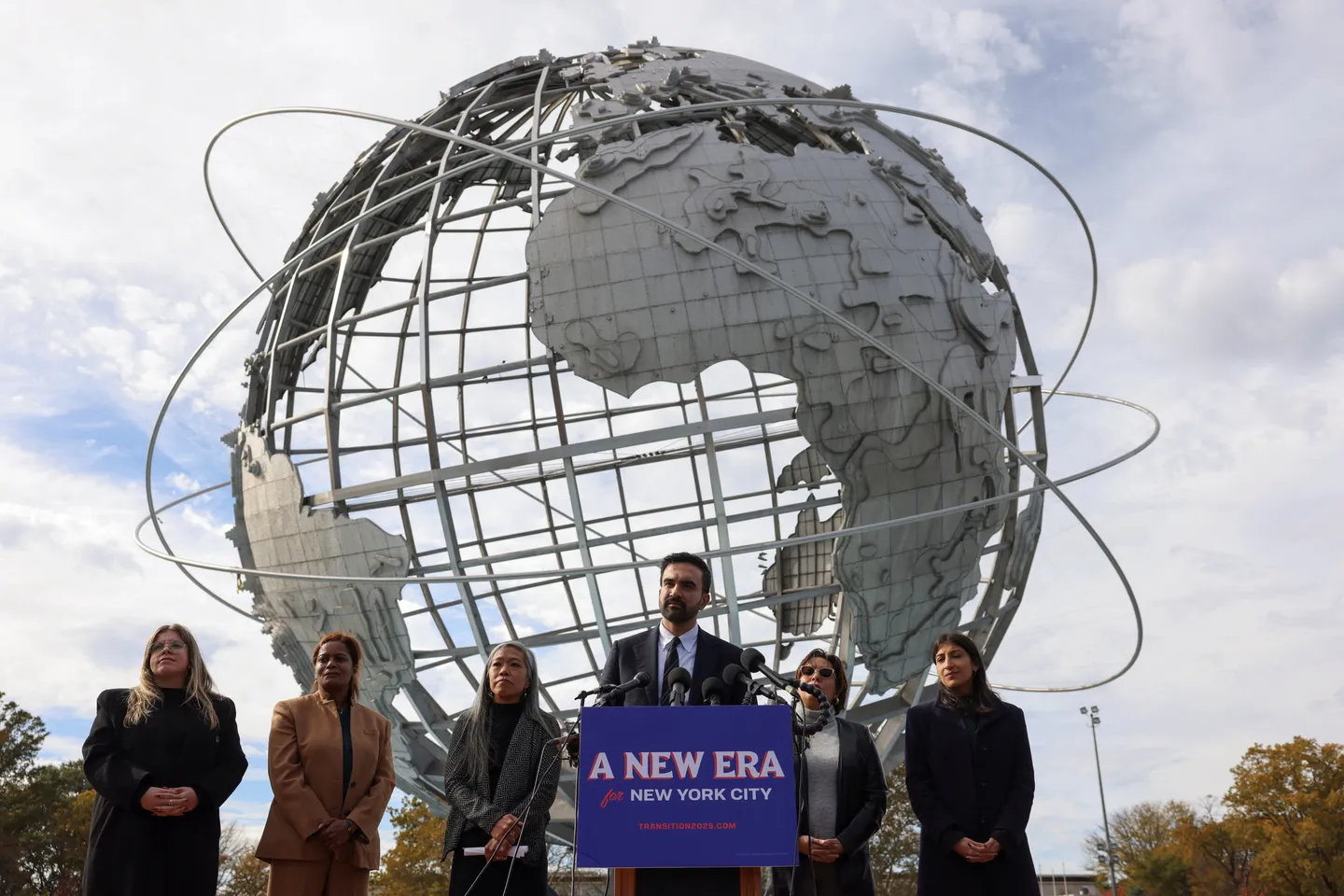
On Wednesday morning, at his first press conference since winning the mayoral race, Mamdani stood before cameras and promised to “stand up for New York against President Trump,” describing the start of a “new era.”
He announced his transition team, which will prepare for his term beginning on 1 January, and said he would soon name the people who will help oversee his agenda in government.
Mamdani also condemned “a sense that is growing” in the United States that people are allowed to violate the law. “Everyone must be held accountable,” he said.
Back in Queens, the words play out on phones in the deli.
“Good,” Khan says. “Finally, someone talking straight.”