 Esra Karataş Alpay
For many, the mornings begin not with a cup of coffee or a walk in the park but a scroll through their social media feed. Some even wake up in the dead of night to check out the notifications or the likes on the latest selfie.
For a generation hooked to social media and online news, notifications, likes, and reels dictate the rhythm of the day.
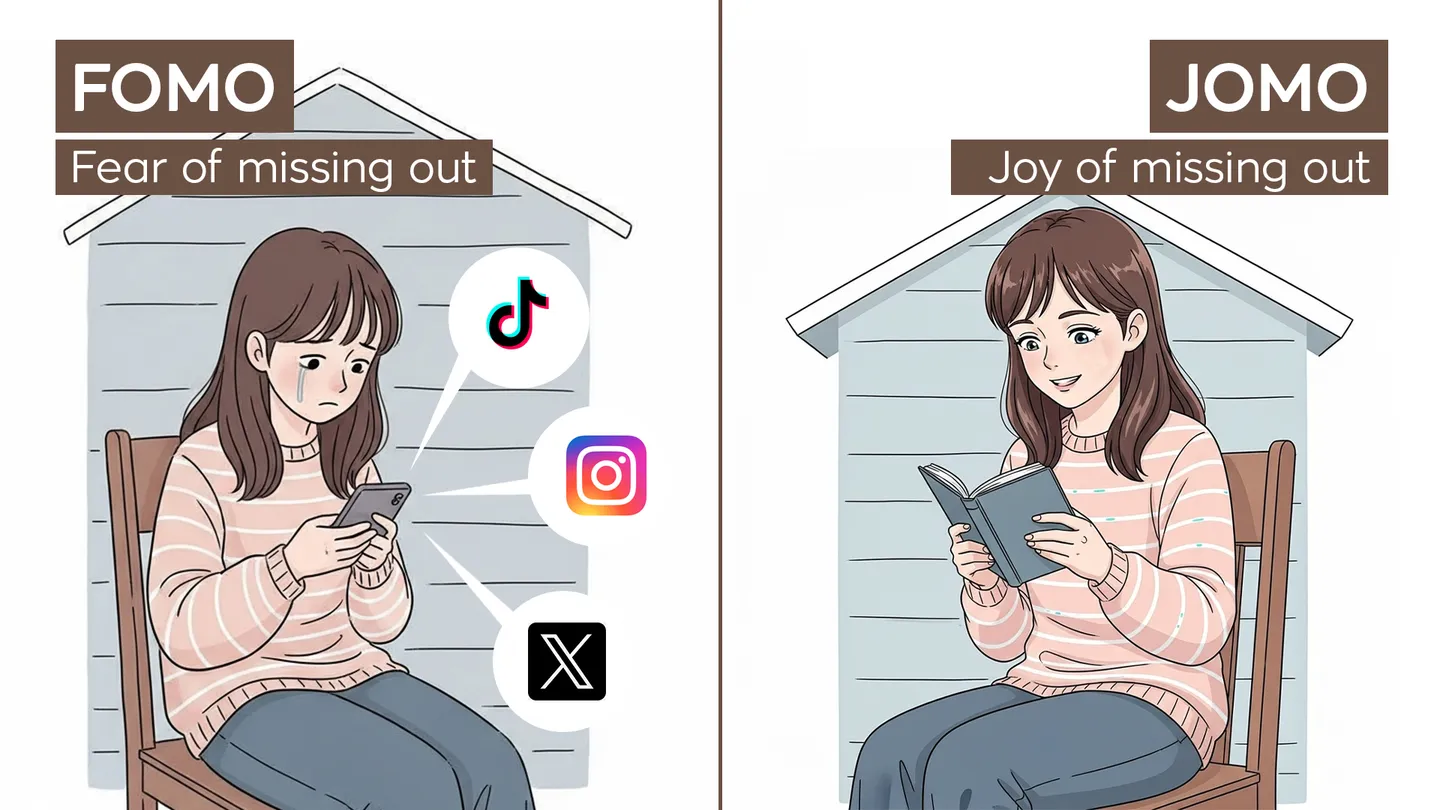
Psychologists say that behind this obsession lies a constant anxiety that life is happening elsewhere, in someone else’s feed, described by the acronym FOMO — the fear of missing out.
But as the world grows weary of the constant information bombardment, a new concept is gaining attention among scholars: JOMO, or the joy of missing out.
The concept of JOMO recently made its way into academic literature thanks to an international study led by researchers from Washington State University and several Turkish universities. Published in the peer-reviewed journal Psychological Reports, the study surveyed 932 social media users across 29 provinces in Türkiye, aged 18 to 45.
The findings revealed that people who deliberately disconnect from social media report lower levels of stress, anxiety, loneliness, and depression, and higher levels of life satisfaction.
Where FOMO breeds restlessness and comparison, JOMO invites individuals to savour the present moment and treat being offline as liberation rather than deprivation.
“Those who truly enjoy being offline are at the lowest risk of social media addiction,” wrote Adem Kantar, one of the study’s authors.
“They don’t feel bored when alone, and they find fulfilling ways to spend their time without needing a digital audience. In today’s world, people are so busy trying to keep up with everything that they end up missing their own lives.”

‘Everyone looks happy’
Istanbul-based clinical psychologist Fazilet Seyitoglu, who counsels couples and young people, warns that heavy social media use is not just a distraction but a major source of emotional distress.
“Spending too much time online is strongly linked to depression and anxiety,” Seyitoglu tells TRT World. “When people constantly watch the lives of others, they end up neglecting their own lives—and worse, feeling dissatisfied with themselves.”
She notes that what is presented online is often an illusion.
“On the screen, everyone looks endlessly happy. But nobody sees the background—the arguments, the loneliness, the exhaustion, even the debt behind those glossy photos. Social media is a world of artificial happiness.”
That illusion, Seyitoglu argues, feeds a culture of constant comparison. Life milestones—baby showers, bridal showers, engagements, birthdays—are increasingly performed for the camera.
“What should be intimate family moments are now staged spectacles of spending and glamour,” she observes.
“Teenage girls, for example, feel pressured to buy endless beauty products to look young and perfect—when they are already young and beautiful.”
The effects ripple into marriages as well. Many men, Seyitoglu says, complain in therapy sessions that their wives expect gifts and gestures modelled on what they see online.








“These demands are not born out of real desire but out of comparison,” she explains. “Social media teaches people to measure love through material display.”

Voices of a younger generation
Beyond the experts, young people themselves are beginning to articulate the cost of constant connectivity.
One young woman, who spoke to TRT World on the condition of anonymity, describes her decision to leave social media.
“I deleted all my accounts six months ago,” she says.
“At first, it felt strange, like I had lost a part of my identity. But now my days are filled with meditation, quiet walks, and time for myself.”
She adds that her anxiety levels have dropped and she feels more content than she ever was while scrolling through endless feeds.
“I finally realised I wasn’t missing out on anything—if anything, I was missing out on my own life while staring at a screen.”
Toward joy and gratitude
JOMO offers a counterpoint, experts say.
Instead of chasing what others are doing, it emphasises presence, gratitude, and acceptance.
The study found that people who embraced JOMO are more likely to enjoy solitary activities—reading, walking, journaling, listening to music, or simply savouring silence—without feeling the need to broadcast them.
“Each of us already has a list of things to be grateful for,” Seyitoglu says. “Instead of asking, ‘Why don’t I have what others have?’ we can ask, ‘What made me smile today? What light did I notice? What simple joy belongs only to me?’ That’s where happiness really lies.”
As the digital world accelerates, JOMO may feel countercultural, even rebellious. Yet psychologists see it not as withdrawal, but as a rebalancing act—a way to reclaim life’s ordinary beauty from the tyranny of endless comparison.
The shift from FOMO to JOMO, Seyitoglu suggests, is not about abandoning social media entirely but about changing one’s relationship with it.
“When you stop chasing other people’s lives,” she says, “you rediscover your own.”