 Zulal Sema
Kate Clow still remembers that evening in Sidyma — once a town of ancient Lycia, now the quiet mountain village of Dodurga Asari in Mugla Province.
Tucked against the southern slope of Mount Cragus, north-west of the Xanthos River’s mouth and midway between Fethiye and Kas, it was there, in the late 1990s, that she first began mapping what would become the Lycian Way.
She had followed the last stretch of the ancient road from Xanthos, passing a half-intact sarcophagus — one of many whose occupants remain unidentified — and a spring dotted with pottery shards; she continued until the ruins of Sidyma emerged ahead of her in the dusk.
Sidyma's acropolis was silhouetted against a deepening blue in the sky, wild goats gathering along the castle walls, a moment that she says captured the spirit of the trail, where you walk the same roads people used two thousand years ago.
Clow recalls the colours shifting as the sun tinted the Akdag range — a Lycian mountain rising over 3,000 metres — in shades of rose and cream, and the moon lifting over its snow-covered slopes. As she walked beneath a giant plane tree in the village centre, she passed the Asar Dodurga Mosque and the Roman baths belonging to ancient Sidyma.
Even now, Clow, 76, says that evening still encapsulates what the Lycian Way feels like—a place where history, landscape, and human warmth converge along the same path.
“Every step is a step through time,” she says.
That sense of time, place, and hospitality that once felt personal now sits behind a global title.
The Lycian Way, stretching from the resort town of Fethiye in Mugla province to the hills above Antalya on Türkiye’s Mediterranean coast, has topped Time Out magazine’s list of the “World’s Most Beautiful Hiking Trails”.
This month, the UK-based outlet praised the route for its blend of nature, history and sweeping sea views.
Hikers, however, describe it in more personal terms: as one put it, “a road that reveals who you are”.
An ancient democratic league
The trail runs for more than 700 kilometres, tracing the backbone of Lycian civilisation — a 3,000-year-old culture known for establishing one of the world’s first democratic leagues.
Clow says the idea was always to “link the old roads and the old cities,” so that modern walkers could “follow the same lines that traders, soldiers and villagers once used”.
As you move east from Fethiye, names like Letoon, Xanthos, Olympos and Phaselis read like a catalogue of Mediterranean antiquity.
In Patara, hikers walk past the restored parliament building where the Lycian League, one of the world's earliest democracies with a constitution and elected officials, once met.
“You stand in that assembly and think, this was a model that impressed even the Romans,” Japanese anthropologist Eisuke Tanaka, who has researched the route for over a decade, tells TRT World.
Higher in the hills, another ancient city, Pinara, appears with its honeycomb of rock-cut tombs.
“It feels like the mountain is full of windows,” says one local guide.
On the ridges near Tlos, an ancient Lycian city close to the modern town of Seydikemer, the view stretches across the Xanthos Valley. Meanwhile, the quieter city of Sidyma — now the village where Clow has lived for more than 30 years — hides its temples and tombs among olive trees and stone houses.
Closer to the sea, the remains of another ancient city, Phellos, and its harbour, Antiphellos, echo above what is today Kas. Along the shoreline, the low stone walls of Pydnai stand among dunes, while the castle of Simena, known as Kalekoy, looks down on boat traffic and Lycian sarcophagi that sit half submerged in the bay.
In the city now called Demre, in ancient Myra, hikers weave between rock tombs and the church associated with St Nicholas.
At Phaselis, one of the oldest ancient cities, three harbour basins still shape the water, and further east, the ruins of Olympos sprawl through the forest along a riverbed that opens to the Mediterranean. In this landscape, Alexander the Great is said to have spent time.
“It’s like walking through an open-air museum that has no walls,” Tanaka says. “Pre-history, classical, Byzantine, Ottoman – you feel those layers with your body, not just your mind.”
Türkiye’s Ministry of Culture and Tourism has promoted this fusion of heritage and landscape for years through guided walks and awareness events.
If the cities give the trail its narrative, the ground itself provides the rhythm. “The Lycian Way carries different textures under every step,” Clow says.
“Porous limestone that drinks water, layered sandstone soft enough to carve, dark volcanic rock polished by centuries of feet, and the occasional vein of marble glinting in the sun.”
One moment, hikers are on grainy limestone; the next, they’re crossing smooth volcanic slabs that feel like glass. Some old roads are still visible as chiselled sandstone ribs. Other stretches sparkle with marble fragments that catch the light.





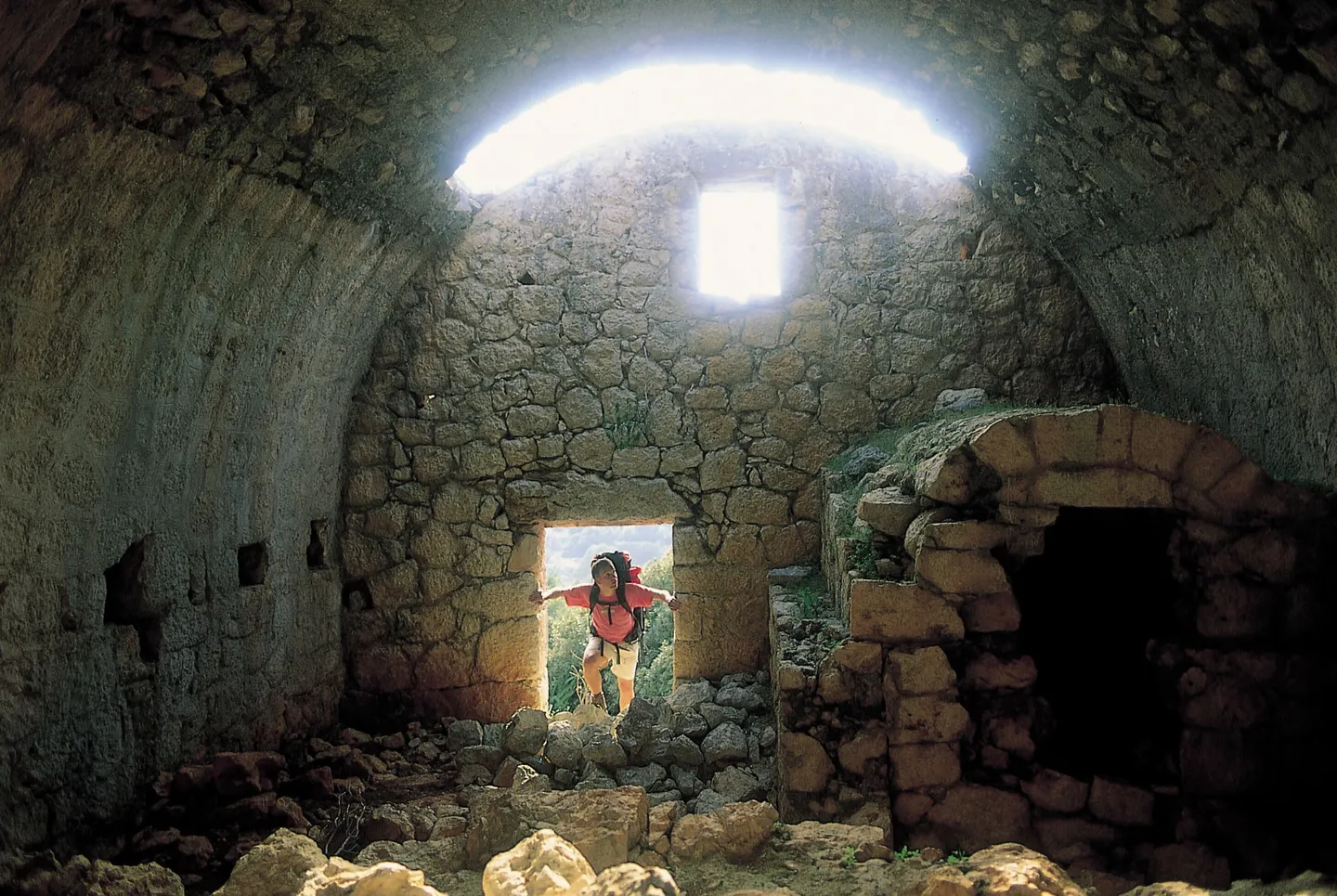
“Even the rocks tell you you’re moving between different ages and different worlds,” says Tanaka.
The route can climb from sea level to nearly a thousand metres in a single day. “You might start your morning swimming and end your evening above the clouds,” local hiker Feyzullah Burucu, 52, tells TRT World. “That change is what makes it powerful.”
‘Can we really do this?’
For many walkers, the Lycian Way is less about ticking off a famous route and more about testing their limits. “We went in May 2023,” Ayse Betul Aytekin, a 27-year-old researcher, who hiked part of the trail with a group of six or seven friends and a guide, tells TRT World.
“We planned a three-night, four-day route for ourselves. One night we camped in Cennet Bay, another on a mountaintop, and another on a high plateau.”
She remembers the doubts at the beginning.“The question became: ‘Can we really do this?’ The total distance for our section was over fifty kilometres. We all do some sport, but we didn’t know if our bodies would carry us. What made it a life-changing experience was realising that we could.”
“You swim where people once lived and worked, and now only the stones and the sea remain. It reminds you that escaping the chaos of the city has always required effort. Beauty has always had a price in sweat,” she says.
For Dr Ozlem Uruk Hammond, 59, the Lycian Way was not just a physical challenge but an escape from burnout.
“I had been living between hospitals, labs and late-night meetings,” she tells TRT World. “I reached a point of emotional exhaustion.”
Hammond works closely with cancer patients, and she had reached a point where she simply needed to breathe — to step away, clear her mind, and find herself again. She didn’t yet know that the trail would become the very path that reconnected her to her own self.
Her first walk on the trail in May 2024 began at Ovacik, heading up towards Baba Mountain above Oludeniz (Dead Sea).
“You smell thyme, dust, sea salt. Between the ruins and the sea, you feel both death and rebirth,” she says.
“These ancient cities show you that whole civilisations can disappear. At the same time, the land keeps producing new life.”
Near Kas, she encountered the Lycian Orchid, a species that experts say exists only in this region.
“It was such a fragile, beautiful thing,” she recalls. “I took photos and later painted them at the centre of an abstract piece. It became a symbol for me of why this place matters.”
History, sea, forest and mountains
Burucu brings another perspective — that of someone who lives with the trail year-round. Born in Diyarbakir, he moved to Antalya after years of working in tourism.
“I enjoyed being a waiter because I met people from many countries,” he says, “but in places without structure, the long hours wear you down physically, mentally and emotionally. At some point, I decided I had done enough.” Being a waiter was emotional labour for Burucu.
He found restoration in walking. “For me, hiking is almost a cleansing experience,” he says. “The moment I take my first step, everything else fades away.”
What the Lycian Way offers, he says, is a complete package. “When I first moved here, I said this region is ‘three in one’ — sea, forest, mountains. For the Lycian Way, I say it is ‘four in one’: history, sea, forest, mountains. The perfect combination.”
He says hiking reshapes your sense of self: after a hard day you feel light again, you hear your own thoughts more clearly, and you remember that peace does not live in crowded places. “A quiet coffee with a view can lift you, a private cry can heal you, and singing to the trees no longer feels strange.”
He has a message for visitors. “Please respect nature,” he says. “The world is our home. You wouldn’t throw rubbish in your living room. Don’t leave it on the trail. Think of the Lycian Way as an inheritance to future generations – and we must not betray an inheritance.”
Walking the Lycian Way offers lessons that extend far beyond the trail itself. It shows how heritage is not something sealed behind glass but a living process shaped by the people who value it today.
The journey has a way of stripping life back to essentials: the noise and rush fall away, leaving a clearer sense of what matters.
Many hikers say they return changed — lighter, more grounded, and more connected to both the past and themselves.
Somewhere between Fethiye and Antalya, between Patara’s parliament and Olympos’s flames, between limestone and volcanic rock, hikers from around the world keep discovering the same truth.
“Every step,” Clow reminds us, “leaves a trace — not on the land, but in your soul.”