Two top officials of Cambodia's Khmer Rouge were found guilty of genocide by a UN-backed court on Friday, almost four decades after the apocalyptic regime which oversaw the "Killing Fields" was overthrown.
The Extraordinary Chambers in the Courts of Cambodia (ECCC), said Khmer Rouge "Brother Number Two" Nuon Chea, 92, and former President Khieu Samphan, 87, had been found guilty of crimes against humanity and genocide against the Cham Muslims and the Vietnamese.
TRT World's Reagan Des Vignes reports.
They were the first Khmer Rouge officials found guilty of genocide and were sentenced to life in prison.
The international tribunal to judge the criminal responsibility of former Khmer Rouge leaders for the deaths of an estimated 1.7 million Cambodians opened its session on Friday to deliver its verdicts on charges of genocide and other crimes.
TRT World spoke to Markus Zimmer, former Cambodian chamber adviser, for his analysis on the court ruling.
'Auto-genocide'
The Khmer Rouge sought to achieve an agrarian utopia by emptying the cities to establish vast rural communes.
Instead, their radical policies led to what has been termed 'auto-genocide' through starvation, overwork and execution.
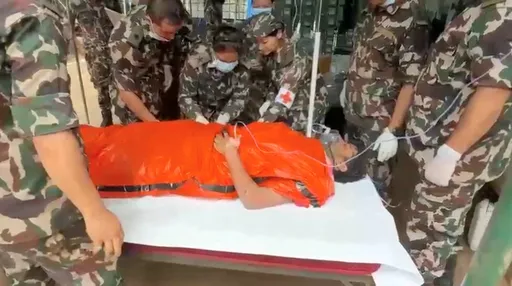
Nuon Chea was brought by ambulance and Khieu Samphan by van from the nearby prison where they are held. The prison and the courthouse were custom built for the use of the tribunal, which is officially called the Extraordinary Chambers in the Courts of Cambodia, or ECCC.
Both defendants were present as Judge Nil Nonn opened the proceedings, but Nuon Chea suffers heart problems, so was granted permission to later move from the hearing room to a separate holding room.






Nuon Chea and Khieu Samphan are being judged on charges of crimes against humanity, such as murder, extermination, enslavement, torture and persecution on political, racial, and religious grounds; genocide, for the killings of members of the Vietnamese and Cham ethnic groups; and more breaches of the Geneva Conventions, including willful killing, torture or inhumane treatment.
Large crowd of spectators
The large crowd of spectators attending Friday's session included members of the Cham, a Muslim ethnic minority.
Lah Sath, a 72-year-old Cham man from eastern Kampong Cham province, brought his wife and four young granddaughters to Friday's session. He said he often heard people talking about the trial and sometimes watched it on TV, but decided it was time to see it with his own eyes.
Just talking about the Khmer Rouge brought back horrible memories of life under their rule in 1975-79, he said. The Cham were treated as enemies and exploited without mercy as they were forced to do intensive farm labour, he recalled.
Lah Sath said his younger brother was killed by Khmer Rouge for failing to take good care of a cow.
In addition to Nuon Chea and Khieu Samphan, the tribunal has carried out one other prosecution, resulting in the 2010 conviction of Kaing Guek Eav, known as Duch, who as head of the Khmer Rouge prison system ran the infamous Tuol Sleng torture centre in Phnom Penh.
Possible roadblocks
Cambodia's long-serving, autocratic Prime Minister Hun Sen has declared he will allow no further case to go forward, claiming they would cause instability. Hun Sen was a Khmer Rouge commander who defected when the group was in power and was installed in government after the Khmer Rouge were ousted from power by a Vietnamese invasion.
Initial work had been done on two more cases involving four middle-ranking members of the Khmer Rouge, but they have been scuttled or bottled up by the tribunal, which is a hybrid court in which Cambodian prosecutors and judges are paired with international counterparts.
The failure to have more extensive proceedings has discomfited some observers, but others point to the tribunal's accomplishments.
"International tribunals are better than the alternative, impunity. They will always be political and fall short of expectations," said Alexander Hinton, an anthropology professor at Rutgers University and author of two books about the tribunal.
"But justice is usually delivered, even if at times, as has been the case with the ECCC, it staggers across the finish line."