 Murat Sofuoglu
Despite growing efforts to end the Ukraine war, the biggest military conflict in Europe since World War II appears to be escalating in scale, even stretching to the relatively safe Black Sea region, where neutral Türkiye has the longest coast.
Ankara was particularly angry after its vessels were targeted in a region where the Turkish leadership worked hard to create a safe corridor for ensuring global food supply through the Black Sea Grain Initiative, a rare point of agreement between Russia and Ukraine.
But things got even uglier in mid-December when four mysterious drones appeared in Turkish skies.
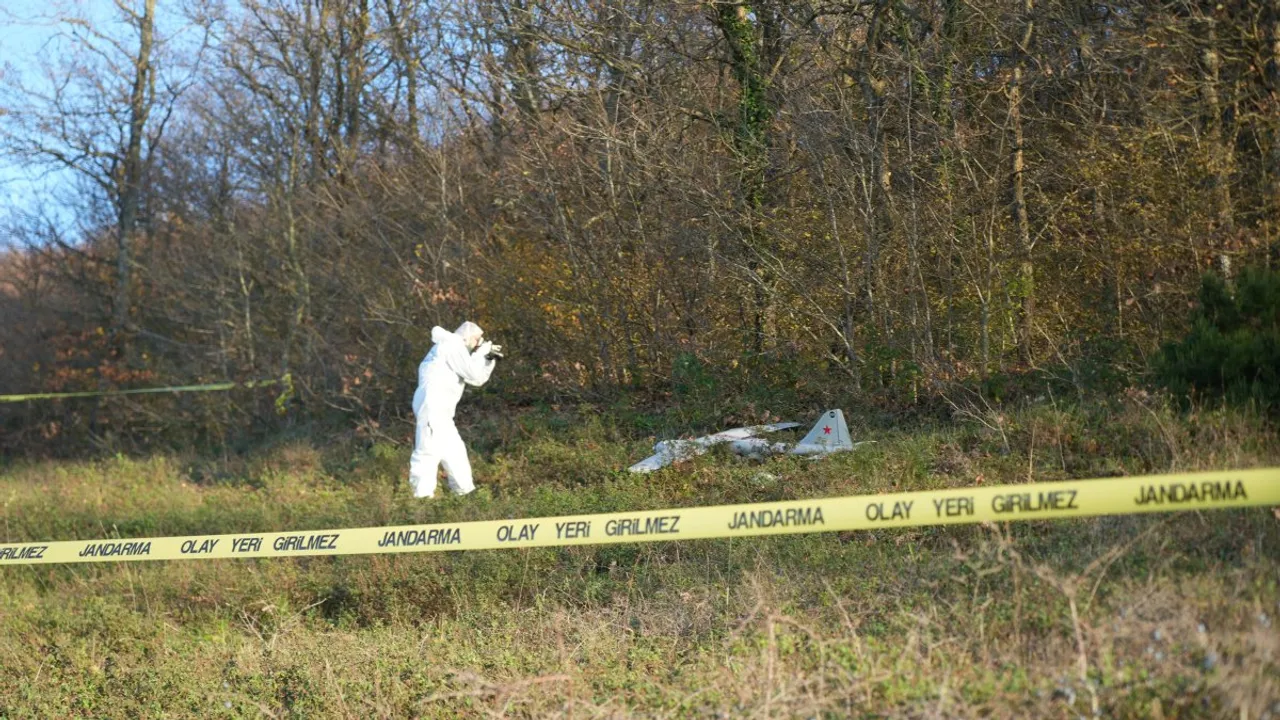
Two of them crashed in Kocaeli and Balikesir, the two northwestern provinces. One drone was “neutralised” over the Black Sea by the Turkish military, while another was shot down by a Turkish fighter jet near the capital Ankara.
Analysts say that the multiple drone incursions and targeting of Turkish-owned vessels in the Black Sea potentially signal a deepening security gap in the region.
The alarmed Turkish leadership has issued warnings to the warring sides as well as European states on the dire possibility that deteriorating conditions can spread the Ukraine war to surrounding areas.
What we know about these drones
Turkish authorities identified the drone found in the Kocaeli province as an Orlan-10, a Russian unmanned aerial vehicle primarily used for reconnaissance and electronic warfare.
The one found in Balikesir was identified as a Merlin VR, another Russian UAV used for reconnaissance.
Reports said that the two drones made emergency landings using onboard parachutes, probably after they faced electronic jamming of their control systems by Turkish air defence.
Two of the three drones appear to have conducted emergency landings using onboard parachutes.
The two drones neutralised by the Turkish military could not be identified because of their destruction and unidentified locations, according to the defence ministry.
TRT World studied publicly available images and data of the crashed drones to analyse the intrusions into Turkish airspace.
The Orlan-10 drone recovered in Kocaeli has what appears to be the conventional Russian ‘red star’ and ‘V/Z’ markings. However, closer examination reveals that they are different in shape and size from standard Russian military emblems, leading to different explanations about the origins of the UAVs.
However, the drone recovered in Balikesir has the exact markings found on Merlin VR.
Due to the developing war conditions in the Ukraine conflict, it is believed that Russia recently restructured its UAV units and might have started using new operational codes/logos, as in the case with the Orlan-10.
Sami Ozturk, a retired Turkish air defence officer, however, says it would be difficult to confirm that the Orlan-10 and Merlin VP drones – with a maximum range of 600 km – came from a Moscow-controlled territory on the Black Sea.
As such, these drones were probably launched from a ship or a military platform in the Black Sea, Ozturk tells TRT World.
How did the drones end up in Türkiye?
According to Sergei Markov, a former adviser to President Vladimir Putin, the drones reached Turkish territory through possible false-flag operations by Ukraine and other anti-Russian Western actors, which have long tried to persuade Ankara to choose between Kiev and Moscow.
Since the start of the war in February 2022, Türkiye has adopted a neutral stance, refusing to back the Western sanctions against Russia. At the same time, Ankara has stressed Ukraine’s territorial integrity.
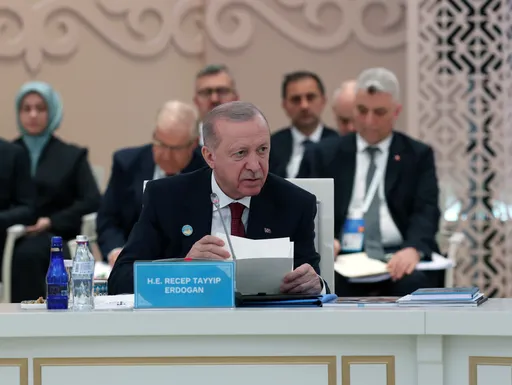
Turkish President Recep Tayyip Erdogan is considered one of the very few global leaders who is equally trusted by both Ankara and Kiev. And this trust had manifested in Istanbul hosting several rounds of negotiations between the warring sides.
“Anti-Ukrainian air-defence interceptions could have redirected them (the drones) to Turkish territory to create a rift between Ankara and Moscow,” says Markov, who responded to TRT World from somewhere near Krasnodar Krai, a Black Sea port facing constant internet blackouts due to attacks by Ukrainian drones and missiles.







Another possibility is that Ukraine might have reproduced UAVs based on designs of captured Russian drones and used them against Türkiye to create the impression of Moscow as an adversary to the Turkish public, he says.
Markov, however, claims that Russia wants to keep NATO states, particularly neutral countries like Türkiye, out of the Ukraine conflict. It was precisely for this reason that Moscow has no intention of involving itself in drone incursions into Turkish territory and making new enemies, he tells TRT World.
Ankara-Moscow ties have grown stronger in the past few decades after centuries of tension and conflict dating back to the Ottoman Empire, the predecessor state of Türkiye.
The Ottomans and Tsarist Russia faced each other in as many as 12 different battlefields across Eastern Europe, Black Sea and the Caucasia regions, which took a heavy toll on both sides.
In the post-WWI period, too, Turkish-Soviet relations were tense as Ankara joined NATO and sided with the Western alliance against the Moscow-led communist bloc during the Cold War.
In the present era, Turkish-Russian relations have reached unprecedented levels, with Erdogan and Putin’s bonhomie paving the way for cooperation across different sectors.
Because of the warm bilateral ties, Ozturk also doubts that the drone intrusions are intentional Russian launches against Türkiye.
“It should not be overlooked that this drone issue may have been orchestrated to mislead us. It is necessary to consider that there would be no difficulty for different actors to obtain various parts of these UAVs to reproduce them,” Ozturk adds, referring to a false-flag operation possibility.
Some analysts believe the drone incursion to be accidental.
Edward Erickson, a former American military officer and a retired professor of military history at the Department of War Studies at the Marine Corps University, is one of them.
“For the most part, these overflights are caused by accidental malfunction of the guidance systems. They (the drones) were programmed to return to Russian-controlled territory, but obviously something went wrong, and they kept on going until they ran out of fuel,” he tells TRT World.
“Both of these systems are large and very expensive, unmanned reconnaissance aerial vehicles. Russia has a limited number of these systems, and they would not intentionally waste them flying on a one-way mission into Turkish airspace. These are accidental incidents.”
There have been reports about such accidents near the country’s Black Sea coast in the recent past. An official source in Kastamonu, a Black Sea province, also told TRT World that there was a Russian drone landing in a rural area in recent months.
But there are also experts who see a possible Russian motivation in launching drones in Turkish airspace, near some strategic military installations in Golcuk, where the navy headquarters are located, and Balikesir, which hosts an important air force base.
“Russians might send a message to us that it would not be a good idea if we decide to return S-400s to them due to our desire to acquire the most advanced F-35 systems from the Trump administration,” says an expert working for a top Turkish defence company. He spoke on the condition of anonymity as he was not authorised to speak to the media.
Ankara and Washington have been negotiating Turkish acquisition of US F-35 systems, and there have been some positive signs that both sides might reach a consensus on this issue. The US has long insisted that Ankara must give up the Russian S-400s defence system if it wants to be part of the F-35 project.
Was Turkish air defence too slow?
Following the drone appearances, there were some speculations that the country’s air defence system was slow to react against them. But experts dismiss this criticism as baseless.
Both the Orlan-10 and Merlin VP are flying in extremely low altitudes, like 1,000-1,500 metres, without making much noise and thus are able to outmanoeuvre even advanced radar systems, which tend to filter such UAVs as "insignificant objects" like trees and birds, according to experts.
Any air defence system, including the newly-developed Turkish Steel Dome, will have gaps against such drone technology due to the fact that no country can cover every metre of its airspace, says Ozturk.
In terms of radar detection, the Merlin-VR is a much more challenging target than the Orlan-10.
While the Orlan-10’s plastic and carbon fibre body makes it hard to detect by conventional radar, the Merlin-VR takes this a step further by using more composite and dielectric materials in its design.
From a technical standpoint, the most notable feature of the Merlin-VR is its hybrid engine structure, which minimises the vehicle's acoustic signature, making it virtually impossible to hear from the ground, even at low altitudes.
Even most advanced American radars might not detect such drones, a common problem for every conventional army, which is trying to figure out how to address the issue, the Turkish defence company source tells TRT World.
But he also reminds that the Turkish military has successfully tracked those drones in its airspace, then neutralised them in safe areas to ensure that their destruction would not lead to any human casualties.