 Jehan Alfarra
“If I must die,” wrote the late Gaza poet Refaat Alareer, “you must live to tell my story.”
Across Palestine and its scattered diaspora, Palestinian women have taken up that call.
As bombs fell on Gaza, a Palestinian woman somewhere pulled a red thread through white fabric. With every soul lost, every hospital bombed, and every home razed, a Palestinian hand was painstakingly memorialising it.
The Gaza Genocide Tapestry became their collective reply to Alareer’s plea.
Hundreds of kilometres apart, from Ramallah to Lebanon’s refugee camps and as far as New Zealand, Palestinian women are embroidering one hundred panels that will together form the tapestry – a cross-stitched testimonial that refuses to let the world forget what is being done or to whom.
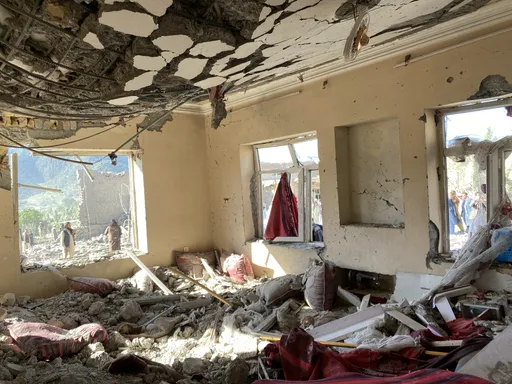
Each of the tapestry’s panels tells a fragment of the past two years as Israel carried out a genocidal war on Palestinians – a child weeping as their world crumbles around them, a home that once carried the laughter of children and mothers now lying in ruins, a man catching on fire, and a grandfather hugging the “soul of my soul” for the last time.
When assembled, the tapestry will become a collective record of loss and endurance, and an indictment of the deafening silence of the world in the face of a live-streamed genocide.
United by grief
By linking the hands of Palestinian women across geographies, the tapestry also counters the fragmentation imposed by Israeli occupation, displacement and exile.
“The threads are mixed with tears, pain and the hope of returning home,” Riham Khalil, who is the Lebanon field coordinator for the Ein Al-Helweh refugee camp embroidery group, tells TRT World.
“This tapestry is a visual testimony to the steadfastness of the Palestinian people in the face of the ongoing war of extermination that has lasted for more than 80 years.”
The Gaza tapestry is an extraordinary act of collective will, designed and coordinated by a small team of volunteers from the Palestine History Tapestry, an arm of the Palestine Museum.
It is realised, however, by Palestinian women refugees whose hands alone are rightfully paid for the labour that sustains their families and keeps memory alive.
One of the core members of this monumental effort is Palestine History Tapestry co-chair and designer Ibrahim Muhtadi, himself a survivor of the Gaza genocide.
“This project is a duty for us, but it has been one of the most emotionally difficult and painful endeavours for me,” he tells TRT World.
“The design process is usually a process of inspiration, innovation and the desire to create joyful elements. This time, the entire process…has been like diving into grief and loss, reliving the pain and displacement we experienced, followed by starvation and the complete devastation of all aspects of life in Gaza.”
At the heart of the tapestry lies ‘tatreez’, a centuries-old Palestinian embroidery tradition, which UNESCO added to its Intangible Cultural Heritage list in 2021.
“Embroidery slows us down. You can’t scroll past a stitch. It demands attention and that time is a kind of respect,” a key embroiderer from Ramallah says, demonstrating how the tapestry is both archive and eulogy, a slow, deliberate act of remembering in a world quick to forget and look away.
The art of ‘tatreez’ has long been the quiet chronicle of a people, passed down from mother to daughter across generations.
Every village once had its own patterns, colours and stitching styles woven into the dresses of women.
The cut of a garment, the shade of its thread or the shape of its motifs could reveal a woman’s origin, her social standing and even her marital status.
But after the Nakba of 1948, when the creation of Israel scattered Palestinians across borders and refugee camps, tatreez became something more than an adornment.
It became a form of resistance, a portable homeland and a way to keep memory intact.
Many of its motifs reach deep into the soil of Palestine’s past. Some trace back four thousand years to the Canaanites, whose echoes live on today in patterns such as the Canaanite star.




In every stitch lies a kind of continuity, a thread that runs from the women of ancient Canaan to the women of Gaza today, from the dresses of Jaffa to the refugee camps in Lebanon.
The art of tatreez, once used to adorn wedding dresses, celebrate life and express tenderness and colour, is now recording mass graves, ruins and starvation.
From South Africa to Palestine
The Gaza tapestry is the latest chapter of the Palestine History Tapestry, founded in 2011 in Oxford by Jan Chalmers, a British nurse who lived in Gaza for two years in the 1960s when she was working with UNWRA.
But it was her earlier involvement with South Africa’s Keiskamma Tapestry, a 126-metre embroidered chronicle made by women from the Eastern Cape and now hanging in the South African parliament, that inspired her to start the Palestine History Tapestry.
“When the Palestinian History Tapestry project began, I thought it to be a means by which talented Palestinian women from refugee camps, both inside and outside Palestine, could tell the truth about their homeland,” Chalmers says.
“I felt it could attract a mix of people with diverse interests, from embroidery to art, colour, textiles, women’s projects, history and Palestine, thus spreading the story of Palestine in colourful, inspired creations.”
The new Gaza tapestry continues that mission, but with unprecedented urgency. It is being made not after the fact, but as the catastrophe unfolds.
Nearly a third of the hundred panels are already complete, each one measuring 80cm x 50cm and made possible through public sponsorship that allows anyone, anywhere, to stitch themselves into Gaza’s story.
“The current devastating and murderous attacks on Gaza, of which there have been many since 1948, surpass all previous attacks,” Chalmers adds.
The stitching of the genocide panels illustrates not only the Palestinian ‘sumud’ – steadfastness – among the people in general, but also the determination and grit of the Palestinian women stitchers.
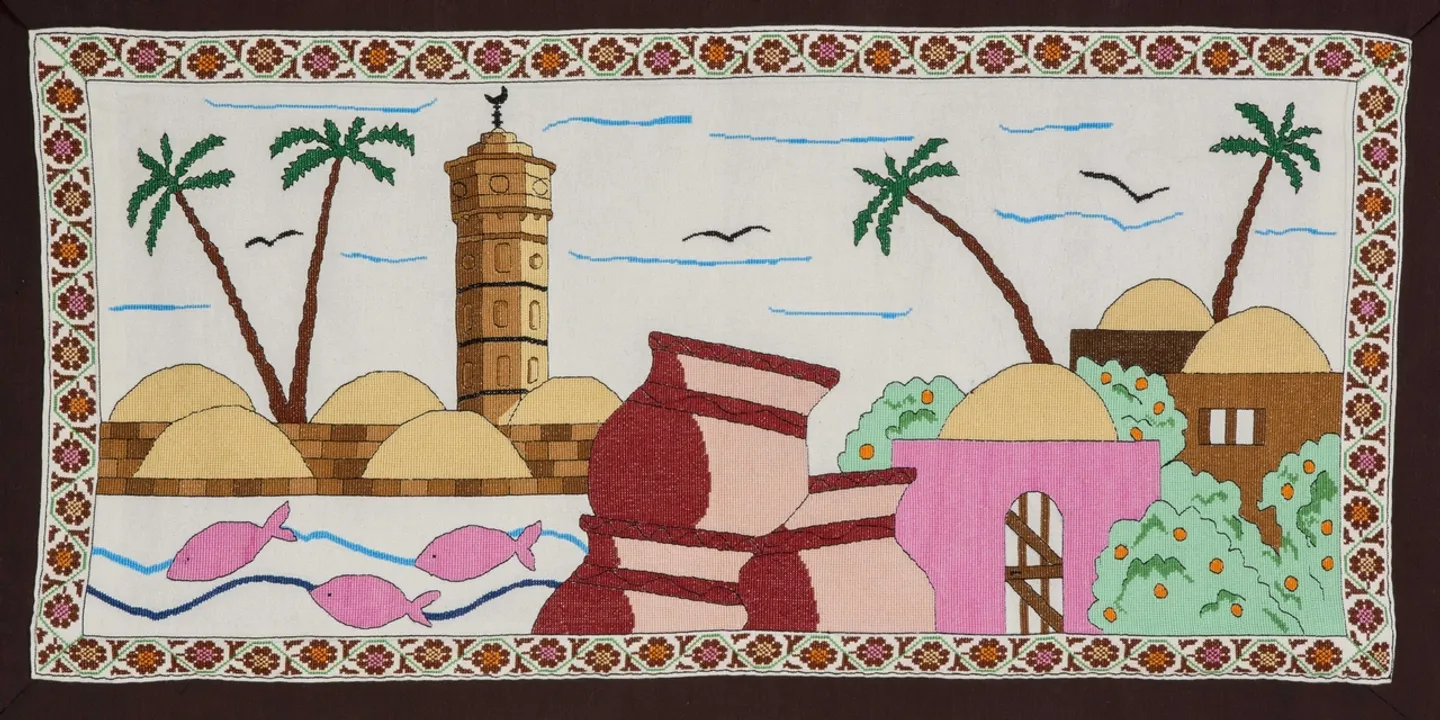
During the making of the earlier tapestry, Gaza’s embroiderers were a core stitching group and among the most active and skilled contributors. Their panels, often vibrant and intricate, carried the warmth of coastal life: fishing boats, palm trees, the domes of old mosques.
Perhaps the most painful irony of the Gaza Genocide Tapestry is that the women of Gaza have become largely the subject of this new chapter, but not the embroiderers of their stories.
As the siege tightened and bombardment began, communication, transport and materials all became virtually impossible to coordinate.
One older panel from Gaza depicting the Great Omari Mosque has already become legend within the project. It was completed in the midst of bombardment during the early months of the genocide by Mona Jouda, 31, a brilliant embroiderer in her own right.
Mona was displaced multiple times over the past two years, but miraculously, both Mona and the panel have survived.
The project’s organisers are now working to reconnect with the Gaza stitchers in the fragile lull of a ceasefire, not only because their skills are irreplaceable and their contributions vital, but also because the income from embroidery may be one of the few livelihoods left to them.
When finished, the Gaza Genocide Tapestry panels will join the larger Palestine History Tapestry collection at the Palestine Museum, which opened its first European branch in the Scottish capital Edinburgh earlier this year.
“The Gaza genocide is being stitched into eternity by Palestinian women in refugee camps,” Palestine Museum founder Faisal Saleh tells TRT World.
“This project comes at a critical moment…It's our mission to ensure the world confronts the reality it has allowed to unfold and to hold accountable those responsible.”
The Gaza Genocide Tapestry is not merely a ledger of destruction.
Each panel speaks of a moment when women chose creation over despair, that even in the shadow of annihilation, Palestinians are still telling their own story, not only using a camera or a pen, but also with the tools passed on amongst them over generations, a needle and thread.