 Hursit Dingil
Standing before the 80th United Nations General Assembly, President Erdogan did more than denounce Israel’s war in Gaza; he challenged the UN itself, accused the international order of complicity, and cast Türkiye as the conscience of a failing system.
His address went further than just condemning the genocide in Gaza; it was a bid to reframe Türkiye’s role as both a moral authority and a regional power at a moment of deep global fracture.
While Gaza dominated his remarks, Erdogan used the platform to situate the crisis within a larger strategic picture.
He invoked the UN Charter to highlight the organisation’s failure to uphold its founding mission of peace and security, thanked states that recognised Palestine, and urged others to follow suit. In doing so, he made clear that Türkiye’s advocacy for a two-state solution is not a passing position but a cornerstone of its foreign policy, a lever for challenging what Ankara sees as the UN’s abdication of responsibility.
Erdogan paused to express his sorrow at the absence of Palestinian Authority President Mahmoud Abbas, who was unable to attend the Assembly due to the United States' denial of his visa, and approximately 80 Palestinian officials.
His nod to Abbas was a small but telling gesture, underscoring Türkiye’s steady backing of a two-state solution and Ankara’s willingness to help create the conditions to achieve it both in rhetoric and in action.
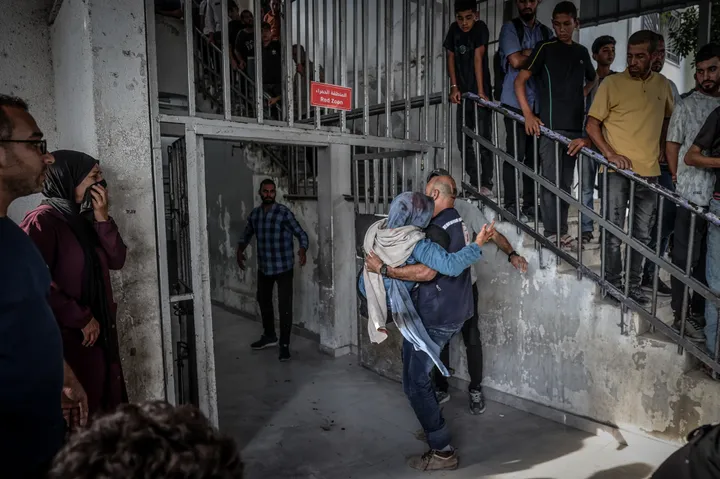
From there, Erdogan turned to Israel’s destructive actions, arguing that the assault is not only aimed at civilians but at the very fabric of Palestinian life: animals, farmland, ancient olive trees, and water supplies. By stressing these details, he sought to show the world that what is under attack is not just people, but an entire way of life.
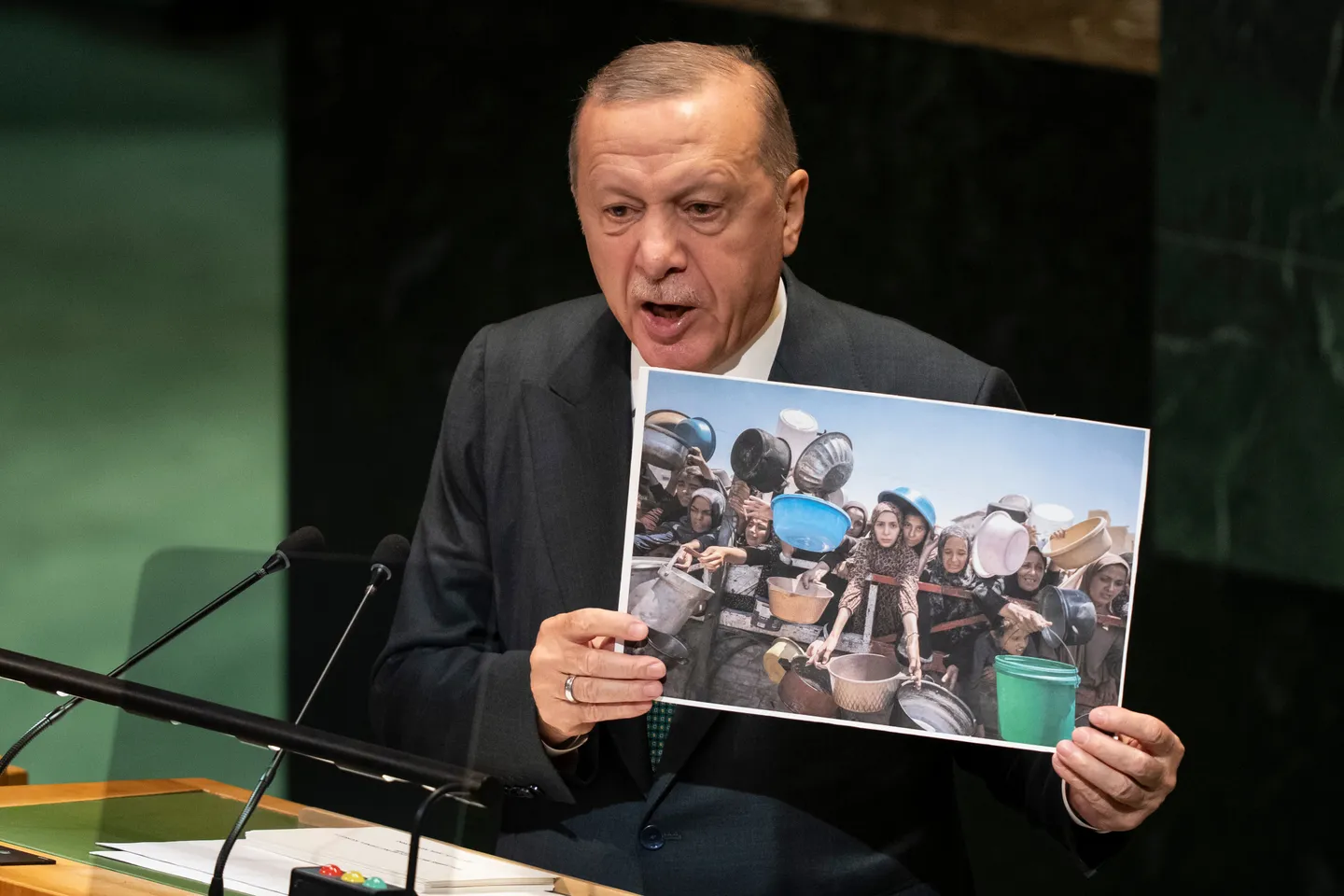
He also underscored the deepening nature of the genocide in Gaza, stating that the massacre and genocide continued even as the UN General Assembly convened. "For the past 23 months, a child has been killed every hour in Gaza," he declared, before showing delegates photographs of Palestinian children suffering from starvation.
These images drove home the reality of Israel's disregard for the most basic human and life-sustaining needs in its pursuit to prevent the two-state solution policy from being realised.
"There is no war in Gaza; one cannot talk about the presence of two sides. On one side, there is a regular army with the most modern weapons, and on the other, there are innocent civilians. This is not a fight against terror; it is a policy of displacement, exile, genocide, and mass killing, using the October 7th incident as a pretext," Erdogan told the international arena. His words are a direct challenge to Israel's efforts to cloak its aggressive occupation and annexation under the banner of security policies.
Pressing this point further, Türkiye’s president highlighted Israeli actions in the occupied West Bank, where Hamas is not in control, to expose Israel’s fabricated justification that its military actions are counterterrorism measures, a narrative that collapses under scrutiny.
Another notable point in President Erdogan's speech was his assertion that Israel's actions undermine the shared achievements of all humanity. “Those who remain silent are complicit in this atrocity," he warned.
The implication was clear: Gaza is not only about Palestinian survival but about the dignity of humanity itself, and the UN’s credibility hinges on whether it takes action.
The Turkish president stressed that this dignity can only be preserved through collective and deterrent measures to stop the ongoing genocide. He also strongly warned that Israel is a threat to regional peace, declaring that this "state of insanity" cannot be allowed to continue.
From Gaza to the region
Erdogan also widened the lens beyond Gaza, framing Israel's wars as part of a broader expansionist agenda. In fact, two years earlier, at the very same UN podium, Prime Minister Benjamin Netanyahu presented maps that depicted the occupied West Bank and Gaza as part of Israel, a visual that many saw at the time as advancing the idea of “Greater Israel.”
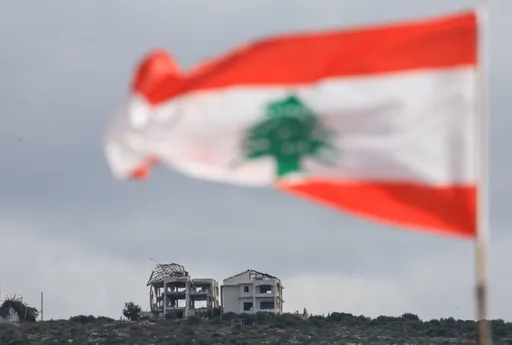
Now, Türkiye’s head of state listed Israel’s attacks against Syria, Lebanon, Yemen, Iran, and Qatar, warning that the destabilisation of Gaza is a harbinger for the region as a whole.
At the Palestine Conference held on the sidelines of the UN General Assembly, Erdogan sharpened the point further: "The Netanyahu government, which governs a people that was to be exterminated by the Holocaust, is perpetrating genocide against its neighbors of thousands of years, with whom they share the same land, water, air, and sea."
From these remarks came a deliberate historical framing: "We have also lived on this land for thousands of years. We share the same land, water, sea, and air together. But this sharing must be fair, equal, and just, not a one-sided maximalism."
By invoking "thousands of years," Erdogan was not only rejecting Netanyahu’s vision for a "Promised Land", a "Greater Israel", but warning that the massacre in Gaza could one day reach the borders of neighbouring countries.
Erdogan’s powerful UN address repositioned Türkiye as the defender of international justice, the protector of regional sovereignty, and the conscience of a UN system that has too often failed its own charter.
Whether one agrees with his framing or not, the speech signals Ankara’s intent to claim a central role in shaping both the moral and strategic narratives of the Middle East. For Erdogan, Gaza is the test case, but the stakes extend far beyond.