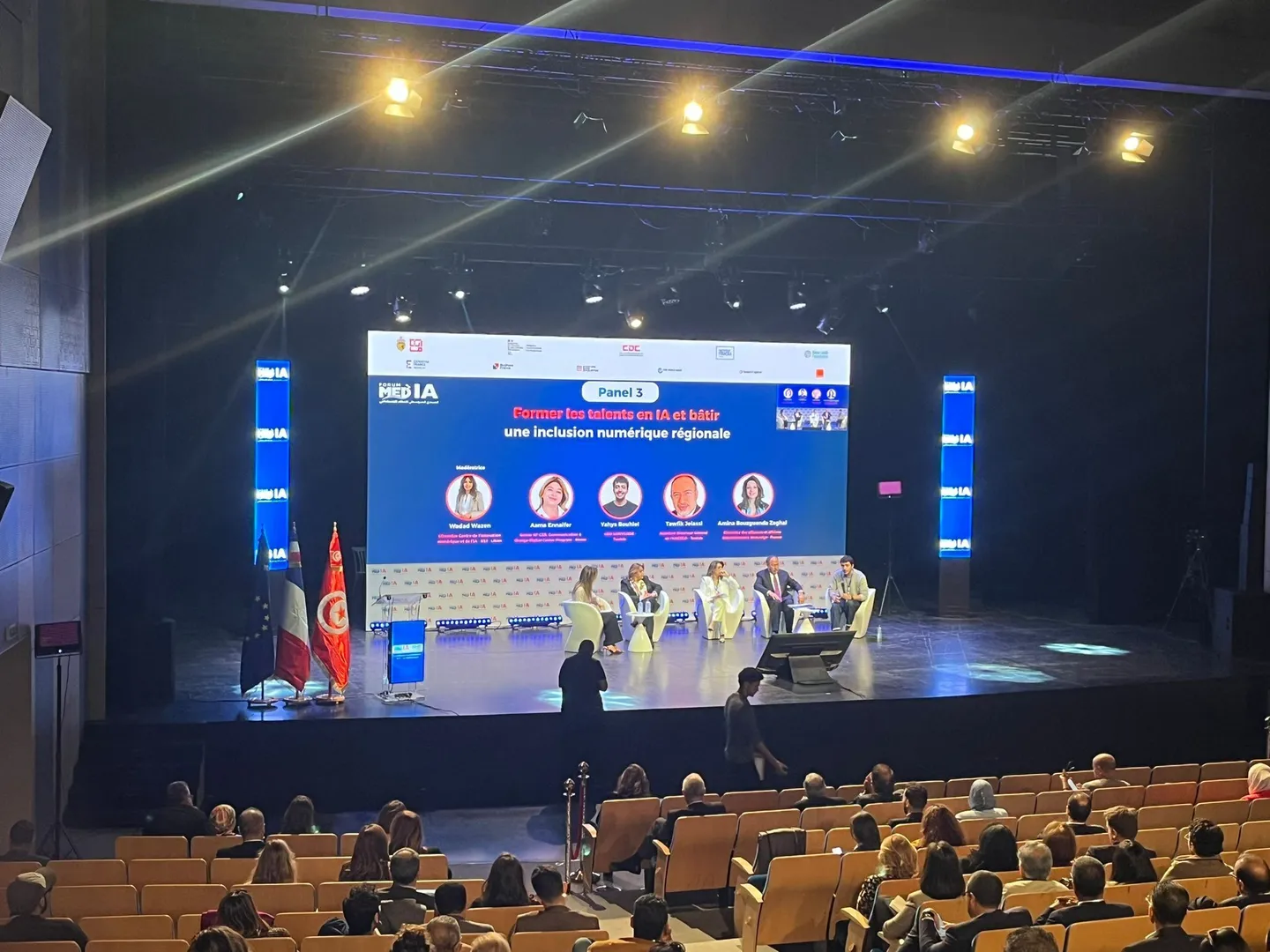
Hundreds of tech leaders, investors and government officials gathered in Tunis this week for the Forum Mediterranean AI (FMIA), aiming to chart an independent course in artificial intelligence that avoids reliance on products from Silicon Valley or Beijing.
Unlike many AI conferences focused on chatbots or social media, FMIA’s discussions centred on practical applications, including water management and crop forecasting, highlighting the region’s pressing challenges.
Currently, the generative AI market is dominated by American companies such as OpenAI, Google and Microsoft, whose cloud services offer efficiency but come with strategic dependencies. China, meanwhile, has extended its influence through the Digital Silk Road, with firms such as Huawei embedding Chinese infrastructure in 5G networks and fibre optic systems.
France is positioning itself as a potential bridge for Mediterranean nations. Nadia Hai, France’s Ambassador and Interministerial Delegate for the Mediterranean, highlighted the country’s AI infrastructure, which includes 81 laboratories—the most in Europe—as a possible partner for regional countries seeking alternatives to American or Chinese systems.
France advocates co-development with Mediterranean partners rather than treating them merely as consumers, aligning with projections that the global AI market could reach $740 billion by 2030 with annual growth of more than 36 percent.
Alongside the main conference, a hackathon is engaging early-stage teams to develop AI tools addressing local issues.
Expert coaches are guiding participants to transform ideas into prototypes, with the hope of securing local funding post-event.








The initiative also seeks to retain Tunisian AI talent domestically, rather than seeing them migrate to Europe. Infrastructure and energy remain critical concerns.
Local data centres are considered essential for safeguarding sensitive information, while powering AI’s energy-intensive operations poses a challenge in a region with limited electricity capacity. North Africa’s abundant solar potential offers a long-term solution, but converting it into reliable data centre power would require billions in investment.
Tunisia’s National AI Strategy for 2025–2030 aims to stimulate the sector through tax incentives, regulatory sandboxes and other measures under the Startup Act.
The strategy also includes creating guaranteed customers by digitising public services—such as health records, court systems and administrative functions—providing local AI firms with a stable market for their technologies.
The FMIA forum reflects a growing determination in the Mediterranean to develop an AI ecosystem that is sovereign, locally grounded, and globally competitive, rather than dependent on the technological dominance of distant powers.