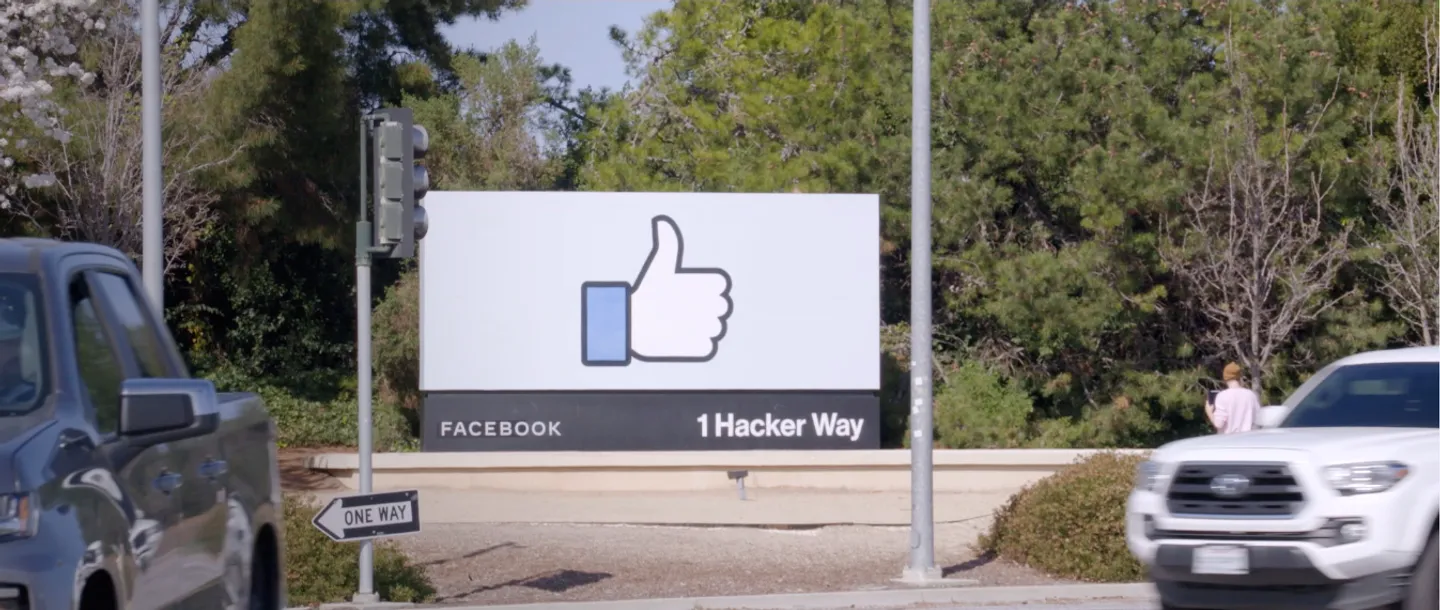
East Palo Alto is a small 2.7-square-mile enclave nestled in the heart of Silicon Valley and bordered by the wealthy cities of Palo Alto, Mountain View and Menlo Park. This little-known territory is home to a large concentration of ills and deviations from the economic and social model promoted by big tech companies – a model aimed at reshaping our societies and governing us all. A disenfranchised and extremely disadvantaged blue-collar town, a ghetto for ethnic minorities excluded from the miracle of the new economy, a city plagued by gentrification and subjected to the omnipotence of Amazon, Google, Facebook and more, East Palo Alto is, in a way, the unfortunate parent of digital’s wild growth. It’s the city that no one wants to see and, more importantly, they intend to get rid of. The last enclave for the tech giants to conquer.
Slowly but surely, private governance is taking precedence over public governance. At the city’s northern border, Facebook is on the verge of building a giant campus reserved for its 20,000 employees – a project that’s moving ahead despite residents and elected officials never having been consulted, and that will no doubt intensify the gentrification process already underway. Only recently, Mark Zuckerberg’s company pushed the cursor a bit farther by financing a new police station and paying the officers’ salaries despite the latter continuing to wear the city police logo. Its philanthropic activities, like those of other companies, should enhance its image and demonstrate its commitment to residents but, in fact, only serve to increase its influence over city management. The same is true of the Waterfront project, a vast initiative to rehabilitate the northeastern neighborhoods of East Palo Alto, steered by the Emerson Collective, an organization led by Steve Jobs’ widow, Laurene Powell Jobs. Accepting money from Big Tech and, in doing so, ratifying their governance model, or rejecting it all entirely, thus depriving themselves of precious resources in an underfunded city in the grips of poverty, is a tricky equation.
Many East Palo Alto residents have no intention of being sidelined and want to have their say in the matter. The words and methods differ, but all are a part of the city’s culture of resistance, inherited from past struggles – in particular, the civil rights movement. And all intend to fight tooth and nail for their right to go on living in their city, their dignity, and their culture. Welcome to another Silicon Valley, a glimpse of the world that awaits us, and an outpost of resistance to the tech giants.
STATEMENT OF INTENT
By Fabien Benoit | Director
My taxi pulls up in front of 2282 Euclid Avenue. The street is empty. Night is falling. The driver turns and shoots me a worried look. “You sure about the address?” “Yes, this is it.” “Well, be careful, and don’t go out alone at night. It’s dangerous around here!” A strange introduction considering I only landed in California a few hours ago and have just arrived in Silicon Valley, better known for its extraordinary wealth than its urban perils.
It’s a well-known fact that Silicon Valley, the cradle of the technological jewels of our time, is flush with money. Its GDP rivals those of many countries, starting with France. Created at Stanford in the heart of the valley, Google alone accounts for 750 billion dollars.
The Other Silicon Valley
However, arriving in East Palo Alto, a city whose name I hadn’t known until recently, one sees no trace of this prosperity. Only an overpass, straddling the highway, separates it from its luxurious neighbor, Palo Alto, and its villas with colonnades, smoothie bars, busy entrepreneurs, and legging-clad joggers. An overpass and a highway: the physical boundary separating the winners from the losers of the digital revolution.
You have to imagine the setting. Euclid Avenue is a small, empty street, its pavement cracked and riddled with potholes, lined with small, abandoned houses. Numerous “For Sale” signs hang on rusted fences. An old pick-up, its paint peeling, seems to have lost all hope of someday driving again. Many of the houses are shut, their windows boarded up. A faded, metal sign reads “Welcome to East Palo Alto”, although the atmosphere says exactly the opposite.
The Excess of Big Tech, In the Flesh
It’s November, 2018. I’ve spent over ten years working on the issues linked to the digitalization of the world. I’ve come to Silicon Valley to write a book on the societal model being touted by the region’s big tech firms, particularly the famous GAFAM (Google, Apple, Facebook, Amazon, and Microsoft) – companies that keep saying they “want to change the world” and “work to make it better.” The companies whose innovations are now turning every aspect of our lives upside down.
I’ll spend over a month in the region, in East Palo Alto as well as in Palo Alto, Mountain View, Menlo Park, San Jose, and Sunnyvale. I’ll push past the doors of big tech companies, immerse myself in the start-up culture, visit laboratories and research centers, and meet with the investors and major financiers of the digital economy. This work will result in the publication of The Valley, une histoire politique de la Silicon Valley [A Political History of Silicon Valley] by Les Arènes in May of 2019. In it, I explain how Silicon Valley has always been driven by a political vision and a social project, and how this vision – initially emancipatory, egalitarian, and libertarian – has gradually transformed into radical libertarianism and the delusion of omnipotence. It is an eminently unequal, anti-democratic model that is devastating for society as a whole. This reality, beyond words and concepts, can be very concretely grasped in East Palo.


A Counter-History of the Digital Revolution
East Palo Alto is, in its own right, a counter-history of Silicon Valley, its hidden side, the behind the scenes. In the 1960s, the city was chosen to host the Romic Environmental Technologies Corporation (1964-2007), a company responsible for storing and processing waste from large tech companies. The result: a part of its land is permanently polluted. Rather unflattering for an industry that readily prides itself on being clean and responsible. East Palo Alto also asserted itself early on as the valley’s blue-collar city, with its unskilled laborers working in food service, maintenance, construction, security, or public transport. Jobs essential to the region’s development, but undervalued, underpaid, and essentially entrusted to African-Americans and Latinos whereas executives are mostly white and Asian. “Racial segregation is the big taboo in the region,” says Tameeka Bennett, an East Palo Alto activist and community organizer.
Today, the city has also come to symbolize the uberization of the economy. People try to make a living by working multiple jobs for Uber, Lyft, TaskRabbit or Google Express Shopping. “Be independent, become your own boss,” preach the companies of what is referred to as the “gig economy.” Meanwhile, the bosses in question sleep in their cars without any social or employment security. In fact, in East Palo Alto, more than anywhere else, you can measure the abyssal gap between the promises of the digital economy and their reality.
Faced with unprecedented real estate pressure, the city as a whole is under the threat of gentrification. “Here, it’s gentrification on steroids,” says local pastor Paul Bains, who has stood witness to the terrible consequences of this phenomenon for years. Luxury residence projects abound. Private investors are converting a large number of homes into Airbnbs. Rents are skyrocketing. As is the homeless population. The town’s incumbent residents are gradually being chased out. Facebook boasts of helping to “build communities” – it was its slogan – but the region has actually been emptied of its communities, the ones that once made up its wealth and took part in its rise. Locals are being pushed farther out to be replaced by executives and engineers.
While travelling throughout the region, I was struck by the absence of social and cultural life. Only East Palo Alto seemed to distinguish itself, still bearing witness to a culture, and a soul. In spite of its destitution, you can still find life, and a beating heart. A social bond, a support system. It’s no doubt Silicon Valley’s last “real” town, in the city* sense. “The last town.” But it’s being severely attacked.
Because Facebook, Amazon, and others are doing everything they can to conquer this last enclave. They need room, and fast, to expand their empire and house their engineers. Often helpless against the fighting strength of these multinationals, City Hall can do little to slow down the movement given the meager means at its disposal, despite being one of the more progressive of the region. Public policy is less and less shaped by the city council and more at the discretion of boards and richly endowed private foundations that want to call the shots. The Chan Zuckerberg Initiative finances schools and associations, and unilaterally decides on their programs and missions. The private governance so desired by valley bosses is already a reality. Now, Facebook wants to build its own city, “Willow Village,” that some have nicknamed “Zucktown,” Mark Zuckerberg’s city. A colossal project on the edge of East Palo Alto, a city reserved for Facebook executives and run entirely by the company.
A City that Resists
But the history of East Palo Alto is much more than the bitter chronicle of a city doomed to disappear under the blows of the tech industry, its population run off, and its culture forgotten. Historically, “EPA” has put up a fight. In the 1950s, many African-Americans that moved here had to carve out a place for themselves after fleeing the racist South to reach the Golden State with its supposed tolerance and industrial jobs. Then, in the 60s and 70s, EPA became a stronghold of the civil rights movement when its residents, the victims of discrimination and redlining, created their own educational system – the Nairobi schools – and set out to take charge of their neighborhoods. In the 1980s, faced with the soil pollution caused by the Romic Environmental Technologies Corporation, resolute to deal with police violences and to get a grip on their destiny, they decided to establish a real municipality. And in the 90s, when the city was ravaged by the arrival of crack and the rise of gangs, it earned the unflattering title of “murder capital of the United States.” Once again, it was the residents that mobilized, went to talk to the dealers, kept watch over their street corners, and organized rehabilitation programs to prevent their community from descending into hell. Now, with a new threat looming, they’re back on the warpath to defend their right to live in their city. “They can’t just ship us off like some Amazon package,” I’m told during a protest in front of City Hall.
I ended up in East Palo Alto by accident, but it was this city that ultimately made the biggest impression on me. The violence of the injustices suffered by its residents. Their shameful living conditions in a region that is exceptionally rich. The denial of their right to work and the miserable jobs we deign to offer them. But most of all, their refusal of any degree of resignation and their capacity for self-organization in the face of all-powerful multinationals that defy democracy and the common good.
The battle being fought by the residents of East Palo Alto is ultimately ours. It’s a collective citizens’ awakening in the face of a social and economic model that wants to privatize, quantify, exploit, and monitor everything, and isn’t concerned with the humblest, and on a larger scale, all that is human. A model that establishes a world with two tracks that are deeply unequal, with the ultra-rich on one side and the ultra-poor on the other. Ultimately, East Palo Alto is no less than an allegory of the world that the so-called “digital revolution” has in store for us.
If the forces at work seem imbalanced, the resistance formed by the residents of East Palo Alto is nonetheless exemplary and it exposes the difficulties to deal with the power of “Big Tech.” None can doubt that the excessive power of “Big Tech” is a key political issue for the future of our societies. “The challenge of the century,” as it was characterized by the historian and sociologist Jacques Ellul, a great thinker of technology. In East Palo Alto, it appears in all its rawness.
Storyteller airs every Sunday at 1800 GMT.