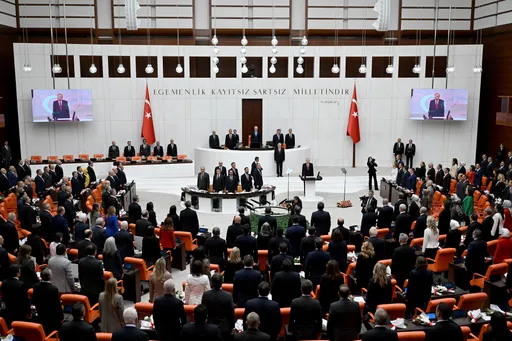
ISTANBUL — Of the more than 55 million voters expected to go to the polls on April 16 in Turkey, some 10.5 million live in Istanbul, the most populated city in the country. In many ways, Istanbul's diversity, history, modernity, politics and multicultural groups is a barometer for the rest of Turkey.
The upcoming referendum is a vote on a constitutional amendment package that if accepted, paves the way for a fully fledged presidential system, while abolishing the position of the prime minister. The proposed changes also include increasing the number of MPs from 550 to 600, and would lower the minimum age required to become an MP from 25 to 18.
We visited six districts across Istanbul: Bagcilar, Fatih, Taksim and Besiktas on the European side, and Uskudar and Kadikoy on the Asian side. We hit the streets and spoke to Istanbulites about their thoughts on the upcoming referendum, what they will vote and why.
Fazli Seker, grandfather
We met Fazli Seker in the working class, mainly conservative, suburb of Bagcilar, on the western side of Istanbul. He told us that, in his view, any campaigning would have little impact as both "yes" and "no" voters were so entrenched in their respective positions.
The country has been set back for a hundred years because of coalitions. First, [the presidential system] will save us from coalitions. Second, it will save us from the rule of others. We will be ruled by the nation, the nation will rule, it's as simple as that.
Munteha Celebi, 33, homemaker, dual German Turkish nationality
We spoke to Munteha Celebi in Istanbul's bustling Taksim Square, in the heart of the city. She lives in Cologne, Germany, and has one child. She will vote "no," and was concerned that the referendum would concentrate too much power in the hands of a single individual.
I find it ridiculous that one person would govern a huge country, to decide on behalf of tonnes of people.
Duygu, 22, Faruk, 22, Aylin, 24, university students, German Turks
Duygu, Faruk and Aylin are all German Turks who live in Stuttgart, Germany. They had already cast their votes — all in favour of the proposed changes — upon arrival to Istanbul.
You can see better from the outside how Turkey is developing. German media is showing Turkey in a bad light. We already voted "yes" at the airport [upon landing in Istanbul]. I hope the changes will be for the better and Turkey will get stronger. - Faruk
Ayse Demirel, 18, student
Ayse Demirel was strolling through the central neighbourhood of Besiktas, a secular stronghold on the European side of Istanbul. She says she will vote "no" because she is worried that Turkey was veering away from its secularist principles.
I think women should be free. I think they're trying to make us forget [Mustafa Kemal] Ataturk. That's why I will vote "no".
Ayhan Kilicarslan, 55, retired accountant
Ayhan Kilicarslan views the debate surrounding the referendum as a sort of "war of independence," arguing the "yes" vote is necessary to eliminate foreign influence on Turkish politics. He was visiting the neighbourhood of Fatih when we interviewed him, but is usually based in the northern Anatolian city of Corum, in the Black Sea region.
If the non-Muslims in Holland and Germany are saying "no", I need to vote "yes" as a Muslim, as a Turkish citizen. Since the Ottoman times, we've been living off [the riches of] this land, we've been standing guard over this land — so we need to say "yes".
Omer Goksu, 44, furniture maker

Omer Goksu is a supporter of the nationalist conservative MHP, who we met in the upper middle class, mainly conservative, neighbourhood of Uskudar, on the Asian side of the Bosphorus. Yet he is breaking ranks with the party, which is campaigning in support of the proposed changes, to vote "no" instead.
[The government is] bragging that they spent $25 billion [on Syrian refugees]. You think about it now, with $25 billion you could build 4000 hospitals, who knows how many kindergartens, schools, bridges, things that would be useful to people and you spend it on — well OK, let's spend it, let them [refugees] come, but you gotta look inside your borders first. First, you look after your own people, then you help those coming from outside. If I'm going hungry here, it doesn't make sense to feed someone there… You wonder what will happen after the transition, you wonder what it will bring you. You look at the country, and the country is in chaos. Refugees, refugees, refugees. But we the people are given nothing.
Seyda, 18, student
Seyda, an 18-year-old student, believes the proposed changes are in the country's best interests. When we interviewed her in the conservative neighbourhood of Fatih, she explained that she finds arguments from the "no" campaign to be unconvincing.
I will vote "yes" because… it will address the issues of the inefficiency of the bureaucracy, the lack of communication between various institutions and abuse of the system. Contrary to what the "no" side says, I think these changes will make Turkey more democratic.
Murat Han, 25, public relations
Murat Han lives in Moda, a liberal neighbourhood on the Asian side of the city, where the "no" campaign has been very active. As a young man, he says the results of the referendum is going to have a very real impact on the rest of his life.
I don't really think that [the election process] — voting and being elected — works very well in Turkey; that this right is fully given to us. That's why, no matter whether the changes go through or not, things will continue on the same path they are already on… I will vote no. I don't want one person having [all the power] and so little respect for our human rights.
Aynur Seyhan, 38, homemaker
Aynur Seyhan is a homemaker, who is involved in the local branch of the AK Party in Gunesli, the western suburb where she lives. She predicts that the "yes" vote would win with an overwhelming majority.
I would say yes with my eyes closed, without having to read any of the proposed changes, because I trust my leader. We've never regretted saying yes to him, to voting for him. I don't think we will in the future either. He's no longer just the leader of Turkey but a world leader.
Fazilet Polat, 21, university student
Fazilet Polat is an arts student at a conservatory in Istanbul who we spoke with in Kadikoy. She is firmly in the "no" camp.
In a world where arts are being trampled underfoot, and the government is becoming a dictatorial regime, I'm worried I won't be able to find employment… The fact that all the powers will be consolidated in the president, for him to have the power to dissolve the parliament and to assign jobs to whomever he pleases and to act as he likes is enough [cause to worry] among all the proposed changes.
Duygu Kocak, Busra Erdogan, Ozden Durak, all 22, students
We met Duygu Kocak, Busra Erdogan and Ozden Durak in Taksim Square who live on the outskirts of the city. They are following the debate in the lead-up to the referendum closely, but prefer to keep their opinions to themselves.
May it work out the best for all of us! What can I say? - Duygu Kocak