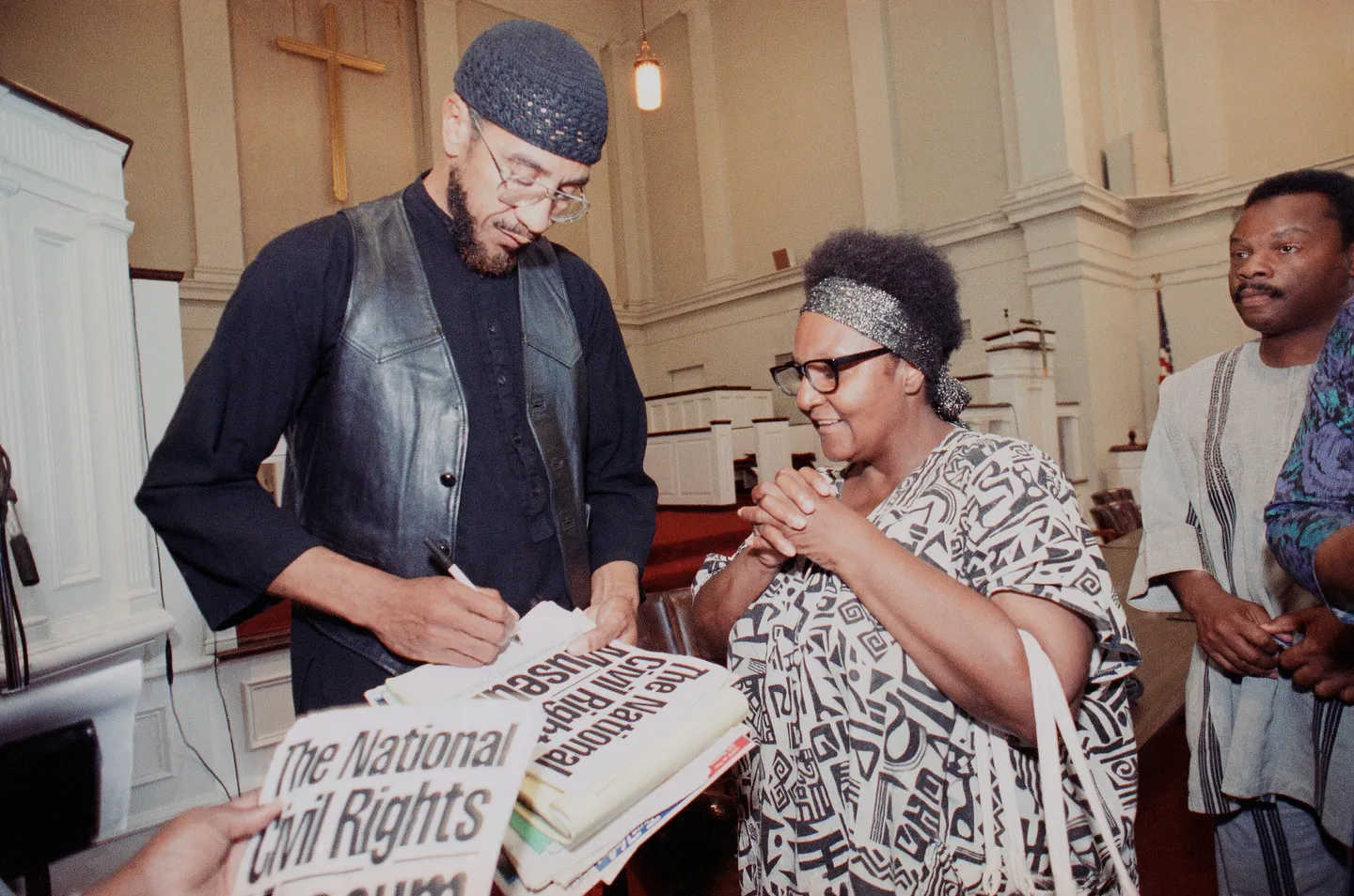
Jamil Abdullah al-Amin, known to history as H. Rap Brown, a prominent Black Power movement activist, passed away at a federal North Carolina prisoner hospital last week at age 82, according to his family.
Brown, a fierce advocate of Black rights throughout the 1960s and 1970s, had been imprisoned several times. During his detention in the mid-1970s, he converted to Islam and changed his name to Jamil Abdullah al-Amin.
After his release from prison in 1976, al-Amin became an imam, a Muslim preacher, serving different black-majority Islamic communities from the National Ummah to the Dar ul-Islam Movement.
In 2002, al-Amin was imprisoned again after a contentious two-year trial, which sentenced him to life imprisonment on the alleged grounds that he was responsible for killing a deputy sheriff and injuring another, both of whom were also African-American, in an armed confrontation in Georgia’s Fulton County.
While al-Amin and his defence team denied the accusations, Otis Jackson, a federal inmate, claimed responsibility for the Fulton County shootings, the court ruled against him, sentencing him to life imprisonment.
Since 2014, al-Amin had undergone cancer treatment and died at the Butner prison hospital on Sunday, his wife Karima al-Amin said.
Fight for civil rights
Born in Baton Rouge, Louisiana, a deep southern state, Brown joined the Black movement in the early 1960s as a young student, becoming part of the Student Nonviolent Coordinating Committee (SNCC), a leading student organisation committed to the civil rights movement during the peak of racial upheaval in the late 1960s and early 1970s.
In 1967, Brown was elected chairman of the SNCC, a crucial role for Black political activism, and the American press “projected” him as a "Black Power leader," in his own words, in Die Nigger Die!, one of his books.
The Black Power movement emerged in the 1960s, advocating a more assertive stance against white supremacy and racist policies in American politics and society. Brown and other Black Power leaders have been heavily influenced by Malcolm X, a renowned Muslim African-American political activist who criticised Martin Luther King Jr’s nonviolent protest plans.
Malcolm X’s assassination in 1965, along with other anti-Black violence across the white-majority US, coupled with ongoing segregated policies, sparked the emergence of the Black Power movement, according to analysts.
They also point to the Black Panther Party's foundation in 1966 as a key factor in the movement’s rise.
In 1968, Brown was not only the chair of the SNCC but also the Black Panther Party's justice minister. But according to his own testimony, he was not impressed by being one of the national leaders of the Black Power movement.
“I knew that it didn't matter what position a dude had, it didn't mean he was a leader, even if he had the title of Chairman or President. The leader might be a dude in the organization who ain't got no title, no office. When I was head of SNCC, that's all I was. I was not a leader of Black people,” he wrote in his book.
Brown also knew that he was “in for trouble” as he toured the US to promote equality and Black rights, warning of violent resistance if necessary against White supremacy, which he described as the Fourth Reich, a clear reference to Hitler’s description of Nazi Germany as the Third Reich.








“Black folks built America, and if America don't come around, we're going to burn America down," he famously said, during a Cambridge, Maryland protest in 1967.
After the speech, there were several violent incidents, which also wounded Brown, as US authorities charged him with several different accusations, from inciting a riot to gun violations.
A secret 1967 FBI memo listed him among Black individuals who should be "neutralised", marking him as a target of the agency's COINTELPRO programme, which sought to disrupt and discredit civil rights leaders through various political and violent methods.
“If you're serious you don't worry about things like that. You do your job and you're either carried off the battlefield or you walk off victorious,” he reflected on his troubles in Die Nigger Die!
Converting to Islam
In 1971, he was arrested following a robbery and a shootout with police officers in New York City. After this incident, Brown served a five-year sentence in a prison in Western New York.
His imprisonment fundamentally changed his life as he decided to become a Muslim in prison. After his release, he moved to Atlanta and opened a grocery store, becoming an imam, a Muslim community leader.
Since then, Imam Jamil Abdullah al-Amin has preached against drugs and gambling, discovering a healing power in Islam, which also transformed his views on politics, racism, and other issues.
“Allah has allowed me to understand that it is not race or color that is the issue. The only important thing is the word of Allah," he wrote in Revolution by the Book, his second book.
“Allah says He does not change the condition of people until they change that which is in themselves. That is what Islam does, and it points out right from wrong,” he added, referring to a famous Quranic verse.
Following the controversial Fulton County shootings trial from 2000 to 2002, Imam Jamil spent the rest of his life in prison, outraging many political activists like Arun Kundrani, who wrote Rise in Fire: H. Rap Brown, Jamil Al-Amin, and the Long Revolution, a book scheduled for publication next year.
During his interviews with Imam Jamil, Kundrani observed various instances of inhumane treatment against him.
“He’d spent five or so of those years in the ADX Florence supermax prison in Colorado, where he was buried underground in a cramped cell with the most minimal human contact, in a situation where many people develop permanent mental health issues,” Kundrani said during a February interview.
“It’s considered psychological torture. So I was wondering how he would be, psychologically. But he was 100 percent as sharp as he would have come across in the videos of him as a young man.”